

▶ Table of Contents
Introduction
Travel agencies often assume that translating English keywords into other languages is enough to attract international travelers. In reality, literal translation rarely captures local search behavior, cultural nuances, or regional trends. A phrase that ranks well in English may be completely irrelevant or even confusing to travelers searching in German, Japanese, or French.
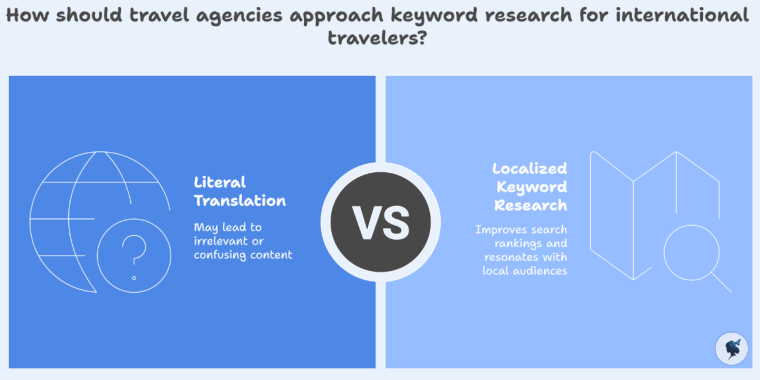
Localized keyword research allows travel agencies to create content that resonates with each audience, improves organic search rankings, and drives more bookings. This approach goes beyond translation, factoring in cultural context, search intent, and local preferences.
Wander Women Hot Tip: Start by auditing your current multilingual content. Identify which pages are underperforming in local markets and prioritize them for localized keyword research.
Why Direct Translation Doesn’t Work
Directly translating English keywords can lead to several issues:

- Linguistic differences: Local languages often have multiple ways to express the same concept. For example, “summer holidays” can be searched as Sommerurlaub in Germany, vacances d’été in France, and 夏の休暇 in Japan, each with different search volumes.
- Search engine variations: Google dominates many markets, but in China, Baidu is the primary engine; in Russia, Yandex is dominant. Each has unique ranking factors and query patterns.
- Cultural context: Seasonal trends, local holidays, and travel behaviors influence search patterns. “Beach holidays” in Spain may be popular in summer, but in Germany, searches for “wellness retreats in the Alps” spike in winter.
Wander Women Hot Tip: Never rely on automated translation tools for keyword research. Instead, focus on how locals actually search for your destinations in their native language.
Understanding Local Search Intent and Cultural Nuances
To create effective localized content, you must understand how local travelers think and search:

- Intent Types:
- Informational: “Best things to do in Paris”
- Transactional: “Book a guided tour in Rome”
- Navigational: “Visit Eiffel Tower tickets”
- More about search intent here.
- Cultural considerations:
- Holiday patterns and school breaks influence travel searches.
- Popular local attractions may differ from global trends.
- Search phrasing varies by region (formal vs. colloquial terms).
- Persona-driven research:
- Create travel personas for each target market (e.g., Japanese solo travelers, French family tourists).
- Map content around personas’ preferences, pain points, and intent.
Wander Women Hot Tip: Build detailed regional personas to guide both keyword selection and content structure. These personas help ensure your content aligns with local search behavior.
Tools and Methods for Localized Keyword Research
Keyword Tools for International Markets

- Google Keyword Planner: Target specific countries and languages.
- Semrush / Ahrefs: Explore regional search volume, competition, and trends.
- Ubersuggest & AnswerThePublic: Identify question-based and long-tail queries.
- Trends Tools: Google Trends, Baidu Index, Yandex Wordstat for local search patterns.
Effective Methods
- Competitor Analysis: Review local agencies’ websites for keyword insights. More about competitor keyword analysis here.
- Search Engine Observation: Analyze local SERPs for phrasing, featured snippets, and related searches.
- Social Listening: Monitor travel forums, Instagram hashtags, and local blogs to identify trending keywords.
- Long-tail Keyword Focus: Target specific, market-relevant queries to capture high-intent traffic. Read our post: Mastering Long-Tail Keyword Identification.
Wander Women Hot Tip: Use multiple tools and cross-check results. A high-ranking English keyword may have little relevance in another language or region.
Integrating Keywords into a Multilingual SEO Strategy
Once you have localized keywords, integrate them effectively:

- Hreflang Implementation: Signal to search engines which language and country each page targets.
- URL Structure:
- English:
/en/destinations/rome/ - German:
/de/reiseziel/rom/ - French:
/fr/destination/rome/
- English:
- Meta Tags & Headings: Include localized keywords in page titles, headings, and meta descriptions. More about meta optimization here.
- Internal Linking: Connect regional pages to related content within the same market. You might like our post: How to Increase Organic Traffic with Internal Linking.
Wander Women Hot Tip: Focus on high-value destinations for each market. Avoid duplicating content across regions; tailor the content to the local search intent and cultural context.
Case Studies
Example 1 – Boutique Travel Agency
- Targeted European travelers for Austria.
- Results included a 38% boost in German organic traffic, a 44% uplift from the UK, and a 60% increase in mobile conversion rates among French users.
Example 2 – Global Hotel Booking Platform
- Optimized for region-specific keywords and travel terms to increase bookings from Asian markets.
- Organic visibility rose 50% across target markets, bookings from Japan and South Korea jumped 75% year over year, mobile app downloads increased 60%, and average session duration grew by 25%.
Wander Women Hot Tip: Document which localized terms perform best per market and use them to inform future content planning.
Actionable Tips for Travel Agencies

- Avoid literal translation; research how locals search for your destinations.
- Build regional personas to guide keyword selection and content creation.
- Update keywords regularly based on seasonal trends, cultural events, and analytics insights.
- Use structured data (schema) to support multilingual content and rich results.
- Leverage social media trends and user-generated content to refine keywords and ideas.
Wander Women Hot Tip: Treat each market as its own ecosystem. Test, iterate, and refine keyword strategies continuously to maintain relevance and search performance.
Conclusion
Localizing keyword research is critical for international travel SEO success. Moving beyond direct translation allows travel agencies to:
- Capture authentic search behavior in each market.
- Create content that resonates with local travelers.
- Improve rankings, engagement, and conversions for multilingual audiences.
Wander Women Hot Tip: Consider every market as a living system. Regularly monitor trends, analyze performance, and adjust strategies to ensure your destination content ranks and converts year after year.
Need help with localized keyword strategy? Contact us today!
Discover more from Wander Women Strategies
Subscribe to get the latest posts sent to your email.
