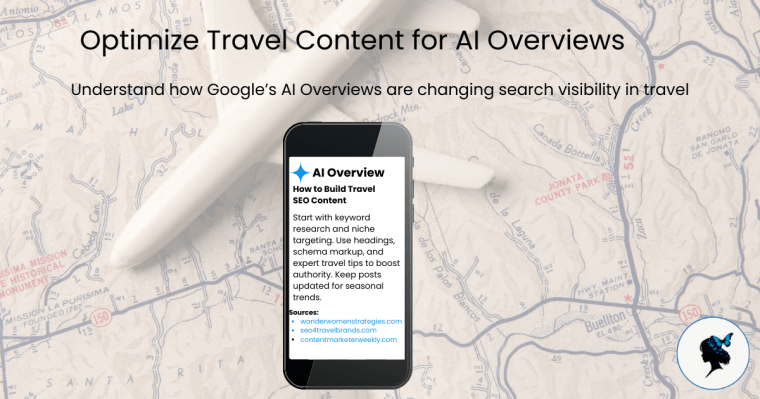
Google’s AI Overviews are short, AI-generated summaries that appear at the top of search results, giving users quick answers without clicking through to websites. While this makes finding information faster, it can also lower click-through rates (CTR) for travel sites by around 34.5% on informational queries, and these overviews now show up on roughly 42.5% of searches.
For travel companies, this means less free traffic from Google when people research destinations or itineraries. To stay visible, travel brands need to structure content so AI can easily pull summaries, boost their trust signals, and explore other channels like video or paid ads.
What Are AI Overviews?
AI Overviews (formerly part of Google’s Search Generative Experience) are brief, 2–5 sentence summaries that appear in a card at the top of the search page. They pull key points from several web pages and cite those sources directly beneath the summary. Sometimes they include images or lists to make the answer clearer, especially for recipe or itinerary-style queries.
How AI Overviews Work
Content Aggregation The AI reads multiple top-ranking pages and picks out the main facts.
Summary Generation It writes a short paragraph that answers the user’s question.
Source Citations It links to the web pages it used, giving users a path to learn more.
Interactive Features Users can simplify or expand the summary, and even send it to Google Docs or Gmail.
Organic CTR Drops: When an AI Overview appears, CTR to the first organic result can fall by about 34.5%.
Non-Branded Queries Hit Hardest: Informational searches like “best beach in Bali” see CTR declines near 20% on average.
Paid Ads Also Affected: Paid search ads can lose about 12 percentage points in CTR whenever an AI Overview shows up.
Reduced Visibility for Travel Research
Travelers often start with “where to go” or “what to see” queries. Since AI Overviews answer these questions directly, fewer people scroll down to organic listings. Major travel brands like Kayak and TripAdvisor are already adjusting their strategies to feed content directly into AI systems, hoping to stay in the AI-sourced summaries.
Authority and Trust Signals Matter More
Google leans on E-E-A-T (Experience, Expertise, Authoritativeness, Trustworthiness). Sites that clearly show author credentials, publish fresh reviews, and use structured data are more likely to be cited in AI Overviews.
Tips for Travel Companies
Add Clear “Quick Facts” Sections Place a bullet-point list or short paragraph at the top of your page that directly answers common travel questions.
Use FAQ Schema Mark up FAQs with structured data so Google’s AI can easily find and use your answers.
Highlight Experts Show author bios with real credentials and local expertise.
Keep Content Fresh Update guides and itineraries seasonally and date-stamp them clearly.
Diversify Channels
YouTube & Video: Video content can be featured in AI Overviews and on Google’s video carousel.
Non-Google AIs: Publish content optimized for ChatGPT or Perplexity to capture referral traffic.
Consider Paid Placements Explore Google Ads extensions that appear alongside AI Overviews to maintain visibility.
Conclusion
AI Overviews are changing how people search and how clicks are distributed. Travel companies must adapt by making their content AI-friendly, boosting trust signals, and branching out into video and paid channels.
If you’re in the travel business and need help staying visible in this AI-driven world, contact Wander Women Strategies. We specialize in SEO, content strategy, and social media for travel brands, and we’re here to help you thrive when Google’s AI takes the lead.
In the highly competitive world of travel, every company, whether it’s a boutique hotel, a travel agency, or a tour operator, is vying for the attention of travelers. With so many options available online, staying ahead of the competition is crucial to your success. One of the most effective ways to achieve this is through competitor identification.
Knowing who your competitors are, understanding their strengths and weaknesses, and strategically positioning yourself against them can give your travel business a competitive edge.
1. What is Competitor Identification?
Competitor identification is the process of determining which companies within your industry are competing for the same customers, traffic, and market share. For travel businesses, this goes beyond just identifying who is in your direct geographic location. It includes those who are targeting similar audiences, offering related services, and positioning themselves in ways that may influence your potential customers.
Competitor identification isn’t just about finding who is already established. It also involves recognizing emerging players, understanding the market shifts, and identifying trends that might disrupt your business.
Types of Competitors for Travel Companies
Travel companies face several types of competitors in the digital space:
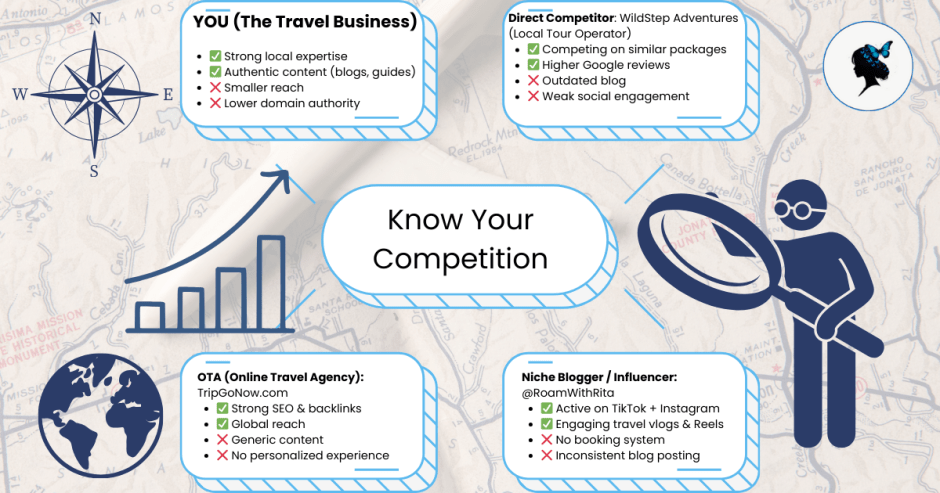
Direct Competitors: These are businesses offering the same or similar services as you. For example, a luxury tour operator in Paris would be competing directly with other luxury tour operators in the same location.
Indirect Competitors: These companies provide alternative solutions that satisfy the same customer need. For instance, a local restaurant in Paris may not be offering tours, but it may compete with your tour company for customer attention in a broader travel context.
Emerging Competitors: New businesses or startups that are entering the travel industry. These may not be major players yet, but identifying them early can provide you with a significant advantage.
Competitor identification allows you to understand who you’re competing with, their positioning in the market, and the strategies they are using to attract your target audience.
2. How to Identify Competitors in the Travel Industry?
Identifying your competitors may seem straightforward, but a strategic approach can help you dive deeper and gather meaningful insights to gain a competitive advantage. Here’s how you can identify your competitors:
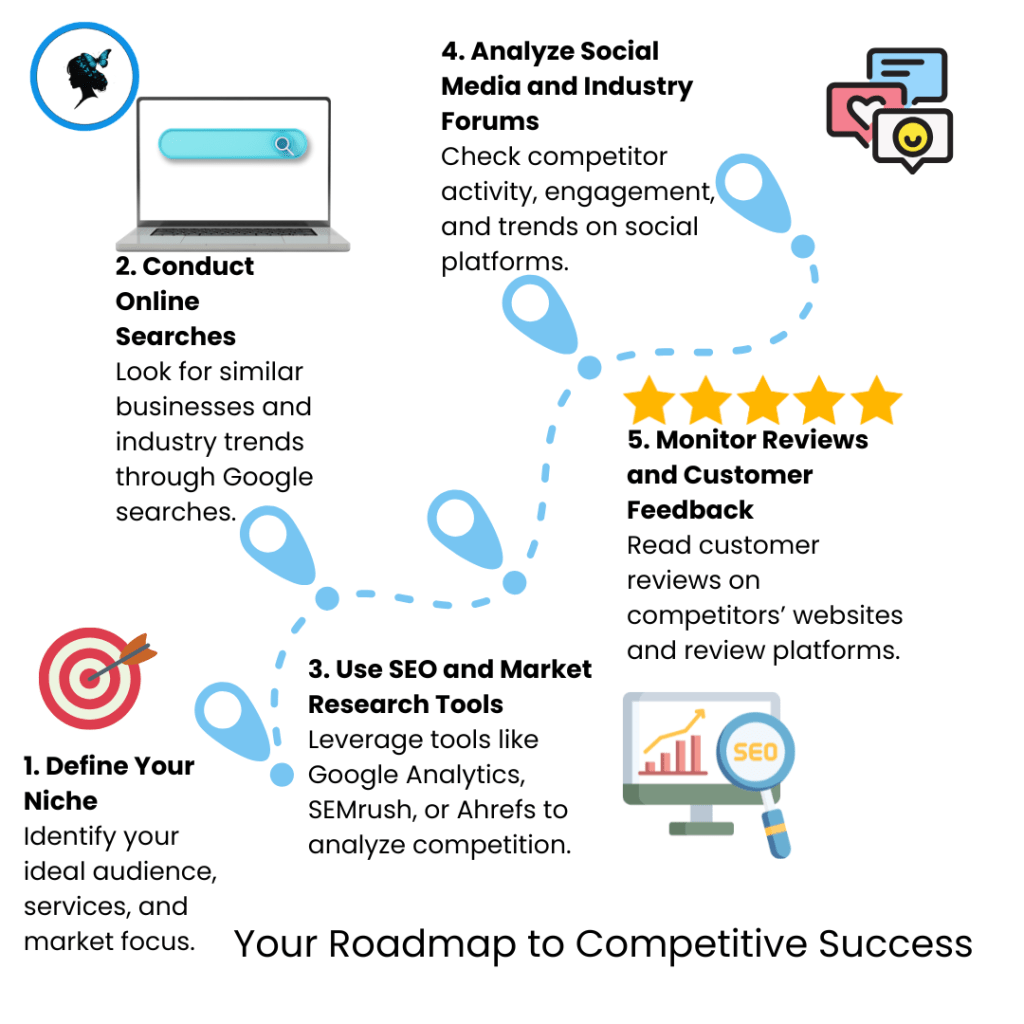
Step 1: Define Your Niche
Before you start identifying competitors, it’s crucial to understand your specific market niche. In the travel industry, there are many different segments, such as:
Luxury travel
Adventure tourism
Cultural or historical tours
Family-friendly vacations
Eco-tourism
Defining your niche allows you to refine your search for competitors who are directly targeting the same audience. A family-owned bed and breakfast in the mountains might be competing with other bed and breakfasts in the area, while a high-end travel agency focused on bespoke itineraries may find competitors among luxury travel providers.
Step 2: Conduct Online Searches
Use search engines to conduct queries around keywords that are relevant to your business. For example, if you specialize in tours in Paris, search for terms like “private tours in Paris,” “best Paris tour operators,” or “Paris sightseeing tours.” Check out the first page of the search results to identify companies that appear repeatedly.
Step 3: Use SEO and Market Research Tools
In the travel industry, many SEO and market research tools can help you dig deeper into competitor analysis. Tools like Semrush, Ahrefs, and Moz allow you to:
Identify competing websites: Search for keywords related to your services and see who is ranking for those terms.
Analyze keyword gaps: Find out which keywords your competitors are ranking for that you are not.
Evaluate backlinks: Discover where your competitors are getting their backlinks from, and use this information to improve your own link-building efforts.
Additionally, Google Trends and Google Alerts can be valuable in tracking shifts in search volume for key travel-related terms and identifying emerging competitors.
Step 4: Analyze Social Media and Industry Forums
Social media platforms, especially Instagram, Facebook, Twitter, and LinkedIn, can provide valuable insights into your competitors’ activities. Pay attention to the type of content they’re posting, the hashtags they’re using, their engagement rates, and how they’re positioning their brand in front of potential travelers.
Industry forums and online communities like TripAdvisor, Yelp, and even Reddit can provide insights into who your customers are talking about and which travel brands they trust.
Customer feedback on review sites, social media, and travel blogs is a goldmine for competitor insights. See what customers are saying about your competitors and identify areas where they are excelling and areas where they are falling short. This will help you find gaps in the market and areas where you can differentiate your services.
3. Why is Competitor Identification Important for Travel Companies?
Understanding who your competitors are and what they are doing well—or poorly—can be the difference between success and failure.
Here’s why competitor identification is so crucial for travel companies:
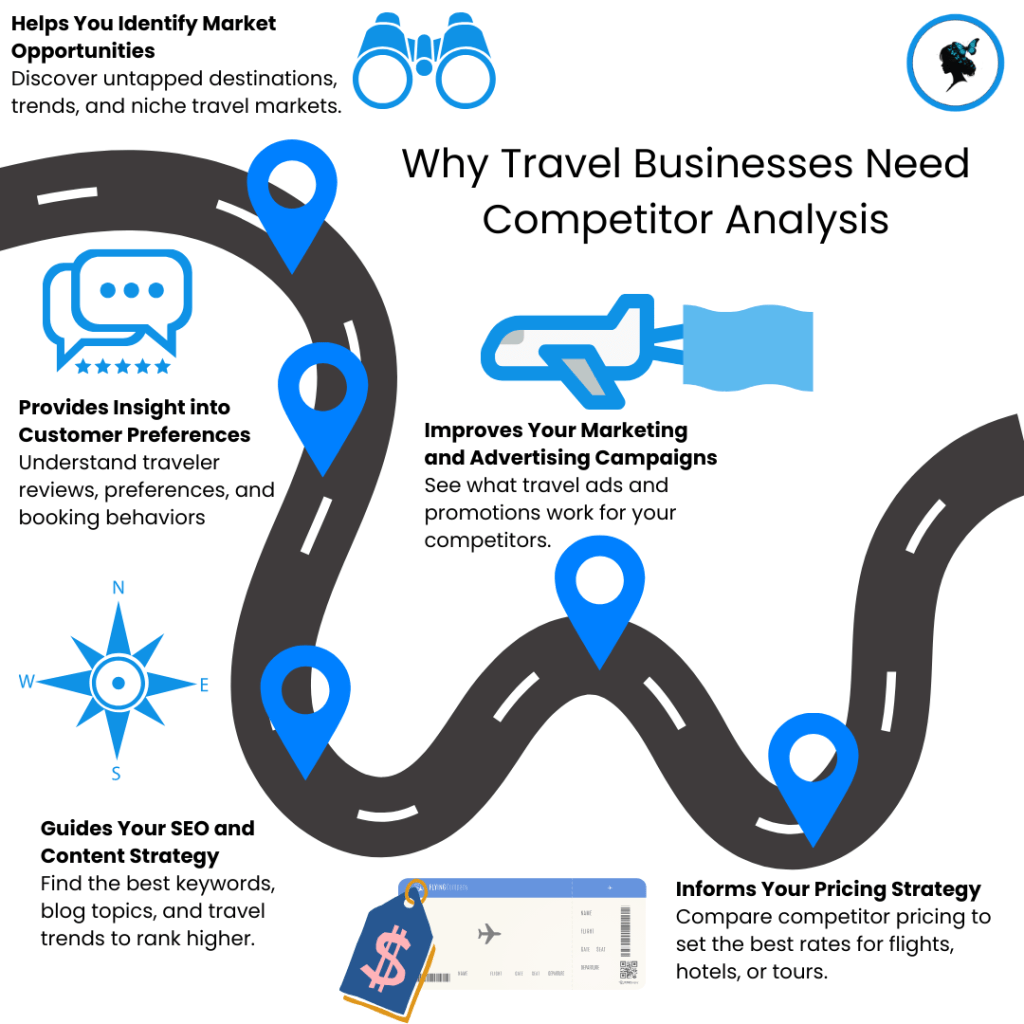
1. Helps You Identify Market Opportunities
By identifying your competitors’ weaknesses, you can spot opportunities in the market that they might be overlooking. Perhaps they’re not offering the level of customer service you believe travelers expect, or maybe they’re not capitalizing on the growing trend of eco-tourism. By filling these gaps, you can carve out a niche that attracts travelers seeking better alternatives.
2. Guides Your SEO and Content Strategy
Competitor analysis is a key part of your SEO and content strategy. Understanding the keywords your competitors are ranking for, the types of content they are producing, and the platforms they are active on allows you to build a more effective SEO plan. For example, if a competitor’s blog is gaining traction with content about “hidden gems in Bali,” you may want to create content targeting other similar off-the-beaten-path destinations.
Competitor research allows you to better understand your customers’ preferences by evaluating what competitors are doing to attract them. If you notice that a competitor is receiving a lot of positive feedback for a specific tour package, you can leverage that insight to create similar offerings that cater to your target audience.
4. Improves Your Marketing and Advertising Campaigns
Tracking your competitors’ marketing strategies—such as paid ads, promotions, and social media campaigns—gives you insight into what’s working in the travel industry. You can adapt or refine your own campaigns based on what you learn. This will save you time and resources, helping you implement strategies that are more likely to succeed.
5. Informs Your Pricing Strategy
By analyzing your competitors’ pricing models, you can ensure your offerings are competitive. If competitors are underpricing or overpricing their services, you can adjust your pricing strategy accordingly. A well-informed pricing structure can give you an edge in attracting more customers without sacrificing profitability.
Ready to Outsmart Your Competitors?
Don’t wait for your competitors to outpace you. Contact us today to learn more about how we can help you stay ahead of the competition and position yourself for success in the travel industry.
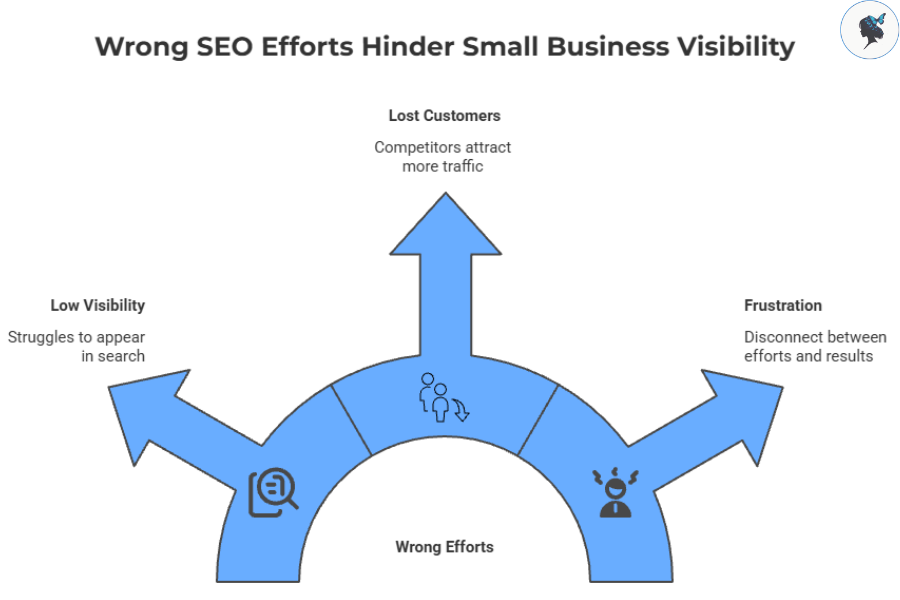
Small businesses rarely fail at SEO because they do nothing. More often, they fail because they spend time on the wrong things.
A business owner updates blog posts, posts regularly on social media, tweaks keywords, maybe even pays for an SEO plugin—and still struggles to appear in search results. Meanwhile, competitors with simpler websites somehow attract more traffic and more customers.
That disconnect has become even more frustrating in 2026.
Wrong SEO efforts hinder small business visibility
Search engines no longer reward websites simply for inserting keywords into pages. They increasingly prioritize useful content, trustworthy information, fast user experiences, and businesses that genuinely answer customer questions well. AI-generated search summaries are also changing how people discover companies online, making visibility more competitive than ever.
The good news is that most SEO problems small businesses face are fixable.
You do not need a massive budget or a full-time marketing team to improve your visibility. You need clarity, consistency, and a better understanding of how customers actually search online.
Here are the most common SEO mistakes small businesses make today—and practical ways to fix them.
Trying to Rank for Everything
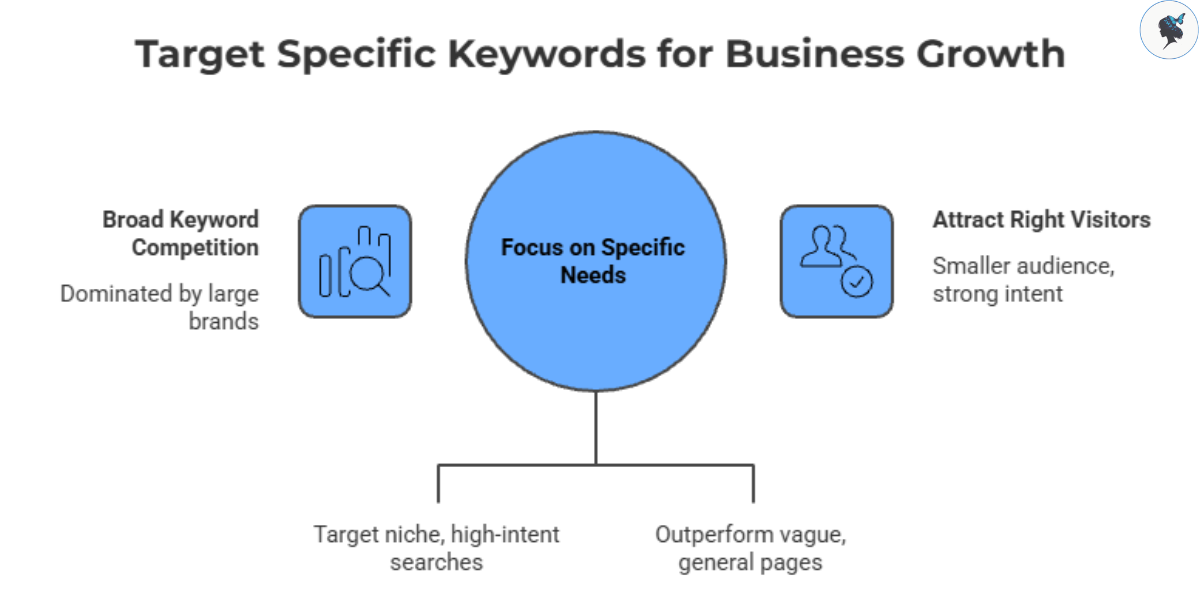
One of the biggest mistakes small businesses make is attempting to compete for broad, highly competitive search terms.
A local accounting firm wants to rank for “finance.” A bakery wants to rank for “desserts.” A fitness coach targets “workout plans.”
These terms are too broad and often dominated by large brands with huge marketing budgets. More importantly, broad searches usually attract people who are browsing, not buying.
Search engines increasingly prioritize intent and topical relevance over sheer keyword volume. Focused, useful content consistently outperforms vague, general pages.
Target specific keywords for business growth
How to fix it
Instead of targeting broad terms, focus on highly specific customer needs.
For example:
“custom vegan birthday cakes”
“bookkeeping for freelance designers”
“strength training for beginners over 40”
Specific searches may attract fewer visitors, but they often attract the right visitors.
A smaller audience with strong intent is usually more valuable than large amounts of unfocused traffic.
Some small business websites still sound like they were written for search engines instead of actual people. You see pages repeating the same phrase over and over:
“Our affordable plumbing services provide affordable plumbing solutions for affordable plumbing needs.”
This kind of writing creates a poor experience for readers — and increasingly, for rankings too.
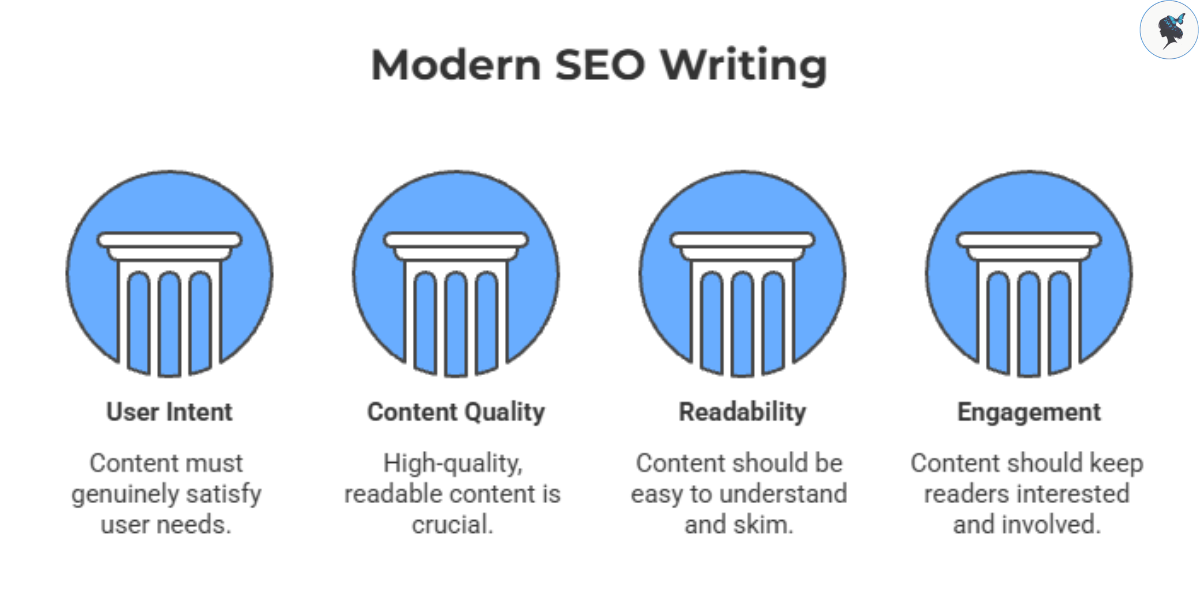
Modern search systems evaluate whether content genuinely satisfies user intent. Content quality, readability, and engagement matter far more than repetitive keyword placement.
Modern SEO writing
How to fix it
Write the way you naturally explain your business to customers.
A simple test helps: If the wording would sound strange in a face-to-face conversation, rewrite it.
Good SEO writing is usually:
clear
specific
helpful
easy to skim
free from unnecessary jargon
The goal is not to “sound optimized.” The goal is to answer questions clearly.
Ignoring What Customers Actually Search For
Many businesses create content based on what they think matters instead of what customers are actively searching for. That creates a mismatch between the website and real-world demand.
For example, a landscaping company might publish pages about “premium outdoor environmental enhancements” while customers are simply searching for:
“backyard drainage help”
“small patio ideas”
“easy garden maintenance”
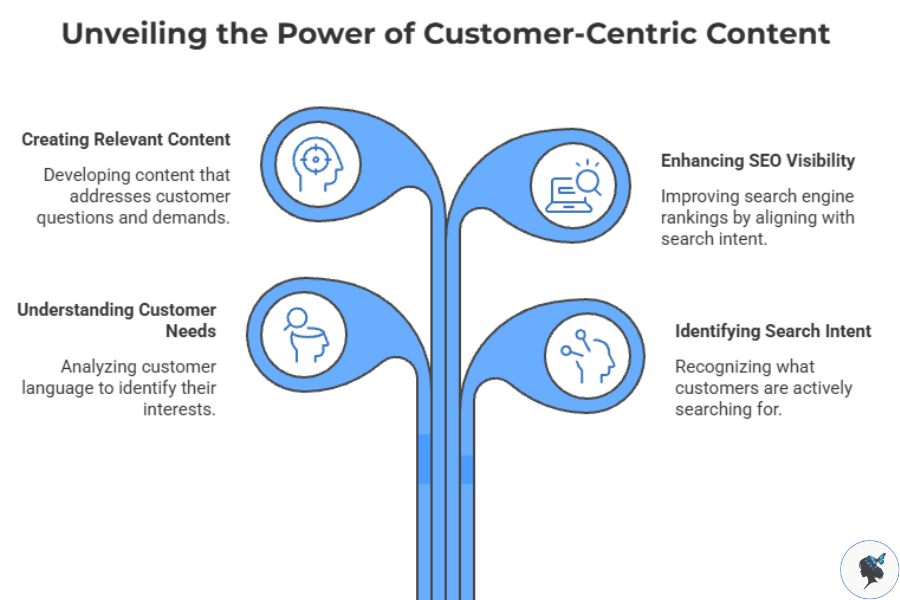
Intent alignment has become one of the strongest visibility signals in modern SEO.
Unveiling the power of customer-centric content
How to fix it
Start listening to customer language more carefully.
Useful sources include:
customer emails
live chat questions
sales calls
online reviews
autocomplete suggestions in search engines
If five customers ask the same question, that question probably deserves its own page or article.
The simplest SEO strategy is often the most effective: answer real questions better than competitors do.
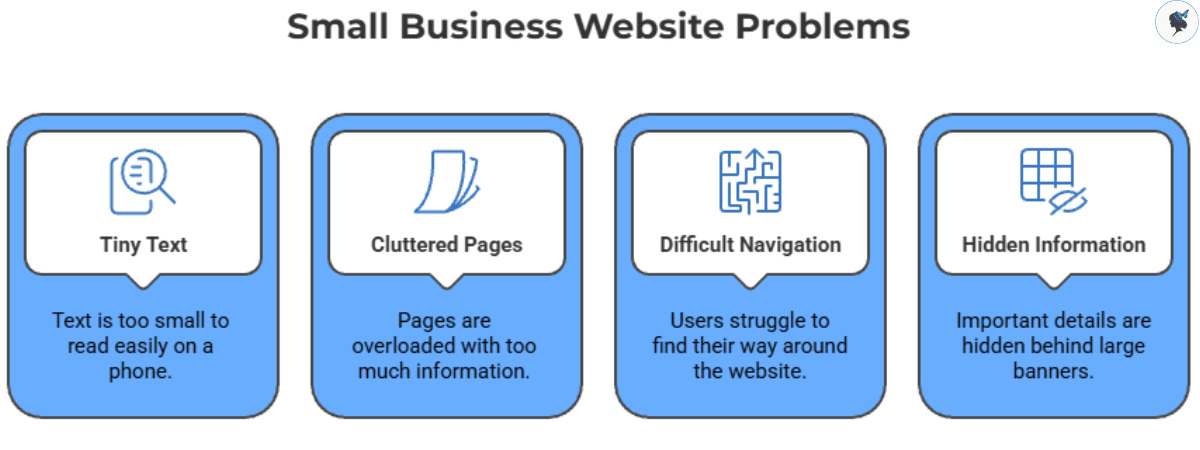
Many small business websites lose customers before visitors even see the content.
Slow loading times frustrate users, especially on mobile devices. Search engines also continue to use page experience and performance signals as ranking factors.
Even a visually attractive website can underperform if it feels sluggish.
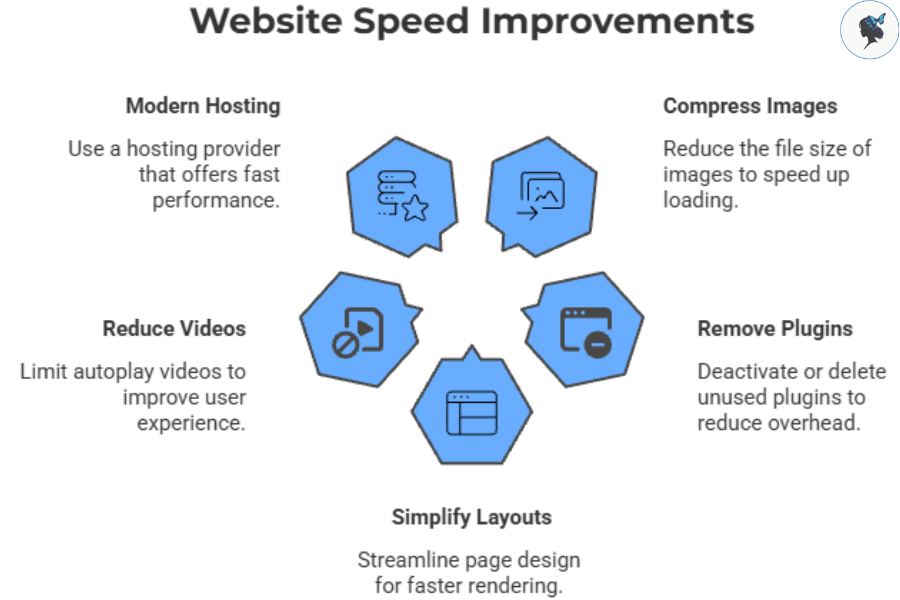
Website speed improvements
How to fix it
You do not need a complicated rebuild to improve speed.
Start with practical improvements:
compress large images
remove unnecessary plugins
simplify page layouts
reduce autoplay videos
use modern website hosting
A fast, simple website often performs better than an elaborate one packed with effects.
Many businesses start blogging because they heard “content helps SEO.”
That part is true.
But random blog posts without strategy rarely produce meaningful results.
A restaurant posting “Top Summer Trends” or a consultant publishing generic motivational articles often creates content disconnected from customer needs.
Before publishing an article, ask: “What practical problem does this solve?”
Good content usually helps customers:
understand
compare
decide
avoid mistakes
feel confident
Ignoring Reviews and Reputation Signals
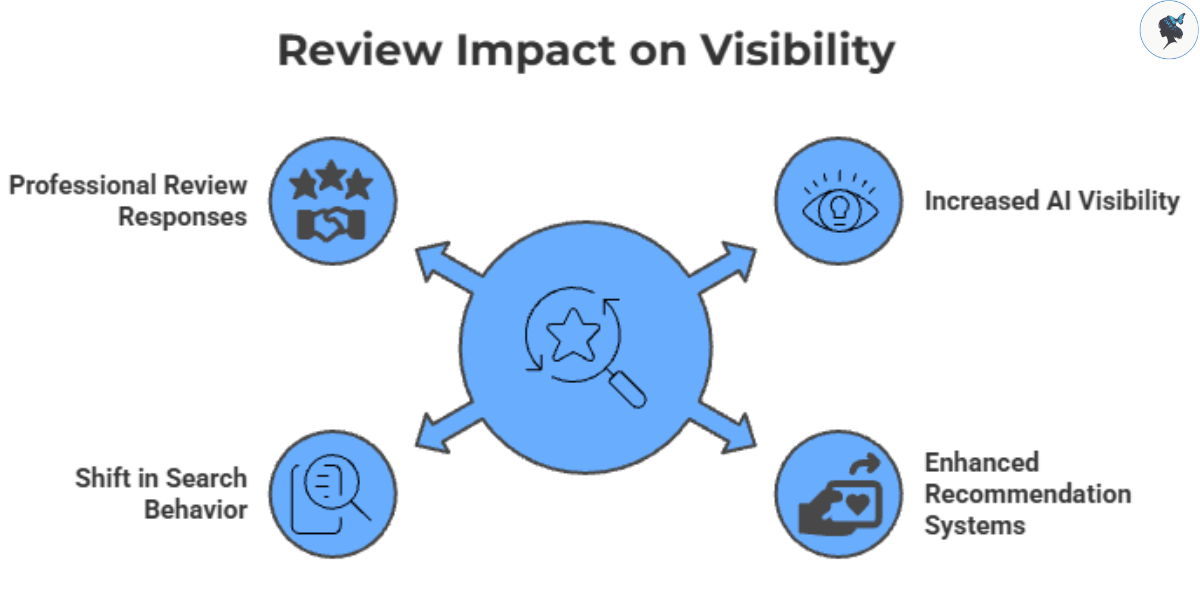
Reviews are no longer just customer feedback. They are visibility signals.
Recent reporting in 2026 suggests businesses with stronger review profiles appear more frequently in AI-generated search responses and recommendation systems. That shift matters because search behavior itself is changing.
People increasingly rely on AI summaries, maps, reviews, and aggregated recommendations before ever visiting a website.
Review impact on visibility
How to fix it
Make review collection part of normal operations. Simple methods work best:
ask after successful purchases
send short follow-up emails
make review links easy to access
Equally important: respond professionally to reviews, including negative ones. Potential customers often judge businesses more by how they handle criticism than by perfect ratings.
Neglecting Local Search Visibility
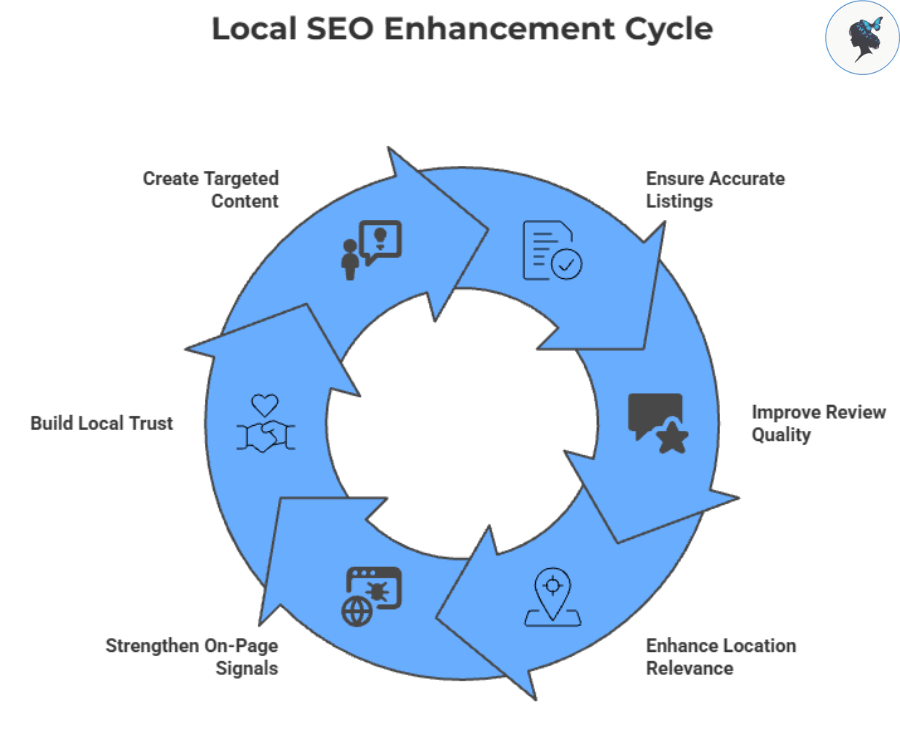
Many small businesses underestimate how much search behavior is locally driven.
Even businesses serving broader markets benefit from local trust signals.
Local SEO enhancement cycle
How to fix it
Make sure your:
contact information is consistent everywhere
business hours are updated
service areas are clearly explained
business profiles are fully completed
Also create pages around real customer needs tied to local intent. For example:
“same-day emergency electrician”
“family-friendly brunch spot”
“wedding florist consultation”
Specificity usually beats generic marketing language.
Expecting SEO to Work Instantly
This may be the most emotionally exhausting mistake. Small businesses often invest in SEO for a few months, see limited results, then abandon the effort completely.
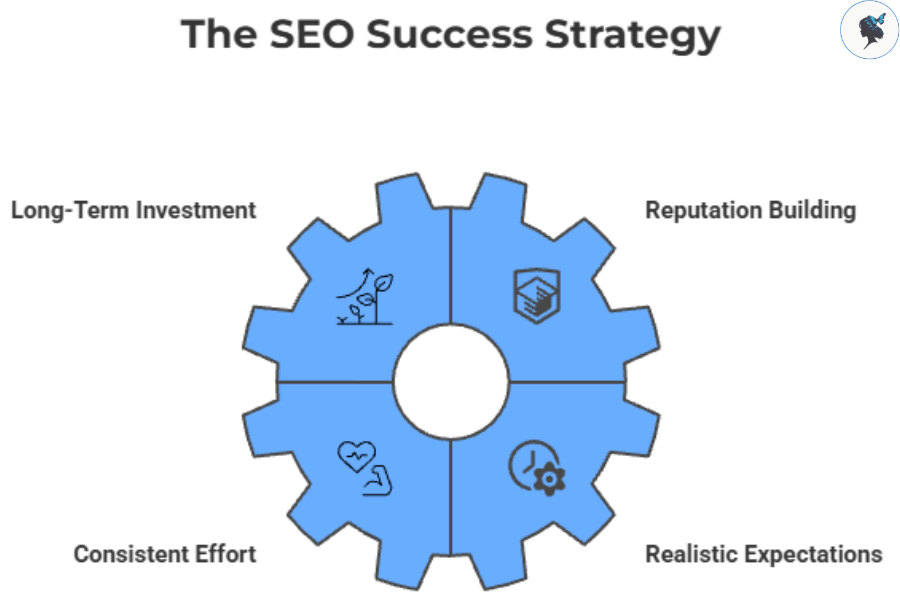
But SEO compounds slowly.
A useful article published today may continue generating leads for years. Meanwhile, inconsistent stop-and-start efforts rarely build momentum.
The SEO success strategy
How to fix it
Treat SEO like reputation building, not advertising.
Paid ads can create immediate traffic. SEO creates accumulated visibility over time.
Set realistic expectations:
3 months for early movement
6–12 months for stronger authority
ongoing improvements for long-term growth
Consistency matters far more than intensity.
Forgetting That User Experience Is Part of SEO
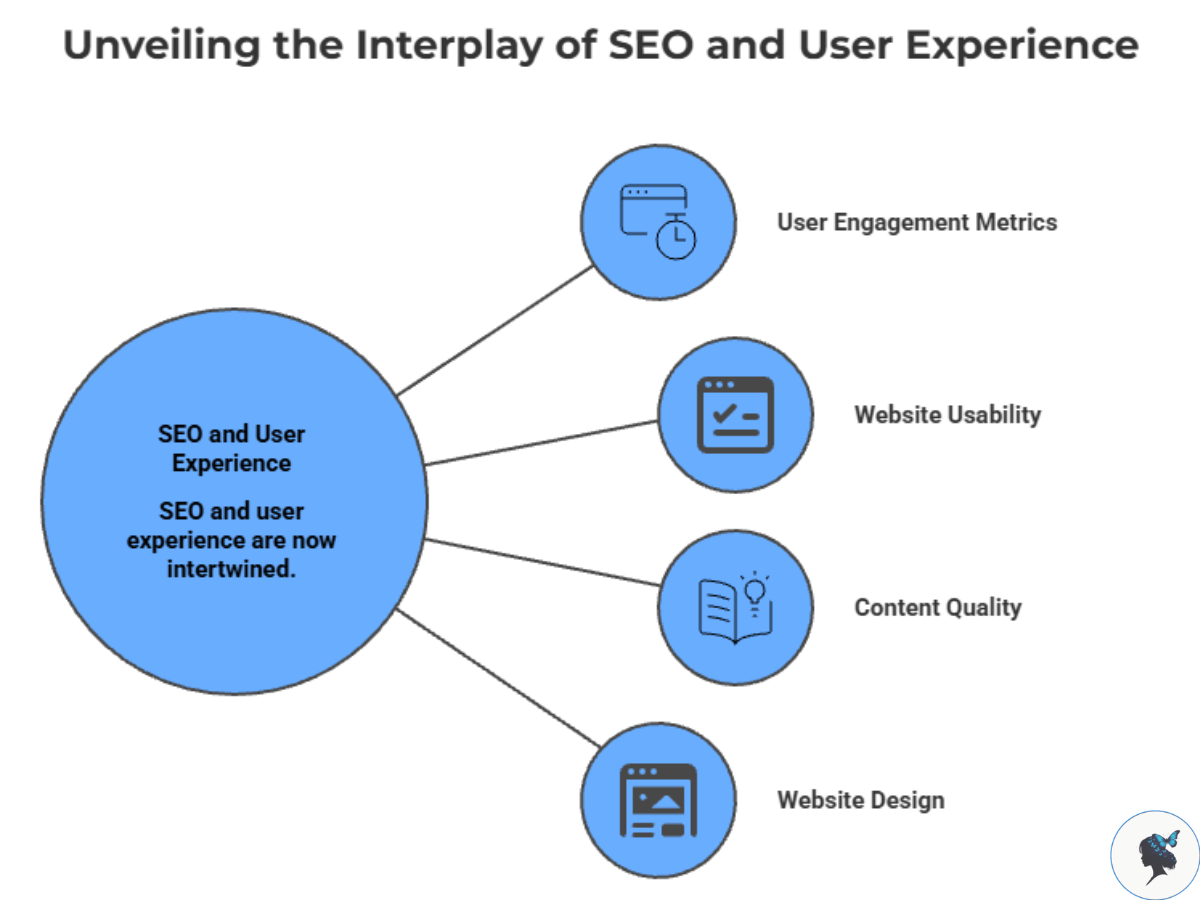
SEO and user experience are no longer separate conversations. Search systems increasingly evaluate how people interact with websites:
how long they stay
whether pages are easy to navigate
whether content feels satisfying
whether users quickly leave and return to search results
This is one reason outdated “SEO tricks” are becoming less effective.
Unveiling the interplay of SEO and user experience
How to fix it
Focus on making your website genuinely easier to use.
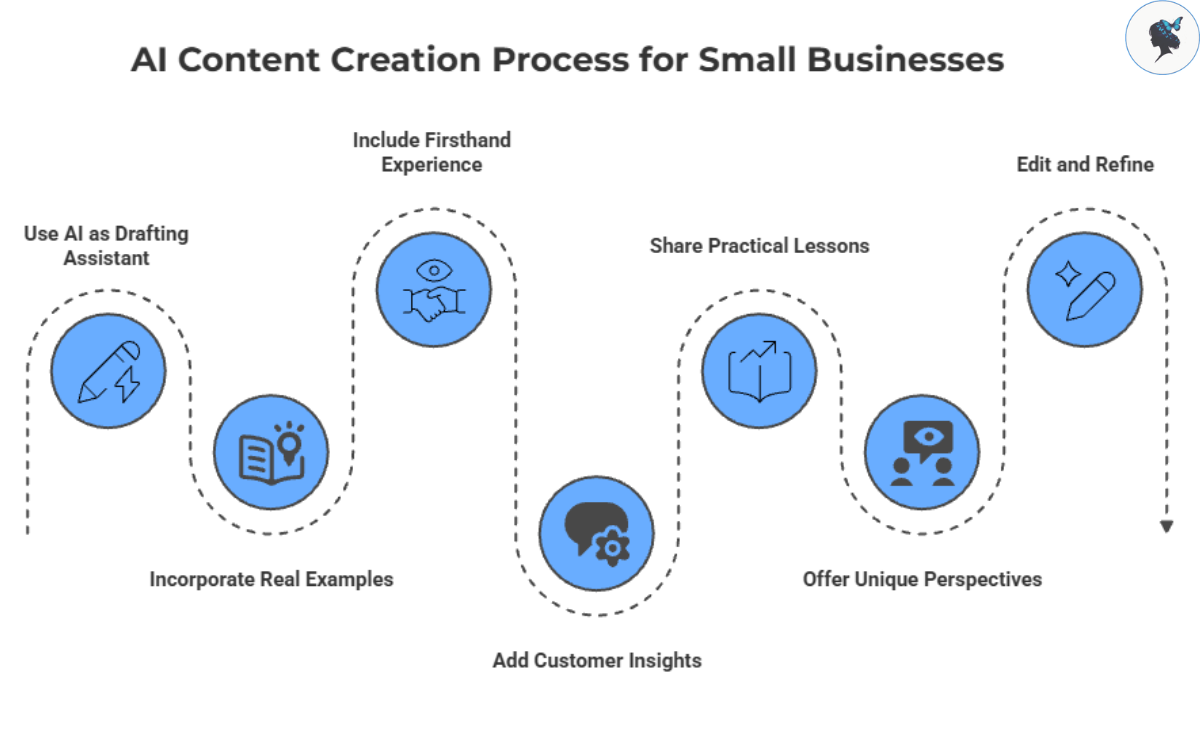
Use AI as a drafting assistant, not a replacement for expertise. The strongest content usually includes:
real examples
firsthand experience
customer insights
practical lessons
unique perspectives
A short, genuinely useful article will often outperform a longer generic one.
Practical SEO Improvements Small Businesses Can Make This Month
SEO becomes less overwhelming when broken into small operational improvements. Here are examples of practical adjustments businesses could realistically implement.
Coffee shop in New York
Instead of optimizing for “best coffee,” the business creates pages answering:
“quiet cafés for remote work”
“best coffee shop for study sessions”
“late-night espresso bar”
Result: more relevant traffic and longer visit times.
Boutique hotel in Tokyo
The hotel adds detailed FAQs covering:
check-in process
transportation tips
nearby attractions
luggage storage policies
Result: fewer customer uncertainties and stronger search relevance for traveler questions.
Fitness studio in London
The studio publishes beginner-focused content:
“what to expect in your first class”
“best workouts for office workers”
“how to start strength training safely”
Result: improved engagement from hesitant first-time visitors.
Retail store in Sydney
The business rewrites product pages using simpler language and clearer descriptions instead of manufacturer copy.
Result: better readability, improved trust, and stronger conversion rates.
The Bigger Shift Happening in SEO
SEO in 2026 is increasingly about credibility, usefulness, and clarity.
Search engines — and AI search systems — are moving away from rewarding pages that merely look optimized.
They are increasingly prioritizing:
trustworthy information
strong user experiences
real expertise
customer satisfaction
structured, easy-to-understand answers
That shift actually benefits small businesses in many ways.
Large companies often struggle to sound human. Smaller businesses can move faster, communicate more personally, and answer customer concerns more directly.
That is a competitive advantage.
Conclusion
Most small businesses do not need “advanced SEO hacks.”
They need:
clearer messaging
faster websites
more useful content
stronger customer trust
better alignment with real search behavior
The businesses that improve online visibility today are rarely the ones chasing algorithms most aggressively.
They are usually the ones making life easier for customers.
If you want better SEO results, start there.
Pick two or three problems from this article and improve them over the next month. Then measure what changes:
website traffic
calls
inquiries
bookings
customer engagement
SEO is not magic. It is accumulated clarity and trust over time.