
▶Table of Contents
Introduction
In the competitive world of online marketing, SEO is the backbone of digital visibility. For travel companies, ranking higher in search engine results can directly translate into increased bookings, brand awareness, and customer loyalty. But how do you gain an edge over your competitors, especially in a saturated market? The answer lies in competitor backlink analysis.
Backlinks are one of the most important ranking factors for search engines like Google, and understanding how your competitors are building their link profiles can give you a significant advantage. In this article, we’ll explore what competitor backlink analysis is, how to do it effectively, why it’s crucial for travel businesses, and how our Wanderer’s Watchlist package can help you track and outsmart your competition.
What is Competitor Backlink Analysis?
Competitor backlink analysis is the process of examining the backlinks that point to your competitors’ websites. Backlinks are external links from other websites that direct traffic to your site, and they play a vital role in determining your site’s authority, relevance, and ranking in search engines.
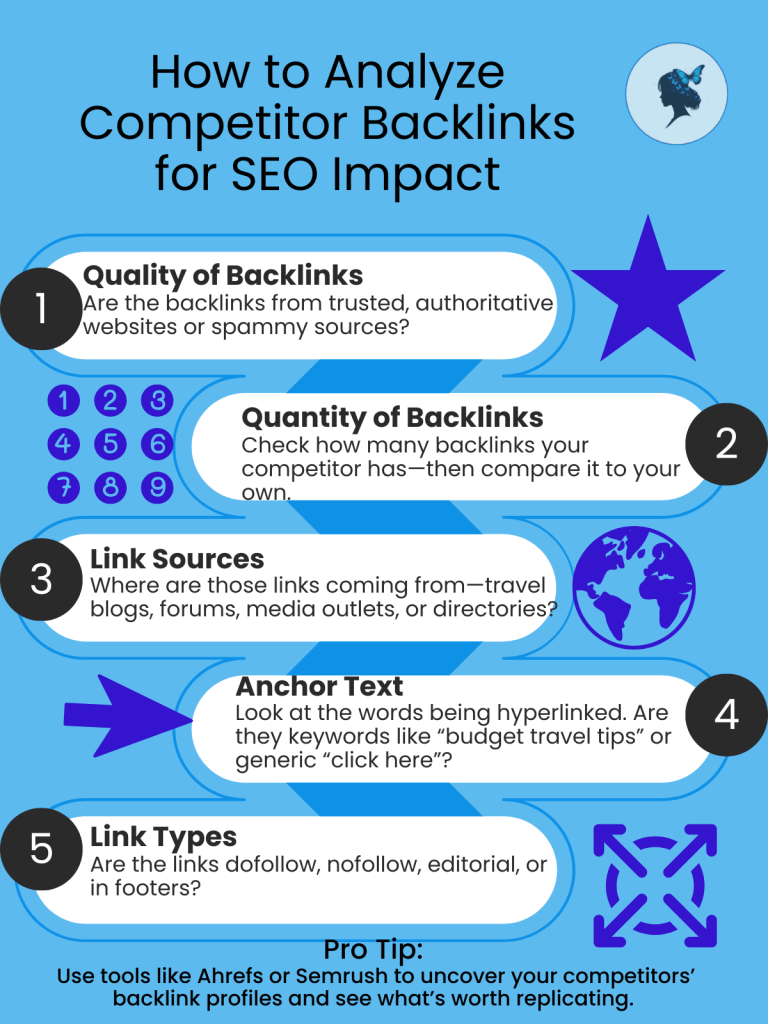
When you conduct a backlink analysis, you are essentially looking at the websites linking to your competitors and identifying:
- The Quality of Backlinks: Are these links from authoritative or spammy websites? Quality backlinks have a much higher impact on SEO.
- The Quantity of Backlinks: How many backlinks does a competitor have, and how does it compare to your backlink profile?
- Link Sources: Where are these backlinks coming from? Are they from high-traffic travel blogs, niche industry websites, or social media platforms?
- Anchor Text: What keywords are used in the anchor text of the backlinks? This can give you insights into the terms competitors are ranking for.
- Link Types: Are these links from guest posts, articles, directories, or other sources? Understanding the types of backlinks your competitors are building can help you identify the most effective link-building strategies for your own website.
By analyzing your competitors’ backlinks, you can identify opportunities for link-building and discover potential weaknesses in their SEO strategy that you can take advantage of.
How to Do Competitor Backlink Analysis for Your Travel Company
Effective competitor backlink analysis requires a structured and comprehensive approach. Let’s break down the steps to analyze your competitors’ backlinks and use that data to improve your travel business’s SEO strategy.
Step 1: Identify Your Competitors
Before diving into backlink analysis, you need to determine who your competitors are. These could include:
- Direct Competitors: Other travel companies offering the same products or services (e.g., tour operators, booking agencies, and destinations).
- Indirect Competitors: Websites like travel blogs, review platforms, or even niche content creators targeting the same audience but not offering the same service.
Use search engines or SEO tools like Semrush, Ahrefs, or Moz to identify these competitors by looking at the keywords you want to rank for and noting which websites consistently rank for those terms.

Step 2: Use Backlink Analysis Tools
Once you’ve identified your competitors, it’s time to dive into backlink data. There are a variety of SEO tools available to conduct backlink analysis:
- Ahrefs: Ahrefs has one of the most comprehensive backlink analysis tools, allowing you to analyze the link profile of any website. You can track the total number of backlinks, view the linking domains, and see the anchor text used.
- Semrush: Semrush offers detailed insights into backlinks, showing you the exact pages where competitors are receiving links, the link types, and their link authority.
- Moz Link Explorer: Moz provides a simple interface for analyzing backlinks and offers metrics such as Domain Authority (DA) and Page Authority (PA) to assess the quality of backlinks.
- Majestic: This tool specializes in backlinks and gives you metrics like Trust Flow and Citation Flow, which can help you determine the quality of links.
These tools will provide you with valuable insights into your competitors’ backlinks, helping you see where their strength lies and where they might be lacking.
Step 3: Analyze Backlink Quality and Relevance
Not all backlinks are created equal. For your competitor backlink analysis to be truly valuable, you need to assess the quality and relevance of the backlinks your competitors are receiving.
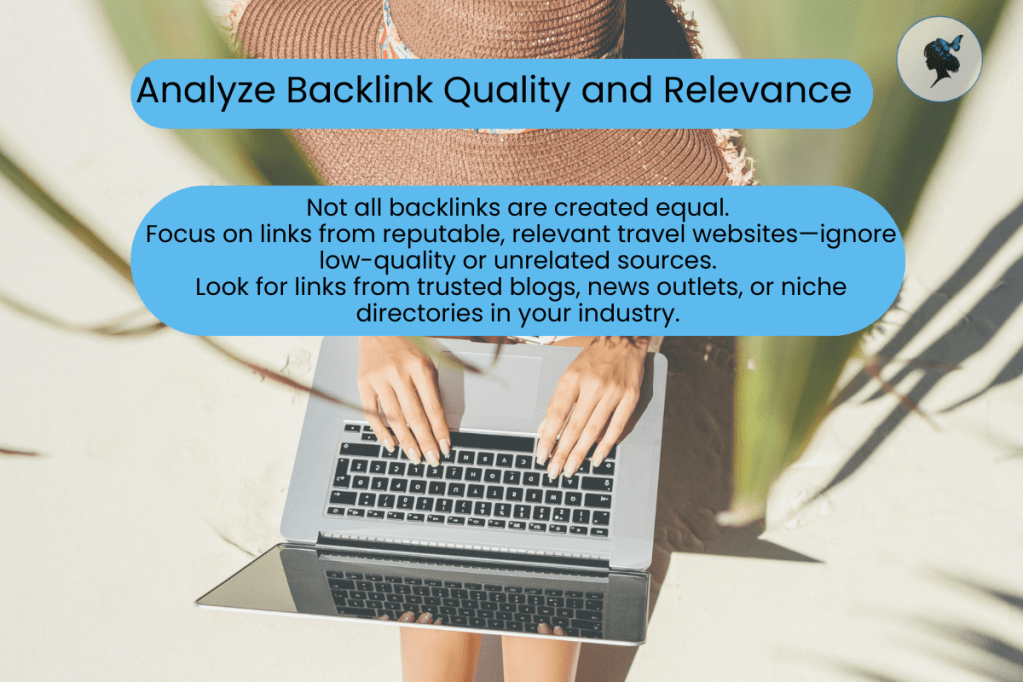
- Domain Authority: Check the authority of the domains that are linking to your competitors. High-authority domains (like popular travel publications or tourism boards) will have a bigger impact on search rankings than low-authority domains (such as spammy websites).
- Relevance to Your Niche: For travel businesses, backlinks from travel-related websites, blogs, tourism boards, and related industry sources are more valuable than generic backlinks from unrelated sites.
- Follow vs. NoFollow Links: Follow links pass link equity and contribute to SEO, while NoFollow links do not. A good backlink profile contains a healthy mix of both, but focus on acquiring Follow links from high-quality sources.
Step 4: Find Link Building Opportunities
One of the most valuable aspects of competitor backlink analysis is identifying potential link-building opportunities.
As you analyze your competitors’ backlinks, make note of any:
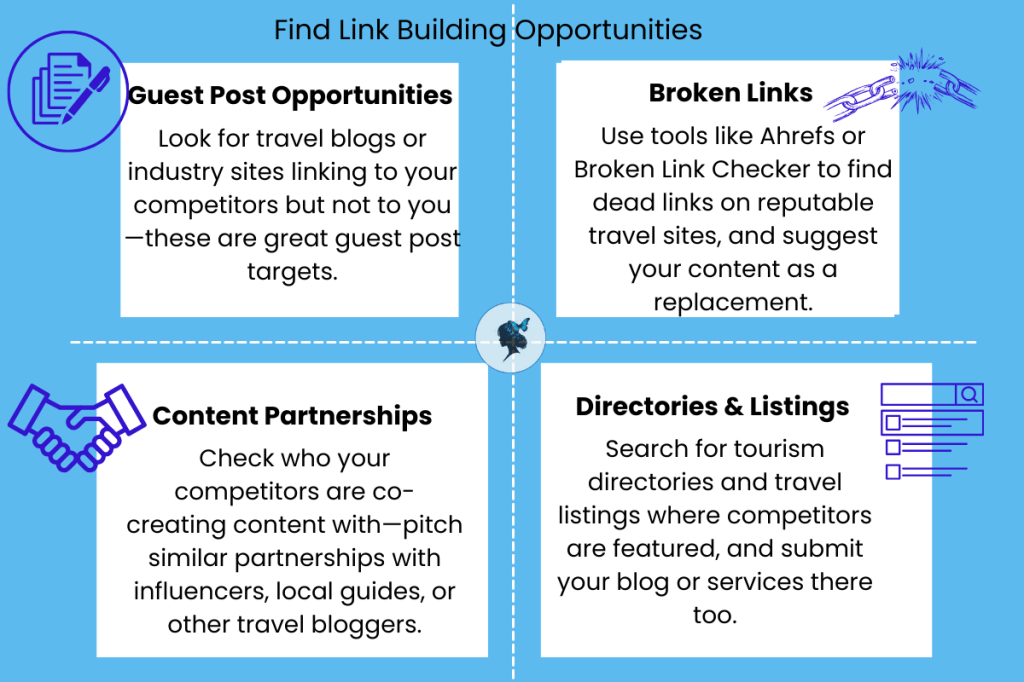
- Guest Post Opportunities: Are there industry blogs or websites that are linking to your competitors but not to you? These might be potential guest post opportunities.
- Broken Links: Find broken or dead links on authoritative websites that could be replaced with a link to your content.
- Content Partnerships: Look for content collaborations, co-marketing opportunities, or influencer partnerships that your competitors have leveraged successfully.
- Directories and Listings: Explore the directories and listings where your competitors have their business listed. You might want to ensure you are included in those same directories.
By identifying where your competitors are getting their links, you can replicate their strategies and even discover better opportunities to enhance your own backlink profile.
Step 5: Monitor and Track Backlink Acquisition
Competitor backlink analysis is an ongoing process. Your competitors will continue to build backlinks, and you should track their progress regularly to ensure you remain competitive. Use SEO tools to set up alerts for new backlinks that point to your competitors’ websites, and adjust your own link-building strategy accordingly.
Why Competitor Backlink Analysis is Important for Travel Companies
Competitor backlink analysis is a powerful tool that offers several benefits for travel businesses looking to improve their SEO strategy.

Identify Valuable Link Opportunities
By analyzing the backlinks of top-performing travel competitors, you can uncover high-value link-building opportunities. These could include websites and blogs that are already proven to link to other travel businesses.
Stay Ahead of SEO Trends
Backlink strategies change over time, and competitors’ link-building tactics can offer valuable insights into emerging trends in the travel industry. By keeping an eye on your competitors’ backlinks, you can adapt your strategy and avoid missing out on new opportunities.
Improve Website Authority and Ranking
Backlinks are one of Google’s most important ranking factors. By building high-quality backlinks to your travel website, you can increase its authority, improve your rankings, and drive more traffic to your site. Competitor backlink analysis helps you understand what types of backlinks work best in your niche, enabling you to build a more effective link profile.
Refine Your Content Strategy
Backlinks aren’t just about quantity—they’re also about the quality of the content they’re linked to. By studying which pages or types of content your competitors are getting backlinks for, you can refine your own content strategy to create more link-worthy content. For instance, you might discover that long-form destination guides or travel resource hubs are frequently linked to, encouraging you to produce similar high-quality content.
Optimize for Local SEO
For travel companies targeting specific destinations, local backlinks can be incredibly valuable. Through competitor backlink analysis, you can discover local websites, directories, and industry-specific portals where your competitors are getting links. This insight can help you build a local backlink strategy to improve your visibility in local search results.
For more, check out our ultimate guide to Local SEO.
Get Started with Wanderer’s Watchlist: Your Competitive Edge in SEO
Now that you understand the importance of competitor backlink analysis and how to leverage it for your travel business, it’s time to take action with Wanderer’s Watchlist. Our backlink analysis package offers:
- Competitor Identification: A list of top 5 competitors in your niche, including domain names and a brief description of each.
- Keyword Analysis: A breakdown of high-performing keywords used by competitors, including search volume & position in SERPs. Keyword gap analyisis, including: monthly volume, competition, and position in SERPs.
- Backlink Analysis: A report on competitor backlink profiles, highlighting linking domains and opportunities for link building.
- Traffic and Ranking Insights: An overview of estimated traffic sources and top-ranking pages for competitors, providing benchmarks for your own SEO strategy.
Ready to Unlock Your Backlink Potential?
If you’re ready to take your travel SEO to the next level and start acquiring high-quality backlinks, contact us today to learn more about how Wanderer’s Watchlist can help your travel business build a stronger, more competitive online presence.
Discover more from Wander Women Strategies
Subscribe to get the latest posts sent to your email.
