

▶ Table of Contents
- Introduction
- 1. AI-Generated Search Results (Generative AI in SERPs)
- 2. Voice Search Is Changing Keywords
- 3. Local & GEO SEO Are Rising in Value
- 4. Search Intent Drives Content Strategy
- 5. Content Velocity and Freshness Influence Rankings
- 6. Core Web Vitals and Page Speed Still Matter
- 7. Video Content Boosts Engagement and Rankings
- 8. Zero-Click Searches Are on the Rise
- 9. Image SEO and Visual Search Are Expanding
- 10. Mobile-First Indexing and UX Are Non-Negotiable
Introduction
As the travel industry continues to rebound and evolve post-pandemic, so does the world of SEO. The landscape is no longer just about ranking for “best beaches in Europe” — it’s about understanding user intent, leveraging AI, optimizing for voice and local search, and adapting to how travelers search today. If you’re a travel brand or tour operator, the ability to stay ahead of SEO trends could mean the difference between a page-one ranking and being invisible.
Here are 10 key SEO shifts travel businesses must embrace, complete with current data, real-life examples, and actionable insights.
1. AI-Generated Search Results (Generative AI in SERPs)
- Stat: By 2026, traditional search engine volume will drop by 25%
- Example: Google’s Search Generative Experience (SGE) now delivers full travel summaries before organic results, answering queries like “best solo travel destinations for women in 2025” directly.
- Insight: Traditional blue links are getting pushed lower. Travel brands must focus on E-E-A-T (Experience, Expertise, Authoritativeness, Trust) and optimize content for AI-generated snapshots. Structured data, FAQs, and authoritative content are key.
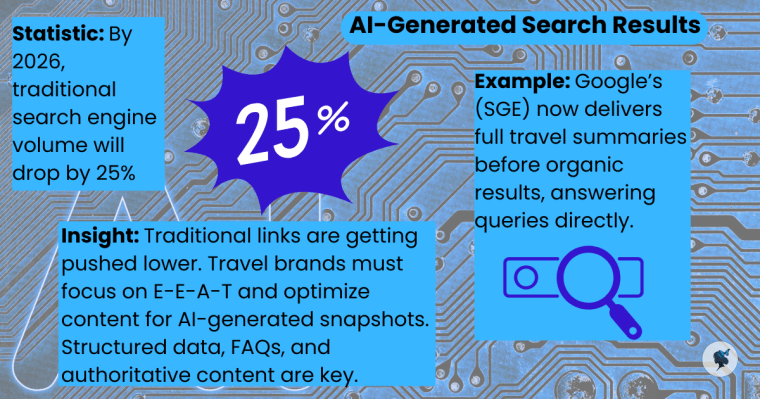
Generative AI is reshaping how search engines display results, favoring AI-generated summaries over traditional listings. This has a profound impact on how travel companies need to craft content. Real-time answers to search queries reduce visibility for traditional SEO tactics, making it essential for travel websites to focus on E-E-A-T principles and structured markup. For instance, Google SGE might display a complete answer about “safe solo destinations for women” before any blog or booking site appears.
For travel companies, this means investing in highly informative and trustworthy content written by subject-matter experts, enriched with structured data to improve discoverability. Consider embedding FAQs, location-specific schema, and expert interviews to strengthen your content’s authority. Companies that adapt will continue to show up in AI summaries and featured results.
Responsible Travel revamped their destination pages with expert content and schema markup, helping them stay visible even as AI reshaped the SERPs. They now consistently appear in AI-generated answers for queries like “small group eco tours in South America.”
For more about AI, read our post: AI overviews SERP integration.
2. Voice Search Is Changing Keywords
- Stat: 71% of users now prefer voice search over typing when planning travel
- Example: Users are now asking “Where can I go on a beach vacation under $1000 with kids?” instead of typing “cheap beach vacations family.”
- Insight: Optimize for natural language and question-based keywords. Tools like AnswerThePublic and Semrush’s Keyword Magic Tool can help capture long-tail, conversational phrases.
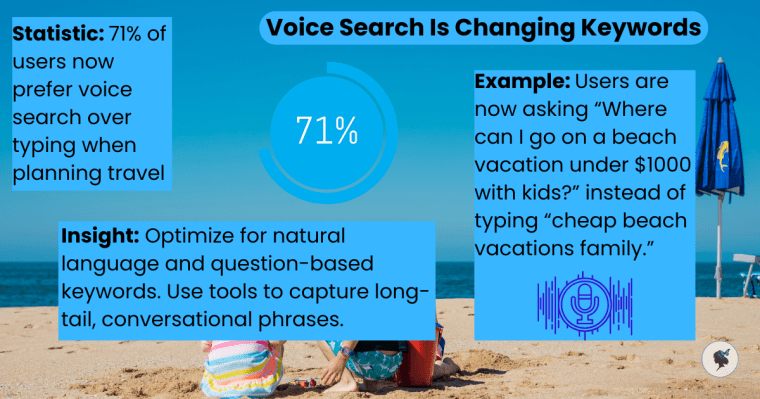
Voice search has fundamentally altered how people look for travel information. Instead of fragmented keywords, travelers now speak in full, natural sentences when using digital assistants. This means your SEO strategy should pivot to accommodate question-based content and long-tail keyword phrases that reflect conversational search patterns.
For example, instead of optimizing solely for “Italy family vacation,” travel sites should include headers like “What are the best family-friendly destinations in Italy?” and answer them in a conversational tone. Including FAQs on your pages is a simple but powerful tactic to capture this traffic.
Kayak launched a voice search integration with Amazon Alexa, allowing users to inquire about travel information such as hotel bookings and flight statuses. This integration aimed to provide users with a hands-free way to access travel information.
3. Local & GEO SEO Are Rising in Value
- Stat: “Near me” travel-related searches have grown over 900% in the last two years
- Example: “Hidden beaches near Barcelona” or “best hikes near Innsbruck” are outperforming generic queries.
- Insight: Travel businesses must optimize Google Business Profiles, add geo-specific landing pages, and focus on hyperlocal keywords to attract spontaneous and mobile travelers.

Location-based SEO has seen explosive growth, especially with mobile and last-minute travelers looking for options near their current location. Search phrases such as “best cafes near Eiffel Tower” or “affordable hotels near Grand Canal Venice” are increasingly common.
To take advantage, travel businesses should create location-specific content and landing pages that target hyperlocal keywords. Complete and maintain your Google Business Profile, encourage reviews, and use local schema markup to improve your visibility in local search results.
Pilote Consulting implemented a comprehensive SEO strategy for a hotel client, working on location-based and experience-based keywords resulting in a 38% increase in booking volume.
Read more in our ultimate guide to local SEO.
4. Search Intent Drives Content Strategy
- Stat: 80% of consumers rely on AI-generated summaries that interpret search intent to answer queries.
- Example: Queries like “family-friendly resorts in Mallorca” imply transactional intent, while “things to do in Mallorca with kids” is informational.
- Insight: Travel companies must match content to intent—creating blog posts for informational searches and optimized landing pages for transactional ones.
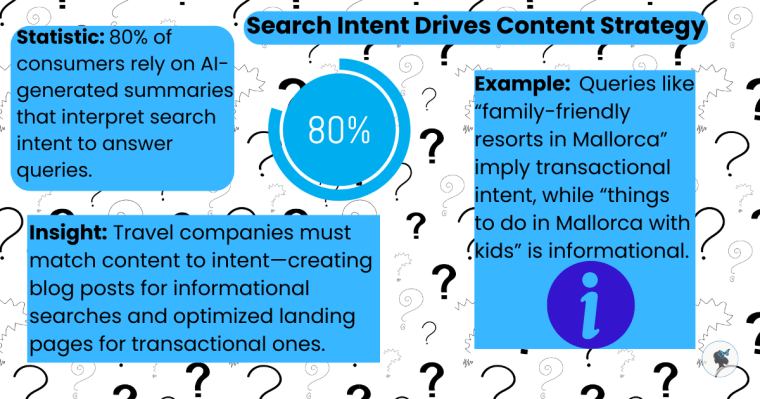
Matching content type to search intent has never been more critical. Travelers today expect highly relevant and tailored content when searching for information. Misaligned content can lead to poor user engagement and lower rankings.
To serve each user stage, travel businesses should categorize keywords as informational, navigational, transactional, or commercial and tailor content accordingly. Informational queries deserve blog-style content; transactional keywords should land on booking pages.
VisitScotland created separate landing pages for “romantic Scotland getaways” and blog articles for “best places in Scotland to propose.” As a result, their site traffic increased for both transactional and informational terms.
5. Content Velocity and Freshness Influence Rankings
- Stat: 50% Increase in click-through rates for updated content.
- Example: A blog updated monthly about “summer festivals in Europe 2025” stays more visible than a static list.
- Insight: Regularly updating and publishing content is vital. Google prioritizes fresher, regularly maintained pages.
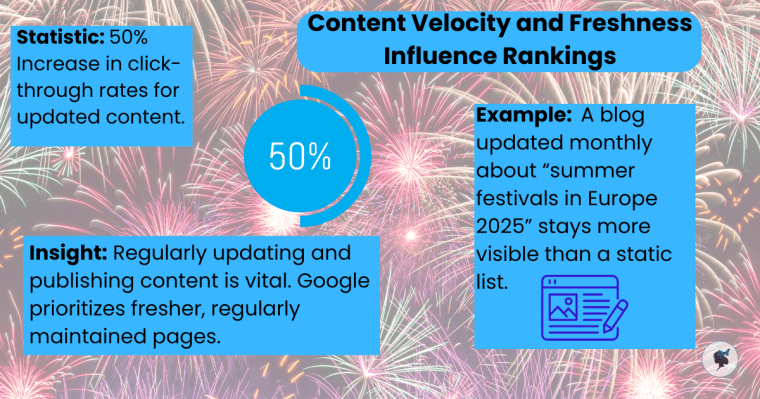
In the fast-moving world of travel, static pages go stale quickly. Google’s freshness algorithm rewards websites that update and add content frequently, especially around seasonal topics, trending destinations, or recent travel policies. Travel businesses should create a content calendar that aligns with peak travel seasons and emerging trends.
Freshness isn’t just about publishing new posts — updating old ones can give a major SEO boost. Add new statistics, improve readability, and refresh images. This signals relevance to Google’s algorithms.
The Travel Team experienced a remarkable 7.5x increase in organic traffic over a year by implementing a comprehensive content optimization strategy. This approach focused on updating existing content and creating new, relevant articles aligned with travelers’ search intent.
6. Core Web Vitals and Page Speed Still Matter
- Stat: Sites that load in 5 seconds vs 19 seconds were observed to have 70% longer average sessions.
- Example: A slow-loading photo gallery of Bali beaches drives users to bounce before viewing tours.
- Insight: Optimize mobile performance, image sizes, and interactivity to meet Google’s Core Web Vitals standards.
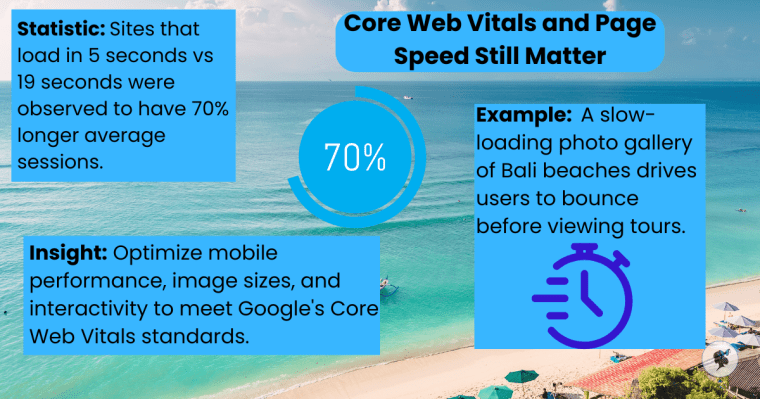
Core Web Vitals continue to be a ranking factor. Fast-loading, mobile-optimized pages improve user experience and SEO. Travel websites with heavy visuals must especially ensure their image-heavy galleries don’t drag down load times.
Improvements like lazy loading, compressing images, and eliminating unused scripts can drastically improve speed. Google’s PageSpeed Insights and Semrush Site Audit are useful tools to monitor and optimize performance.
TourRadar cut homepage load time by compressing hero images and deferring non-essential scripts, which led to a rise in page views per session.
Check out our post on website speed optimization.
7. Video Content Boosts Engagement and Rankings
- Stat: Pages with videos are 53 times more likely to rank on Google’s first page
- Example: Travel vlog-style content like “A Week in the Dolomites” garners more engagement than text-only itineraries.
- Insight: Embedding optimized video content improves SEO, increases dwell time, and appeals to visual learners.
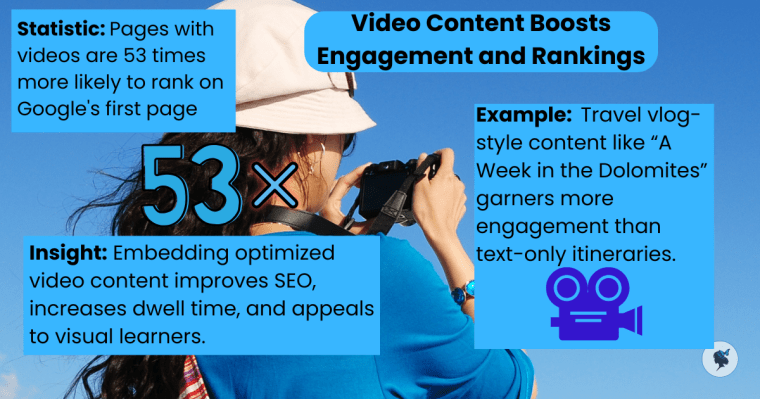
Video content resonates with modern travelers seeking immersive, real-world experiences before they book. Whether it’s a cinematic destination guide or a walkthrough of a resort, video can drastically improve engagement, boost time on page, and contribute to stronger SEO metrics.
To leverage this, travel brands should embed YouTube-hosted videos on their site with keyword-rich titles, captions, and schema markup. Platforms like Vimeo and YouTube also drive external traffic, while video snippets can appear directly in SERPs.
United Airlines used video to inspire wanderlust and in just one month noticed a 52% increase in conversions.
8. Zero-Click Searches Are on the Rise
- Stat: Over 65% of Google searches now result in no clicks
- Example: Google displays full answers to queries like “currency in Croatia” or “visa rules for Thailand.”
- Insight: Optimize for featured snippets, FAQs, and schema markup to capture attention in zero-click environments.

With more searchers getting their answers directly on the results page, traditional click-through rates are declining. This trend is especially relevant for travel companies providing quick answers on safety, weather, or visa requirements.
To remain visible, optimize your content with structured markup, concise headers, and FAQ schema. Even if users don’t click, branded exposure in zero-click boxes builds trust and authority.
Rome2Rio dominates SERPs for “Paris to Amsterdam ways to travel” with their snippet-optimized route summaries, even when users don’t click through.
Read our post: AI Overviews & SERP integration.
9. Image SEO and Visual Search Are Expanding
- Stat: 67% of users prefer visual search over text-based search.
- Example: Users search “pink beach Bali” and click directly through from Google Images.
- Insight: Use high-quality, optimized images with descriptive file names, alt tags, and geotags to increase discoverability.
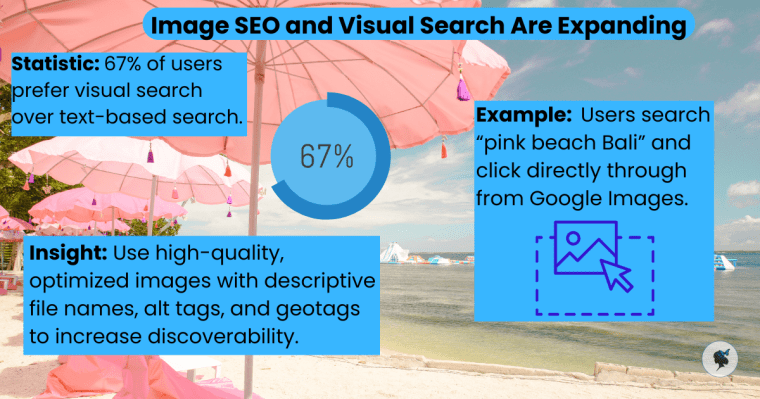
Images are becoming powerful entry points to websites. Travel is inherently visual, so optimizing imagery is no longer optional—it’s foundational. Google Lens and image SERPs can now drive considerable organic traffic.
To take advantage, use original, high-res images and add alt text, descriptive filenames, and geotags. Compress without compromising quality and organize media galleries with SEO in mind.
AirBnB optimized listings with location-tagged photos and saw higher visibility in image-based searches for “treehouse stays in Tuscany.”
10. Mobile-First Indexing and UX Are Non-Negotiable
- Stat: over 70% of travelers use smartphones at some point during their travel journey.
- Example: A slow or unresponsive mobile site can tank bookings from international users on the go.
- Insight: Prioritize mobile design, streamlined UX, and cross-device compatibility to capture today’s travel planner.
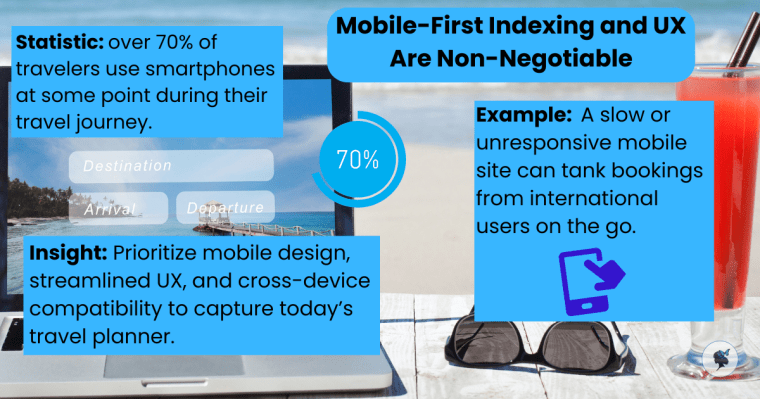
Google has fully transitioned to mobile-first indexing, meaning your mobile site is the primary version used for ranking. For travel companies, this underscores the need for lightning-fast, easy-to-navigate mobile experiences.
Simplify mobile booking flows, ensure responsive design, and eliminate intrusive pop-ups. Mobile SEO is now table stakes—not a bonus.
TravelPass Group undertook a comprehensive optimization of their site, focusing on enhancing the mobile user experience. As a result of these optimizations, TravelPass Group experienced a 14% increase in phone call conversion rates from mobile users. Over the course of a year, continuous testing and refinement led to the doubling of their overall website conversion rates.
By adapting to these evolving SEO trends, travel companies can position themselves for long-term visibility and engagement. Whether you’re a boutique agency or a global OTA, understanding and implementing these tactics will future-proof your digital presence.
Need help future-proofing your travel brand’s SEO?
Contact us today to explore tailored packages designed for growth in 2025 and beyond.
Discover more from Wander Women Strategies
Subscribe to get the latest posts sent to your email.
