
▶ Table of Contents
- Introduction
- Understanding AI in Travel
- AI-Driven Email Personalization: The Future of Targeted Travel Campaigns
- Case Study: BrazeAI Decisioning Studio — AI-Powered Optimization for Personalized Engagement
- Benefits of AI-Personalized Emails for Travel Agencies
- Implementation Strategies: How Travel Agencies Can Adopt AI-Driven Email Personalization
- Conclusion
Introduction
In today’s travel industry, personalization isn’t a “nice-to-have” — it’s an expectation. Modern travelers expect offers, content and communications that reflect their interests, previous trips, budget, and style. For travel agencies, this shift means moving beyond generic email blasts or one-size-fits-all newsletter templates.
That’s where artificial intelligence (AI) steps in. By analysing user behaviour, past bookings and contextual data, AI can transform how travel agencies craft and deliver highly personalized travel content — especially via email campaigns.
In this post, we’ll explore how AI works in the travel space, dig into how it drives email personalization, examine a leading case study, outline the clear benefits for travel agencies, and provide actionable implementation steps. If you’re aiming to boost engagement, conversion and customer loyalty through smarter email marketing — this is for you.
Understanding AI in Travel
What is AI?
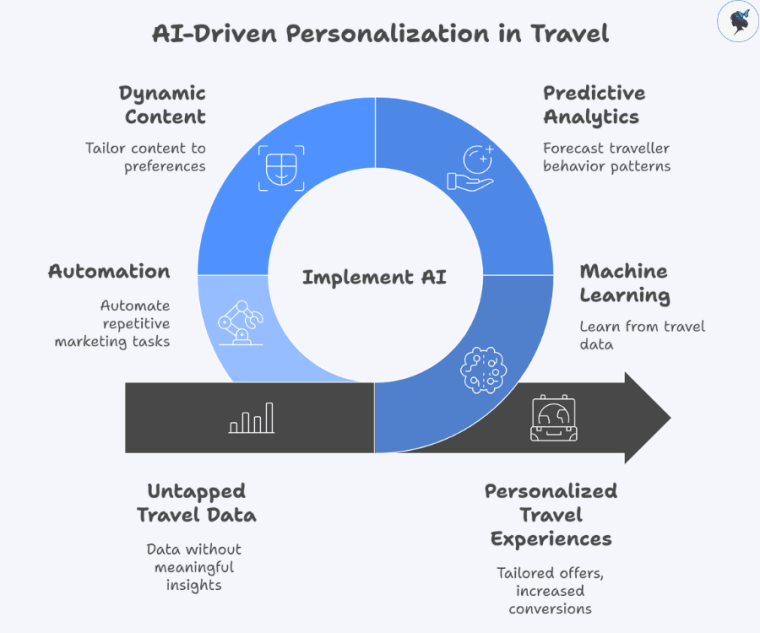
Artificial Intelligence (AI) refers broadly to computer systems that can perform tasks typically requiring human intelligence: learning from data, recognising patterns, making predictions, and sometimes generating content. Within travel marketing, AI often looks like machine-learning models, predictive analytics, dynamic content generation and automation of repetitive tasks.
Relevance of AI in the Travel Industry
The travel industry is awash with data: traveller profiles, booking histories, preferences, search queries, seasonal trends and more. But gathering data isn’t enough — the real value comes from turning that data into meaningful insights and tailored experiences.
According to research, the market for AI-driven travel experience personalization was valued at around USD 3.61 billion in 2024, with a projected CAGR of 22.3% from 2025-2032. Furthermore, AI-driven personalisation in tourism marketing has been shown to deliver conversion increases of up to 20-25%.
This means for travel agencies: AI isn’t futuristic—it’s already reshaping how travellers engage, how offers convert, and how content must be crafted.
AI-Driven Email Personalization: The Future of Targeted Travel Campaigns
The Role of AI in Email Marketing
Email remains one of the most effective channels for travel agencies: you own the list, you control the message, you can guide travellers from email → landing page → booking. But generic blasts no longer cut it. According to a 2024 study, personalised emails delivered 6× more transactions than non-personalised ones.
Here’s how AI upgrades email marketing for travel agencies:
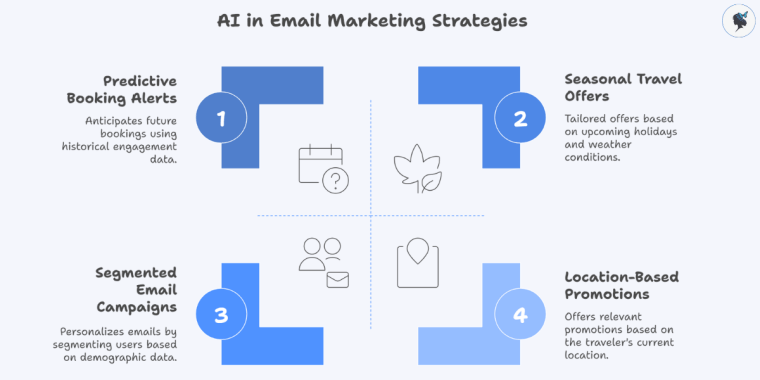
- Behavioural analysis: AI examines how travellers have previously engaged — which destinations they viewed, which trip types they booked, what emails they clicked, what content they ignored.
- Demographic & profile data: Age, travel frequency, solo vs family, preferred style (luxury, budget, adventure) feed into segmenting and personalising offers.
- Contextual data: Seasonality, upcoming holidays, weather, location, time of day — AI uses this to send more timely and relevant messages (for example: “City break escapes for early Autumn” rather than generic “Summer deals”).
- Predictive modelling: AI anticipates when a traveller is poised to book again — and sends the right message at the right time.
- Dynamic content generation: Email subject lines, body copy, images and CTA buttons can all be tailored per recipient, improving relevance and engagement.
More about managing seasonal content here.
Key AI Techniques Used in Email Personalization
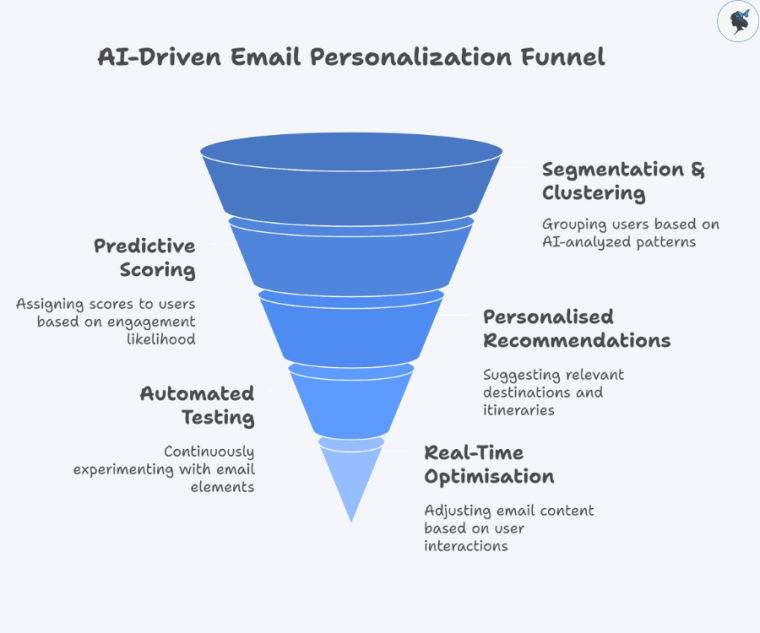
- Segmentation & clustering: Rather than manual segments (“families”, “solo travellers”), AI creates ever-changing clusters based on behaviour, intent and patterns.
- Predictive scoring: Assigns scores to each user (likelihood to engage, likelihood to book), enabling prioritised targeting.
- Personalised recommendations: Based on past behaviour and preferences, the AI suggests destinations or itineraries the traveller is most likely to respond to.
- Automated A/B and multivariate testing: AI continuously experiments with subject lines, send times, visuals, copy, and learns which variant performs best — automatically.
- Real-time optimisation: If a traveller clicks on a city-break email and visits your site, the next email can adjust its content accordingly (e.g., offering hotel options in that city).
More about A/B testing here.
Why It Matters for Travel Content
For travel agencies, leveraging AI in email campaigns means the difference between “Here are 100 generic trip deals” and “Here’s a hand-picked 5-day itinerary in Lisbon that matches your food-lover profile, budget and family size”. The latter builds trust, improves conversion, and drives up lifetime value.
Case Study: BrazeAI Decisioning Studio — AI-Powered Optimization for Personalized Engagement
Overview of BrazeAI Decisioning Studio
BrazeAI Decisioning Studio is an AI marketing automation platform that specialises in self-learning personalization for email and other channels. They replace traditional A/B testing with machine-learning models that continuously optimise each offer. Their clients span hospitality, travel, retail and other industries.
How it Works
- The AI analyses individual-level data: past transactions, engagement metrics, preference data.
- It identifies which offer type (discount vs upgraded package vs loyalty reward) appeals to which user.
- It picks the best send time, channel (email, push, SMS) and subject line for each user.
- It adapts over time — learning what works for each segment and improving campaign performance.
Application in the Travel Industry
Imagine a travel agency uses BrazeAI Decisioning Studio:
- They pull data on who has booked adventure trips versus beach holidays versus city breaks.
- The AI segments newsletter recipients by these profiles.
- For the “adventure seekers” segment: an email goes out with a subject line like “Ready for your next adrenaline rush? See our Peru trekking deals”, sent on Wednesday morning when this segment historically opens most.
- For “family beach holiday” segment: an email offers early-bird booking for summer escapes, subject line “Family summer fun: 3 nights free if you book by June!”.
- The results: higher open rates, higher click-throughs, stronger conversions. Travel agencies report boosted engagement and improved ROI thanks to AI-personalized offers.
Why This Matters
- Shows real use of AI in automating what was previously manual and guesswork-driven.
- Demonstrates how email content becomes “smart” — personalised and adaptive, rather than one-size-fits-all.
- Travel agencies gain a strategic asset: targeted messaging based on data and AI insights, not just gut feel.
Benefits of AI-Personalized Emails for Travel Agencies
Let’s break down the advantages your agency can expect when you adopt AI-driven email personalization.
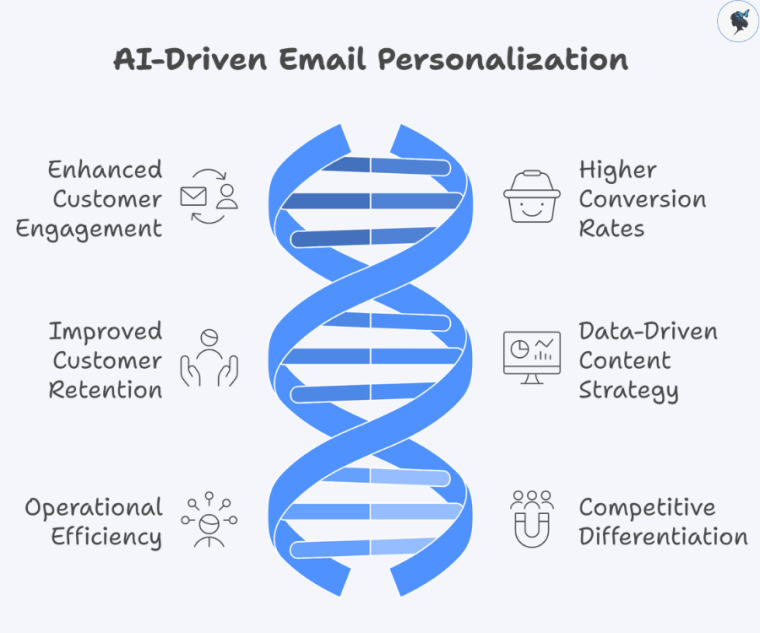
- Enhanced Customer Engagement
Personalized emails resonate more. Data shows personalised campaigns see ≈ 29% higher open rates and 42% higher conversions than generic ones. - Higher Conversion Rates
By sending the right offer at the right time to the right person, you reduce friction and increase booking probability. - Improved Customer Retention
Personalization fosters loyalty — travellers feel recognised and valued. Post-trip follow-ups, tailored up-sells and relevant offers drive repeat bookings. - Data-Driven Content Strategy
Email AI tools generate insights about what travellers are responding to: destinations, trip types, content formats. This shapes blog topics, landing pages and future campaigns. - Operational Efficiency
Automation means less manual segmentation, fewer generic blasts, and more time for creative strategy and high-value client interactions. - Competitive Differentiation
Agencies embracing AI-driven personalization position themselves as tech-forward, customer-centric, and likely ahead of competitors still doing mass newsletters.
More about using AI in personalized itineraries here.
Implementation Strategies: How Travel Agencies Can Adopt AI-Driven Email Personalization
Here’s a practical step-by-step roadmap to help your travel agency get started.

Step 1: Audit and Consolidate Your Data
- Gather data from your CRM, booking system, website analytics, email engagement history.
- Ensure you have permissions, data hygiene and structure in place (GDPR compliance if operating in EU).
- Identify key traveler-attributes you want to leverage: destination preferences, trip type, budget, companion type (solo, family, couple), past email engagement.
More about leveraging data here.
Step 2: Choose the Right AI Email Personalization Platform
Look for tools that integrate with your existing stack, support dynamic content, predictive modelling and automated optimisation. A few examples:
- BrazeAI Decisioning Studio (for automated offer testing & personalization)
- Mailchimp (offers AI features for subject lines and send time optimisation)
- HubSpot (Marketing Hub with AI email personalization)
Wander Women Hot Tip: Ensure the tool supports your scale, data privacy needs and travel-specific requirements.
Step 3: Develop Dynamic Content Assets
- Build a library of destination content, trip types, visuals, itineraries and offers.
- Ensure flexible modules in your emails: dynamic placeholders for destination, budget tier, traveller segment.
- Create copy templates tuned for traveller personas (family, solo adventure, luxury couple, etc.).
- Use the AI platform to pull these modules and assemble tailored emails per recipient.
Step 4: Segment & Test — Start Small, Scale Fast
- Pick one segment to start (e.g., “frequent travellers who booked city breaks last two years”).
- Send control email (generic offer) and AI-personalised email side-by-side. Measure open, click and conversion rates.
- Gradually expand to other segments as you learn what works.
- Use AI’s automated testing to refine subject lines, send times and content blocks.
Step 5: Integrate with Your Broader Marketing Ecosystem
- Synchronise email personalization with landing pages: the same traveller who clicks “family beach holiday” should land on a page with tailored content.
- Integrate with your social media retargeting and chatbot efforts so the message is consistent across channels.
- Use email insights to inform blog content: “Top 5 beach locations this segment clicked on” → blog post with tailored content for that audience.
Step 6: Monitor, Analyse & Optimize
- Track KPIs: open rate, click-through rate, conversion rate (bookings from email), engagement depth, unsubscribe rate.
- Use AI platform reports to identify what travel segments perform best and what offers resonate.
- Iterate content: update assets, refresh visuals, adjust segments, refine timing.
- Ensure data privacy and compliance: travellers may be increasingly sensitive to how their data is used. Maintain transparency.
Conclusion
In a travel world where consumers expect tailored experiences and instant, relevant communications, AI-driven email personalization offers a major leap forward. By leveraging traveller behaviour, preferences and contextual data, travel agencies can transform their email campaigns from “just another deal” into meaningful, customised journeys that resonate.
Platforms like OfferFit demonstrate how AI can power smarter segmentation, offer optimisation, dynamic content and clearer ROI. The benefits are clear: higher engagement, improved conversions, stronger loyalty, deeper content insights and operational efficiency.
If you’re reading this and wondering “Where do we start?” — here’s your prompt: begin with your data, pick an AI tool, build dynamic content templates, choose one test segment and run a personalised campaign. Measure the results. Then scale.
Personalisation is no longer optional — it’s expected. And with AI, your agency can deliver it at scale. Embrace AI for your travel-email strategy and watch your content, engagement and bookings soar.
Need help with your AI email strategy? Contact us today!
Discover more from Wander Women Strategies
Subscribe to get the latest posts sent to your email.

One thought on “Ways AI Can Enhance Travel Content Personalization: AI-Driven Email Personalization”
Comments are closed.