In today’s competitive travel industry, data-driven decisions are essential for success. Tracking the right marketing metrics helps travel brands understand what’s working, optimize campaigns, and boost bookings. However, with so many data points available, knowing which ones truly matter can be overwhelming.
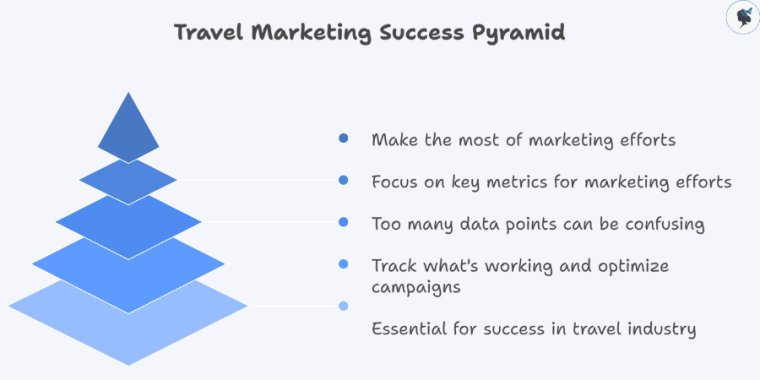
Travel marketing success pyramid
This guide breaks down the top metrics every travel marketer should track, with examples and actionable tips to help you make the most of your marketing efforts.
Website Traffic Metrics
Tracking your website’s traffic provides a clear picture of your brand’s online visibility and user engagement.
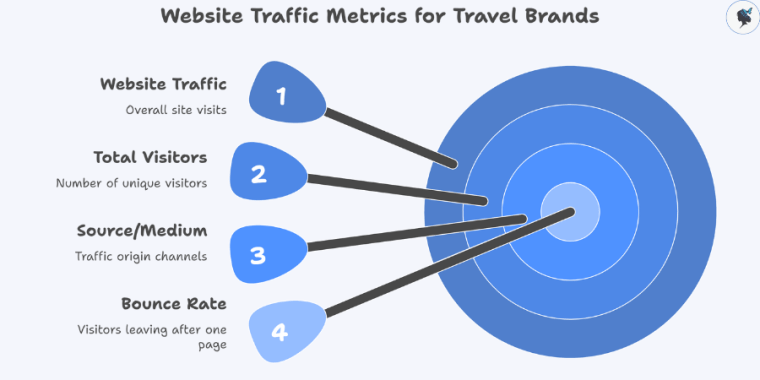
Website traffic metrics for travel brands
Total Visitors: This is the number of people visiting your site. Monitoring growth here helps gauge the effectiveness of your awareness campaigns. For example, a spike in visitors after launching a new Instagram campaign indicates successful cross-channel promotion.
Source/Medium: Understand where your traffic comes from—organic search, paid ads, social media, or referrals. This insight helps allocate budget effectively. If most visitors come from organic search, investing in SEO makes sense.
Bounce Rate: The percentage of visitors who leave after viewing only one page. A high bounce rate may suggest your landing pages need improvement or your audience targeting is off.
Wander Women Hot Tip: Use Google Analytics to segment traffic sources and identify your most valuable channels. Aim to reduce bounce rates by improving page load speed and creating compelling content.
Conversion Metrics
Conversions show how well your website turns visitors into customers or leads.
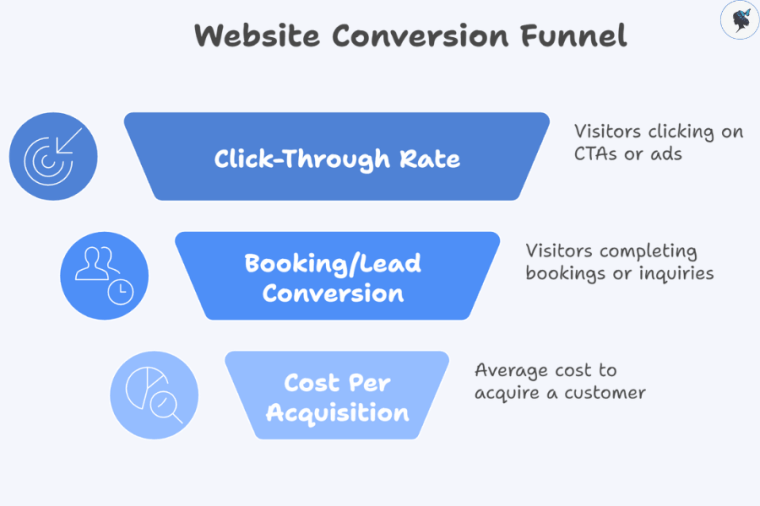
Website conversion funnel
Booking/Lead Conversion Rate: Track the percentage of visitors who complete bookings or submit inquiries. Improving this metric directly impacts revenue.
Click-Through Rate (CTR): Measures how often users click on your calls-to-action (CTAs) or ads. For example, a low CTR on a “Book Now” button might signal unclear messaging or poor placement.
Cost Per Acquisition (CPA): The average amount spent to gain a paying customer. Knowing your CPA helps optimize ad spend and marketing ROI.
Wander Women HotTip: Use conversion tracking tools like Google Ads Conversion Tracking or Facebook Pixel to monitor and optimize user journeys.
SEO Performance Metrics
SEO is crucial for attracting organic traffic, especially for travel brands targeting specific destinations or experiences.
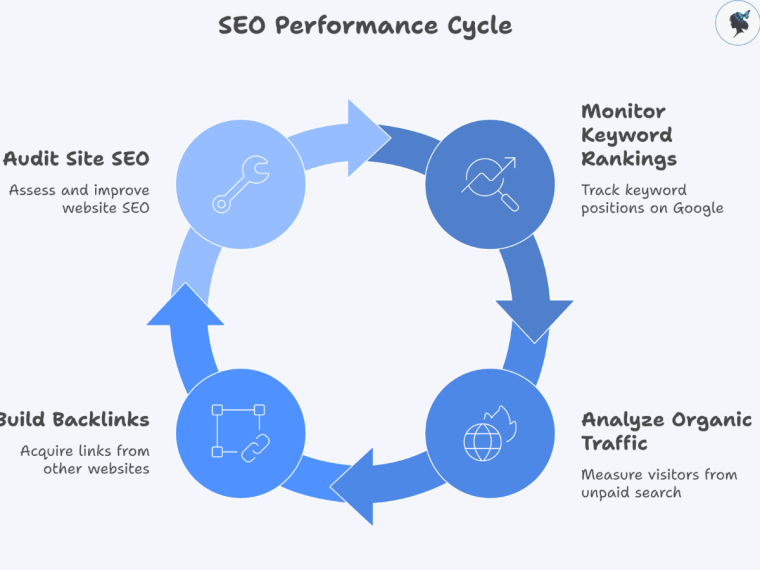
SEO performance cycle
Keyword Rankings: Monitor how well your targeted keywords rank on Google. Tools like Semrush or Ahrefs can track changes over time.
Organic Traffic: The number of visitors arriving through unpaid search results. Growth here indicates successful SEO strategies.
Backlinks: Quantity and quality of other websites linking to your site affect your search ranking and credibility.
Wander Women Hot Tip: Regularly audit your site’s SEO health and build backlinks through guest posts, partnerships, and high-quality content.
Social Media Metrics
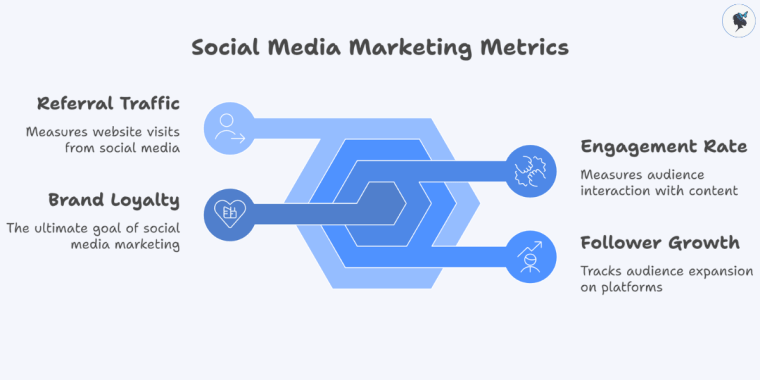
Social media drives engagement and brand loyalty in travel marketing.
Social media marketing metrics
Engagement Rate: This includes likes, comments, and shares relative to your follower count. High engagement signals resonant content.
Follower Growth: Track how fast your audience grows on platforms like Instagram, Facebook, or TikTok.
Referral Traffic: Measure how many visitors come to your site from social media posts.
Wander Women Hot Tip: Use native platform analytics (e.g., Instagram Insights) and tools like Sprout Social to analyze engagement and adjust your content strategy accordingly.
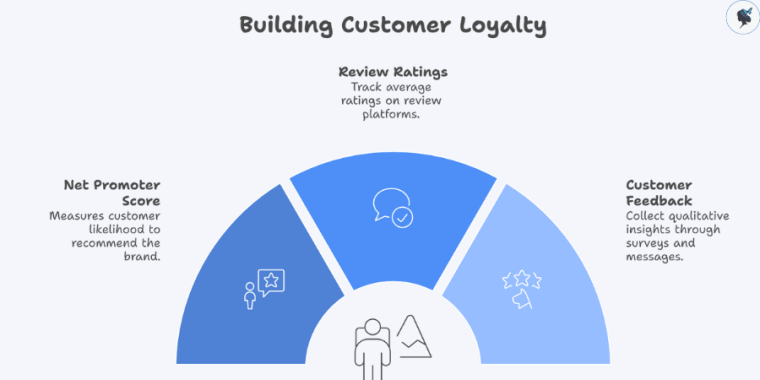
Net Promoter Score (NPS): Measures likelihood of customers recommending your brand. Scores above 50 are considered excellent.
Review Ratings: Track average ratings on platforms like TripAdvisor or Google Reviews to monitor brand reputation.
Customer Feedback: Collect qualitative insights through surveys or direct messages to uncover pain points and opportunities.
Wander Women Hot Tip: Actively respond to reviews and use feedback to improve your services, which boosts loyalty and referrals.
Advertising Metrics
Paid advertising fuels rapid growth but must be carefully managed.
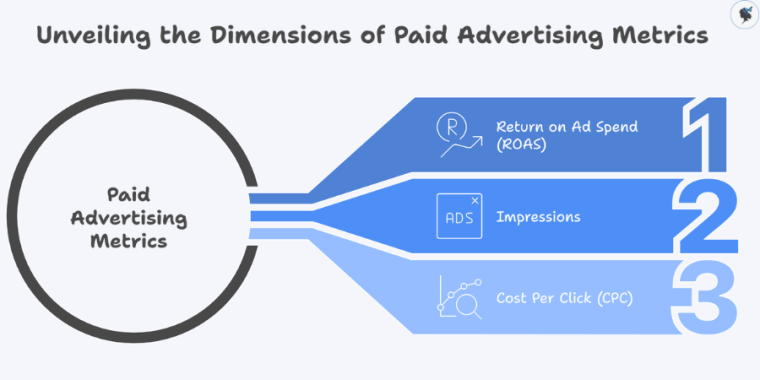
Unveiling the dimensions of paid advertising metrics
Return on Ad Spend (ROAS): Revenue generated per dollar spent on ads. A ROAS greater than 4:1 is often targeted in travel campaigns.
Impressions: How often your ads are shown. Useful for brand awareness metrics.
Cost Per Click (CPC): Average cost per ad click; lower CPC means more efficient spending.
Wander Women Hot Tip: Continuously test ad creatives and targeting options to maximize ROAS. Use A/B testing for best results.
Conclusion
Tracking these key metrics empowers travel marketers to make informed decisions, optimize campaigns, and grow their brands sustainably. Use the right analytics tools, regularly review your data, and adjust your strategies accordingly to stay competitive in the evolving travel marketplace.
Need help setting up analytics dashboards or interpreting your data? Contact us today!
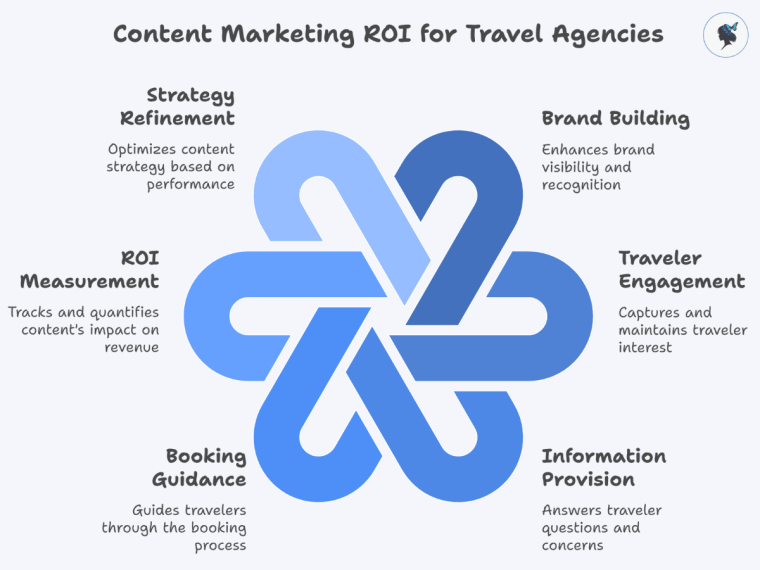
For travel agencies, content marketing is more than a brand-building exercise—it’s a revenue driver. Blogs, destination guides, social media posts, and videos all work together to engage travelers, answer their questions, and guide them toward booking. Yet, one of the biggest challenges agencies face is proving the ROI of content.
Content marketing ROI for travel agencies
Unlike paid ads, which provide immediate tracking of clicks and conversions, content often has a longer, more subtle influence on bookings. Travelers may read multiple blog posts, follow your social media, and download itineraries before making a reservation. Accurately attributing bookings and leads to these content interactions is essential to justify investment and refine strategy.
Wander Women Hot Tip: Start by auditing all your content channels—blogs, emails, social media—to identify where travelers first engage and how content contributes to the booking journey.
Why Content Marketing Matters for Travel Agencies
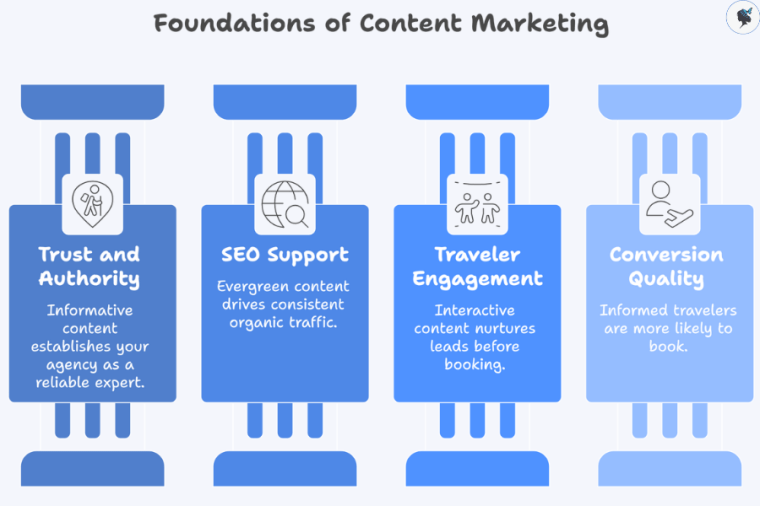
Content is the bridge between travelers’ curiosity and their decision to book. Here’s why it’s essential:
Foundations of content marketing
Builds Trust and Authority: Informative content like destination guides, tips, and itineraries positions your agency as an expert.
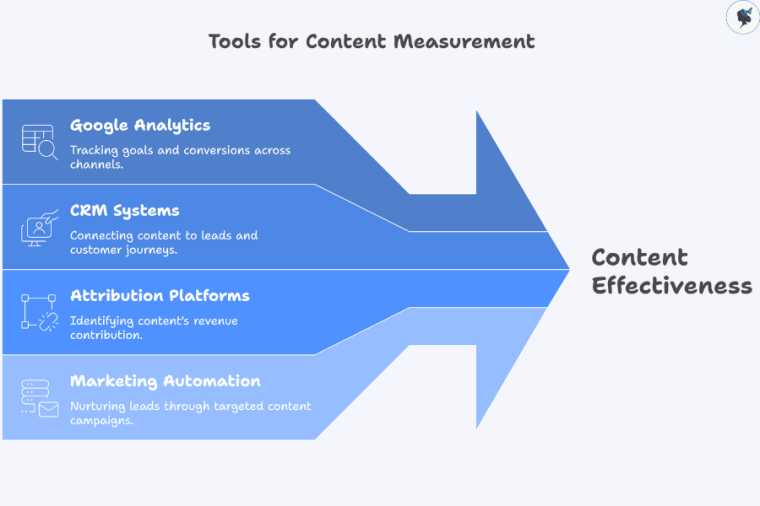
Provide advanced multi-touch attribution reporting.
Identify which content pieces contribute the most revenue.
Marketing Automation Tools
Track emails, clicks, and content interactions.
Nurture leads through targeted campaigns and monitor content’s influence.
Wander Women Hot Tip: Use UTM parameters on blogs, social posts, and emails to track exactly which content drives traffic and leads.
Case Studies: Successful Attribution in Travel
Example 1 – Major UK Travel Company
A UK travel company adopted a multi-touch attribution model to better understand how customers moved across channels before making a booking. By mapping the full customer journey—rather than relying on last-click attribution—the company was able to evaluate the true impact of blogs, email, paid media, and social touchpoints working together. This approach revealed how different channels contributed at various stages of the funnel, enabling the marketing team to make more informed budget decisions, optimize campaign performance, and demonstrate the real business value of their marketing efforts, even when individual channels were not the final point of conversion.
Example 2 – Travel Nevada
Travel Nevada, the state’s official destination marketing organization, demonstrated how email newsletters paired with strong content can drive measurable engagement. After revamping its email strategy with a greater focus on travel inspiration, itineraries, and visitor guides, the organization saw clear performance gains across key metrics. Email-driven sessions to the website increased by 23%, while requests for the official visitor guide rose by 150%, indicating deeper engagement from subscribers actively planning trips. The campaign also led to substantial growth in newsletter sign-ups and partner referrals, reinforcing the role of content-led email marketing in moving audiences from inspiration to meaningful action.
Example 3 – Regional Tourism Board
Atout France, in partnership with regional tourism boards such as Provence-Alpes-Côte d’Azur, used market and performance data to adjust seasonal campaigns and promote autumn and winter travel to the French Riviera and Provence. By shifting messaging toward off-season experiences and targeting travelers earlier in the planning cycle, the initiative increased interest and bookings during typically slower periods, demonstrating how data-driven campaign optimization can help stimulate off-season tourism.
Wander Women Hot Tip: Identify content that consistently appears in the conversion path and prioritize updates, promotion, or repurposing.
Actionable Tips to Improve Content Strategy Based on Attribution Insights
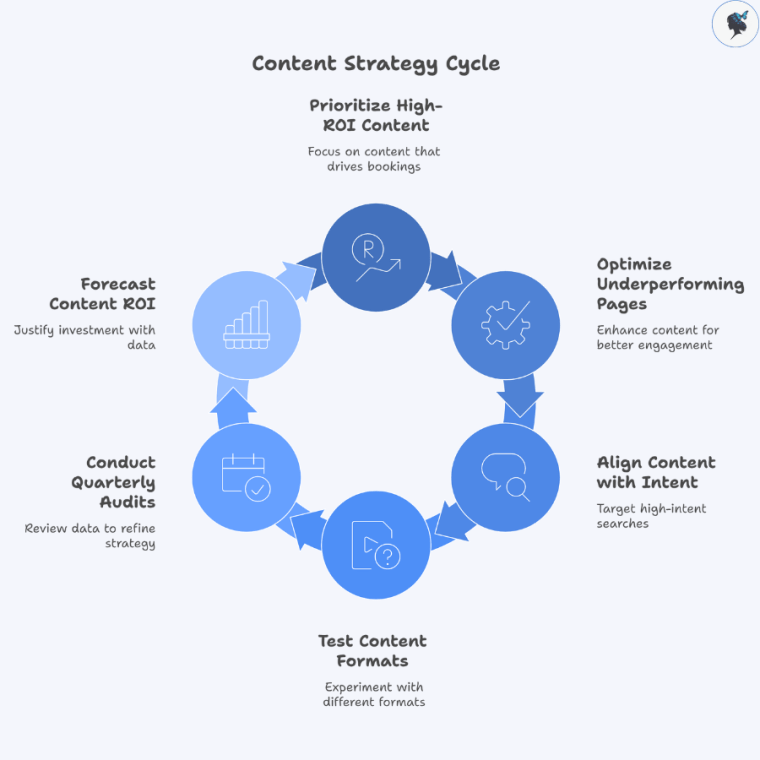
Content strategy cycle
Prioritize High-ROI Content: Focus resources on blogs, guides, and videos that consistently contribute to bookings.
Optimize Underperforming Pages: Update information, add calls-to-action, or reformat content to increase engagement.
Test Content Formats: Experiment with videos, infographics, or interactive maps, and monitor which formats drive leads.
Quarterly Audits: Regularly review attribution data to refine strategy and adjust budgets.
Wander Women Hot Tip: Use attribution insights to forecast content ROI for upcoming campaigns, helping justify investment to leadership or stakeholders.
Conclusion
Attributing bookings and leads to content is essential for travel agencies looking to justify content marketing investment. While content may not generate immediate conversions like paid ads, it often influences the traveler’s journey at multiple touchpoints.
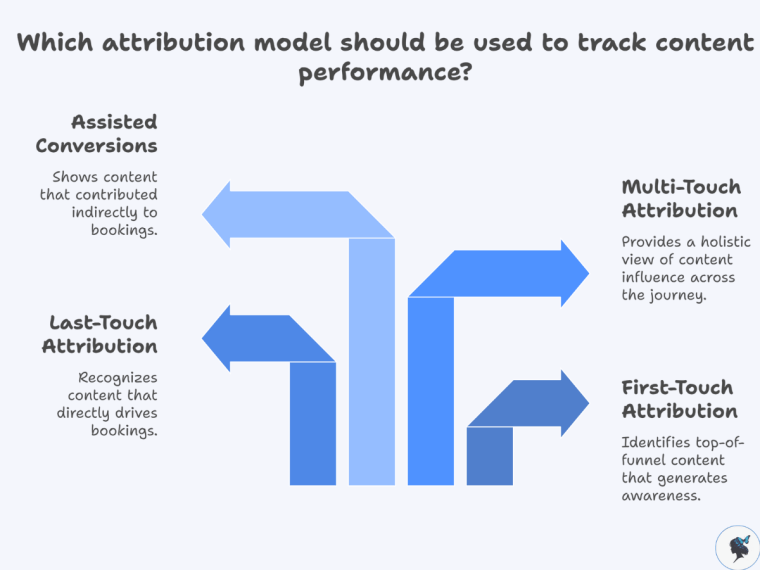
By implementing first-touch, last-touch, and multi-touch attribution, and leveraging analytics tools, agencies can:
Understand which content drives awareness and bookings
Optimize content strategy based on data-driven insights
Increase ROI and justify marketing spend
Final Wander Women Hot Tip: Start small by tracking first-touch and last-touch attribution, then scale to multi-touch for deeper insights. Treat your content as an investment that compounds over time, building trust, engagement, and ultimately, more bookings.
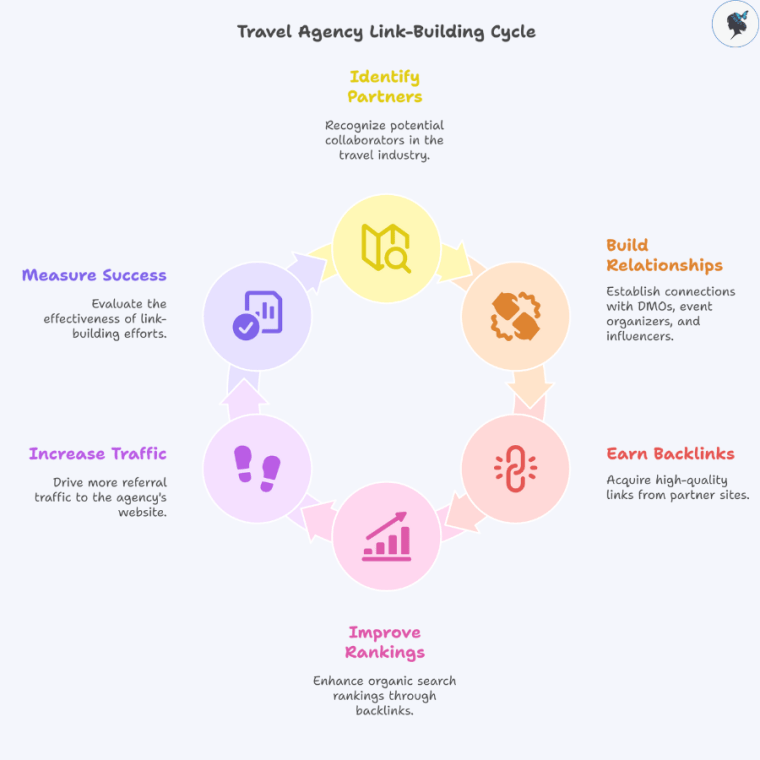
For travel agencies, achieving strong organic search rankings and sustainable referral traffic means going beyond standard on‑page SEO. One of the most effective ways to build authority and visibility is link‑building—earning high‑quality backlinks from relevant, authoritative sites in the travel world. According to recent data, link‑building remains a core long‑term ranking factor: 85 % of marketers believe link‑building is crucial for brand authority and ranking in the years ahead.
Travel agency link-building cycle
In the travel niche, however, not all links are equal. The best opportunities often come through industry‑specific relationships:
DMOs (Destination Marketing Organizations) that promote regions and destinations,
Event organizers whose pages attract travellers and local interest
Destination bloggers and influencers whose audiences align with your travel brand
This article will walk travel agencies through how to understand each partner type, how to approach realistic collaborations, and how to measure success.
Wander Women Hot Tip: Begin your link‑building plan by listing all the destinations you serve, the local DMOs, major events, and active destination bloggers in those areas. This gives you the raw partner pool to work from.
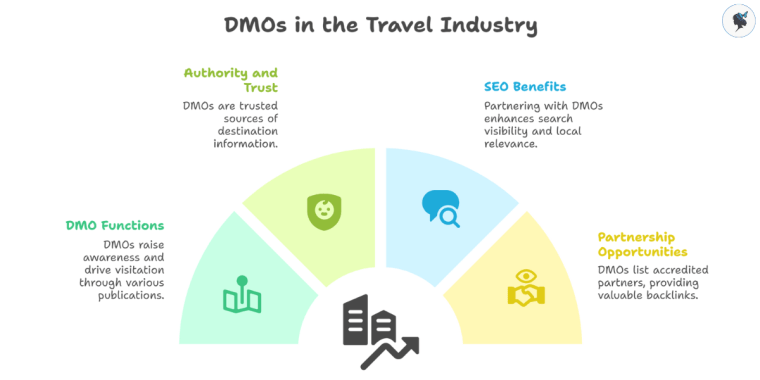
Destination Marketing Organizations are official or semi‑official bodies (city tourism bureaus, regional tourism offices, national destination boards) whose job is to raise awareness and drive visitation to a region. They publish destination guides, events calendars, partner directories, and often link out to businesses that service the local market.
DMOs in the travel industry
Role of DMOs in the Travel Industry
DMOs carry authority: they’re often trusted sources for destination information. Travel agencies that partner with them can benefit from backlinks from high‑authority regional domains, improved local relevance, and referral traffic from destination‑specific visitors. One guide notes that tourism SEO requires constant investment and dedicated content creation by DMOs for results. Because DMO pages often rank highly for destination keywords, securing links from them can give your agency a boost in search visibility for those locales.
Wander Women Hot Tip: For each DMO you target, check their Partners or Industry page and see if they list accredited tour operators or travel agencies. Having a presence there often equals a credible backlink.
2. Partnering with DMOs
How to Establish Partnerships
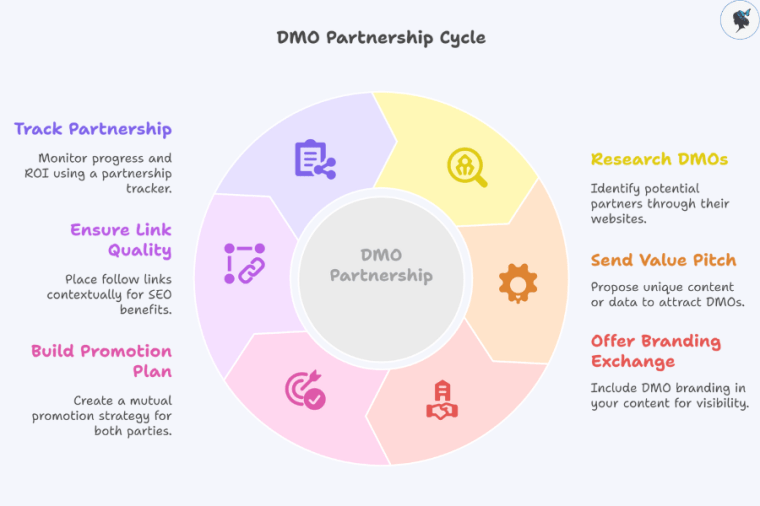
Research the DMO websites of each destination you target. Find their “Industry Partners,” “Tourism Trade,” or “Visit (Destination)” sections.
Send a pitch that adds value: propose co‑created content (e.g., “Top 10 Hidden Gems Tour for [Destination]” with your agency’s expertise) or offer unique data or insights (you’ve served X number of visitors last year).
Offer to include the DMO’s branding or link in your own travel‑guide content in exchange for a feature.
Build a mutual promotion plan: you feature their destination content, they link to your page or tour.
Ensure the link is follow (not nofollow) and placed contextually (within relevant content, not buried in a footer).
DMO partnership cycle
Potential Benefits
High‑authority backlinks from DMO domains will improve domain/authority score which helps your other pages.
Referral traffic from people interested in the destination.
Boost in local relevance: search engines interpret links from destination‑specific sites as signals of authenticity for your travel services.
Credibility and trust with potential travellers who see your agency associated with official destination partners.
Wander Women Hot Tip: Create a DMO partnership tracker: list DMO name, site URL, contact person, date contacted, proposal type, link outcome, and estimated domain authority. This keeps your outreach organised and your ROI measurable.
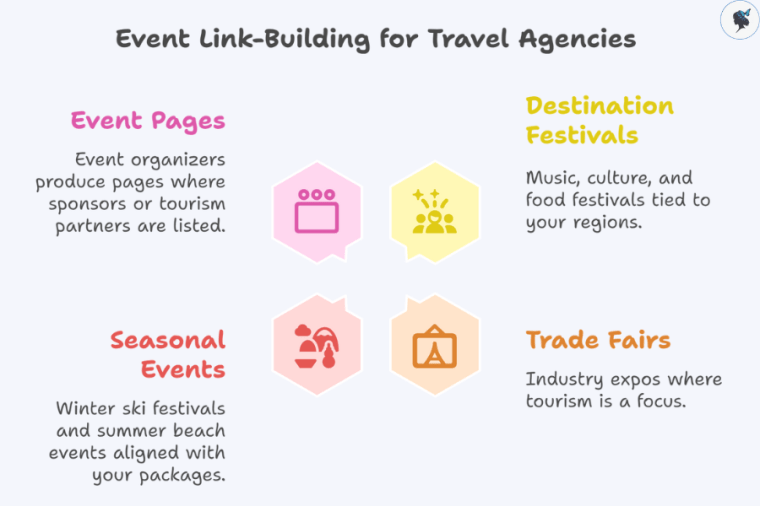
Travel agencies can also build links through local or destination events, such as:
Destination festivals (music, culture, food) tied to your regions.
Trade fairs or industry expos where tourism is a focus.
Seasonal events (winter ski festivals, summer beach events) aligned with your packages.
Event organizers often produce event pages or partner directories where sponsors or tourism partners are listed (with links).
Event link-building for travel agencies
Link‑Building Strategies with Events
Offer to produce a blog or guide about the event (eg, “Ultimate Guide to the X Festival in Y Region”), then ask the event organizer to publish or link to it.
Sponsor or co‑host an event: sponsorship often includes a link on the event site.
Provide media coverage: offer a post‑event review or recap which the event site may link to or embed.
Bundle the event with your travel offering: you create the tour + the event experience, then event organizer links to your agency as official partner.
Benefits for Travel Agencies
Context‑specific backlinks: links tied to an event in your destination signal relevancy.
Potential referral traffic from event audiences seeking travel services.
Fresh content opportunities (event guides) that are link‑worthy and shareable.
Opportunity to tap into the event’s marketing reach (social, email, partner links).
Wander Women Hot Tip: Build an event calendar for all your destination markets. For each event, note the event website, domain authority, potential for partner link, and ideal content topic (guide, recap, offer).
4. Engaging Destination Bloggers & Influencers
Identifying Influential Bloggers
Look for travel bloggers, micro‑influencers, and niche content creators who:
Focus on destinations or travel themes you sell (solo female travel, adventure, luxury).
Have a blog or website with decent authority (check Domain Rating/DR on Ahrefs).
Operate in your target destination region or serve your target audience.
Bloggers often link to travel agencies when reviewing tours, writing destination guides, or collaborating.
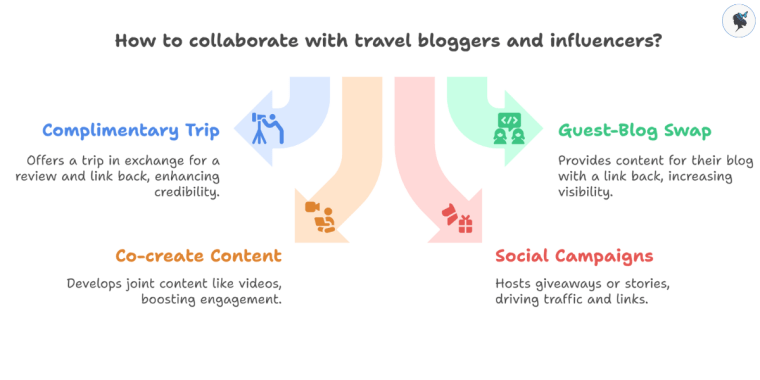
How to collaborate with travel bloggers and influencers?
Approaches to Collaboration
Offer a complimentary familiarisation trip or tour in exchange for a blog review + link back to your booking page.
Guest‑blog swap: you provide a destination guide for their blog and they link to your relevant service page.
Co‑create content: interview the blogger, create a video series about the region, then link it back.
Run social campaigns: the blogger hosts a “giveaway” or “travel story” featuring your agency and links to your website.
Backlinks from niche travel blogs can have high relevance and strong engagement signals.
Social amplification from bloggers’ followers can increase referral traffic and potentially links from other sites (link‑baiting).
Authentic user content: blogs are seen as more credible by travellers, increasing trust and the likelihood of conversion.
Wander Women Hot Tip: Start by engaging 3‑5 micro‑influencers (5k‑50k followers) in each destination. They often have higher engagement rates, are more approachable, and can deliver quality links and mentions for less budget. Scale the relationships once you see results.
5. Practical Execution: How to Implement These Strategies
Research & Targeting
Create a spreadsheet of all your target destinations.
For each destination, list the local DMO website, major upcoming event websites, and top 10 destination bloggers/blogs.
Qualify each target by Domain Authority (DA/DR), relevance to your niche, and the potential link placement.
Prioritise quick opportunities (low‑hanging fruit) that can deliver link placement within 3‑6 months.
Outreach Strategy
Craft personalised email templates for each partner type: DMO, event organizer, blogger. Highlight what you can bring (content, tours, audiences).
Offer value: “We will provide a destination guide, industry insights, photo assets.”
Follow up gently after 1 week, then 2 weeks. Maintain a CRM or tracking sheet.
When a link is secured, ensure it’s live, is “follow” (if possible), uses relevant anchor text (e.g., destination name + “Tours by [Your Agency]”), and is indexed.
Develop content pieces specifically for link building: destination partner page, event guide, blog collaboration.
Use supporting media: high‑quality images, video, infographic—making it more link‑worthy.
Ensure your website is ready: the target page (your own) is optimised with H1, descriptive text, internal links, and conversion CTA (booking form or contact).
Track each backlink: note placement date, anchor text, referring URL, monthly referral traffic from that link, and any ranking movement.
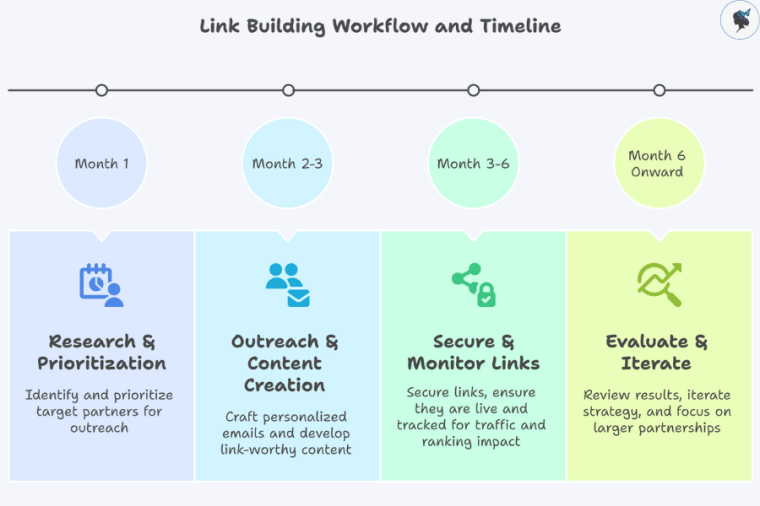
Workflow and Timeline
Month 1: Research & list target partners, prioritise.
Month 2‑3: Outreach to DMOs and event organisers; produce content.
Month 3‑6: Secure links, monitor referral traffic and ranking changes.
Month 6 onward: Evaluate results, iterate, focus on blogs and larger partnerships.
Wander Women Hot Tip: Use a simple link‑building dashboard (spreadsheet or BI tool) that tracks each link: Partner, URL, Domain Authority, Outreach Status, Go‑Live Date, Referral Traffic, Ranking Impact. Review monthly.
6. Measuring Success
Link‑building isn’t just about counting links—it’s about measuring impact.
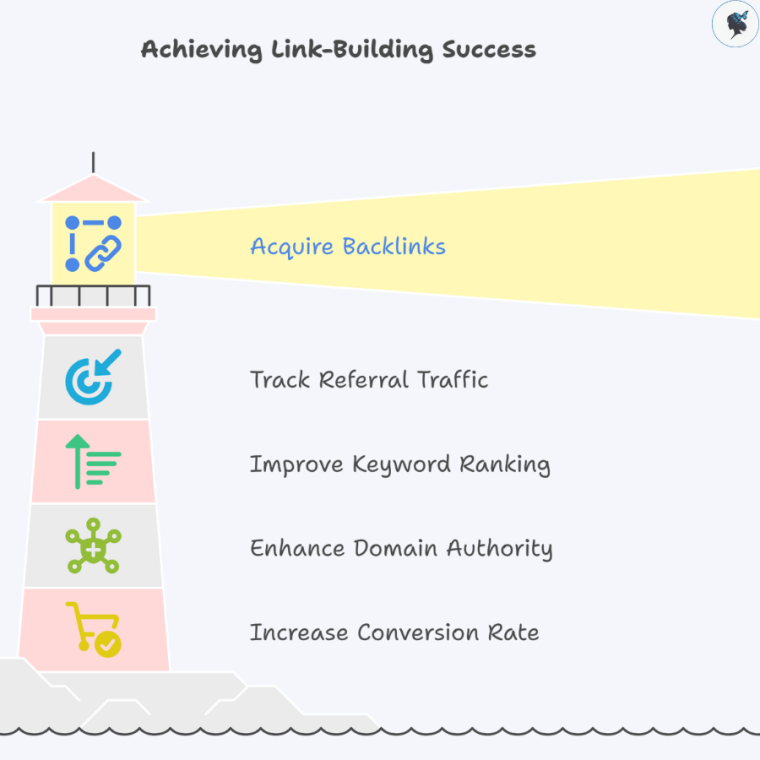
Achieving link-building success
Number of new backlinks acquired, broken down by source type (DMO, event, blogger).
Referral traffic from those backlinks.
Keyword ranking improvements for destination pages benefiting from the link(s).
Domain Authority/URL Rating improvement (via Ahrefs/SEMrush) over time.
Conversion rate from pages receiving referred traffic (are visitors booking?).
According to link‑building statistics, only 28% of link‑builders track revenue from links and just 46% report measurable results within 3‑6 months. Therefore, you need clearly defined KPIs and time the reports appropriately (some links take months to show impact).
Wander Women Hot Tip: Set a KPI milestone at 6 months for each link‑building campaign: “Ranking for target keyword improved by X positions”. If no movement, adjust strategy.
Conclusion
Link‑building is a strategic, high‑impact SEO tactic for travel agencies—but it works best when you leverage industry‑specific opportunities. By partnering with DMOs, collaborating with event organisers, and engaging destination bloggers, you can earn relevant backlinks, boost organic visibility, and drive referral traffic.
The key is realistic execution: research, target relevant partners, create value‑driven content, outreach thoughtfully, and measure success.
Wander Women Hot Tip: Pick one destination this quarter. Secure one DMO link, one event link, and one blogger collaboration for that destination, then compare performance after six months. Use that pilot to scale across your other destinations.
By treating link‑building as an ongoing, destination‑centric strategy rather than a one‑off task, your agency will build both credibility and visible SEO momentum in highly competitive travel search environments.
In the fast-paced world of travel, customer support isn’t just a department — it’s a critical part of the traveler experience. Studies show that about 60% of travelers say prompt and helpful customer support heavily influences their booking decisions. Delays, unanswered questions, or inconsistent service can quickly erode trust, leading travelers to switch to competitors.
For travel agencies, traditional support systems — staffed agents handling phone calls and emails — often struggle to provide timely, personalized service. The challenge intensifies during peak seasons, international holidays, or unexpected travel disruptions.
This is where Artificial Intelligence (AI) becomes transformative. AI-powered customer support, especially through chatbots and automated messaging, enables travel agencies to deliver personalized, 24/7 assistance, boosting customer satisfaction and engagement while gathering insights that improve marketing and content strategies.
AI-Powered Systems for 24/7 Customer Support
Significance of AI in Customer Support
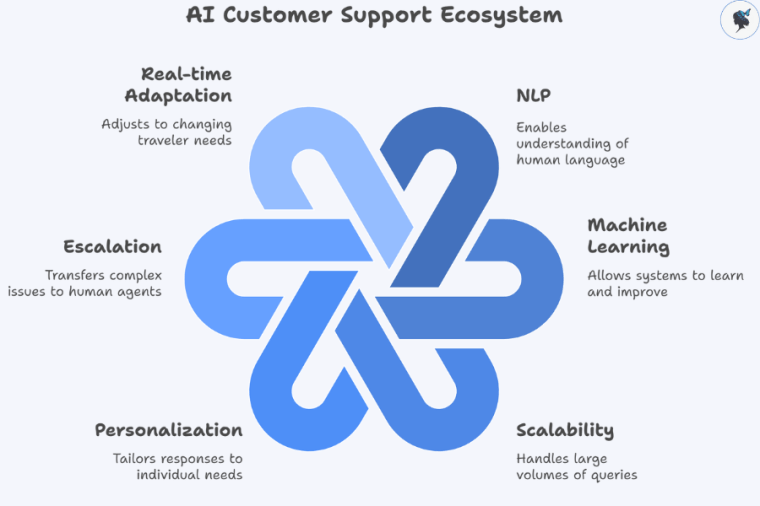
AI customer support ecosystem
AI customer support systems, powered by Natural Language Processing (NLP) and machine learning, are designed to understand and respond to traveler inquiries automatically. These systems can:
Handle large volumes of queries simultaneously, eliminating long wait times.
Provide responses based on past bookings, travel preferences, and context such as seasonal trends or current flight delays.
Escalate complex queries to human agents, while maintaining conversation context to ensure a seamless experience.
By combining automation with personalization, AI creates a support ecosystem that can adapt in real time to each traveler’s needs.
Benefits for Travel Agencies
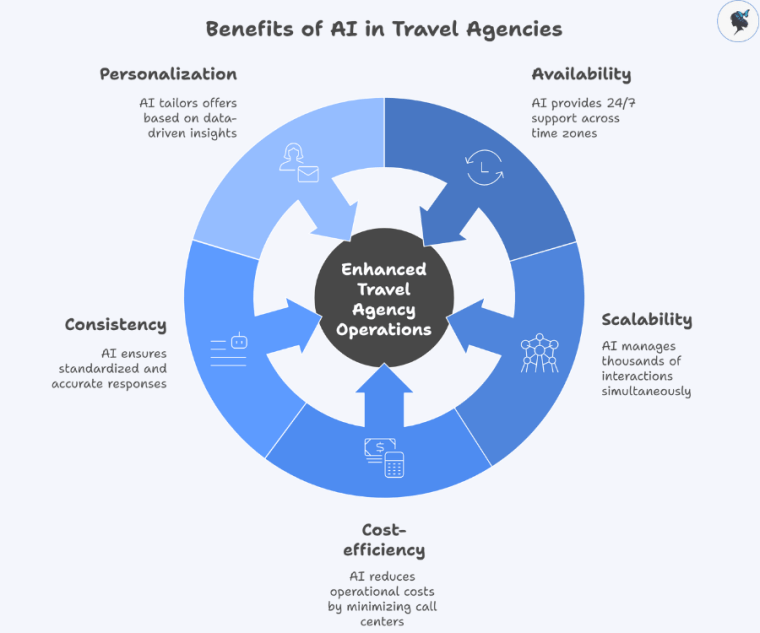
Benefits of AI in travel agencies
Availability: AI chatbots and automated systems provide instant support, anytime and anywhere — across multiple time zones.
Scalability: A single AI system can manage thousands of simultaneous interactions, a feat impossible for human teams alone.
Cost-efficiency: Reduces operational costs by minimizing the need for extensive call centers.
Consistency: AI ensures standardized, accurate, and on-brand responses across all communication channels.
Data-driven personalization: Every interaction gathers valuable data, helping agencies tailor future offers, email campaigns, and content recommendations.
These advantages make AI not only a customer service tool but also a strategic driver for content personalization, guiding travelers with suggestions, insights, and promotions that reflect their unique preferences.
Expedia is at the forefront of using AI to enhance customer support. Their AI chatbots help travelers with:
Booking modifications
Refund requests
FAQs about destinations, travel policies, and promotions
The Expedia chatbot also analyzes traveler interactions to provide personalized recommendations, suggesting hotels, flights, or activities based on past searches and preferences. This not only improves the traveler experience but also increases conversion rates.
Booking.com
Booking.com uses AI-powered support to handle millions of queries globally across its website, app, and messaging platforms. Key features include:
Instant responses for common inquiries like reservation changes, payment issues, and local travel tips.
Learning from interactions, refining recommendations for future personalized communications.
This approach reduces wait times, improves booking satisfaction, and builds trust — critical for retaining repeat travelers.
Lessons for Travel Agencies
Travel agencies can adopt AI support gradually:
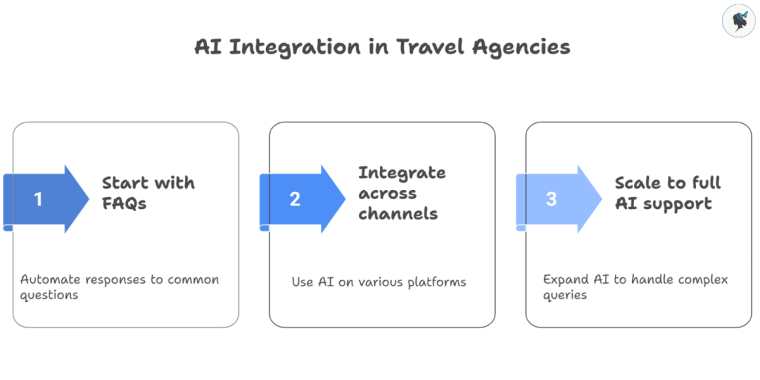
AI integration in travel agencies
Start with FAQs: Automate responses to common questions about bookings, destinations, or policies.
Integrate across channels: Use AI on your website, mobile app, and messaging platforms like WhatsApp or Facebook Messenger.
Scale to full AI-driven 24/7 support: Once successful, expand to handle complex queries and provide real-time, personalized recommendations.
Even small agencies can leverage AI to match the responsiveness of global platforms, making them more competitive and customer-centric.
How AI Enhances Travel Personalization Through Customer Support
AI-powered support doesn’t just respond — it personalizes the travel experience. Here’s how:
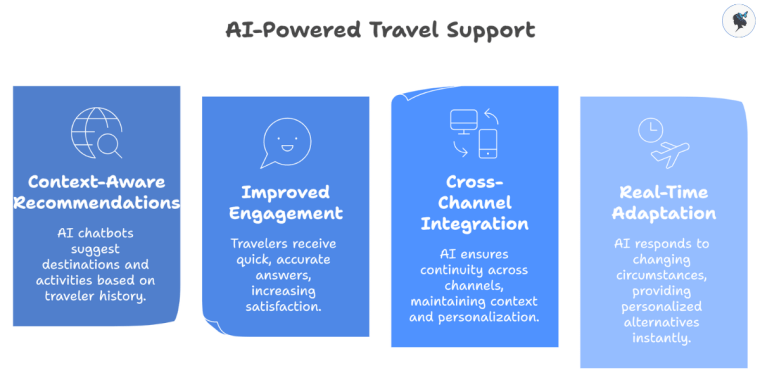
AI-Powered travel support
Context-Aware Recommendations
AI chatbots can suggest destinations, activities, and deals based on traveler history and preferences.
Example: A traveler who previously booked a beach holiday may receive a message recommending a tropical getaway during peak season, with suggestions for family-friendly accommodations.
Improved Engagement
Travelers receive quick, accurate answers, increasing satisfaction and encouraging further interaction.
AI can also send proactive messages, such as reminders about upcoming trips, check-in notifications, or local event suggestions.
Cross-Channel Integration
AI ensures continuity across channels. Whether a traveler interacts via mobile app, website, or messaging platform, the system maintains context and personalization, avoiding repeated questions or confusion.
Real-Time Adaptation
AI can respond to changing circumstances — flight delays, cancellations, or last-minute deals — providing personalized alternatives instantly.
Example: “Your flight to Rome has been delayed. Here’s a suggested activity to enjoy while you wait, based on your past preferences.”
Benefits of AI-Powered Customer Support
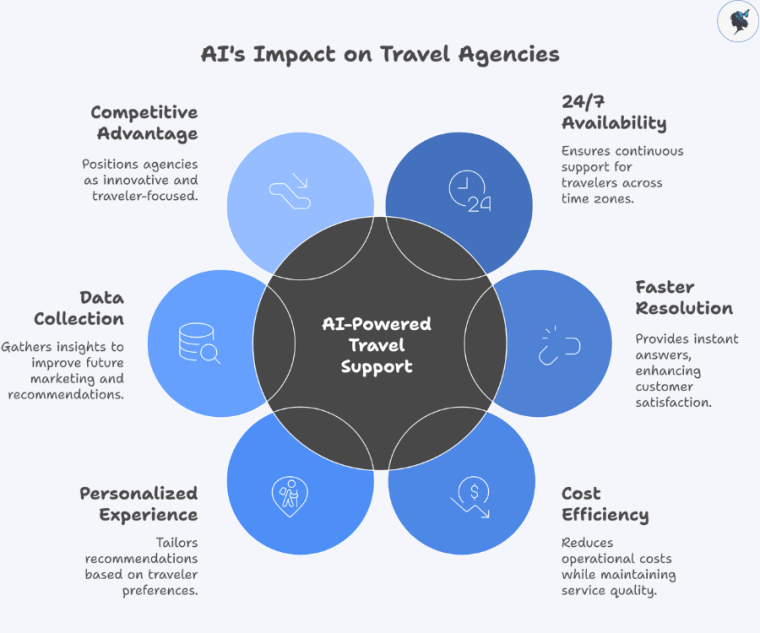
AI’s impact on travel agencies
24/7 Availability
AI chatbots provide round-the-clock support, critical for international travelers across multiple time zones.
Faster Resolution
Instant answers reduce frustration, prevent churn, and increase trust in your agency.
Cost Efficiency
AI reduces the need for large customer support teams while maintaining high-quality service.
Personalized Traveler Experience
AI leverages past bookings, preferences, and interactions to tailor recommendations and support messages.
Data Collection and Insights
Each interaction generates data, informing future email campaigns, website content, and destination recommendations.
Competitive Advantage
Travel agencies implementing AI support can match the responsiveness and personalization capabilities of major players like Expedia and Booking.com, positioning themselves as innovative and traveler-focused.
Implementing AI Customer Support in Your Travel Agency
Implementing AI customer support
Identify Common Queries
Audit your current support requests to determine which questions are repetitive or high-volume.
Examples: booking changes, cancellation policies, visa requirements, hotel info.
Refine AI models based on feedback and changing traveler behavior.
Transforming Travel Experiences with AI Customer Support
AI-powered customer support is more than a tool — it’s a strategic asset for travel agencies seeking to enhance personalization. By combining 24/7 availability, instant resolution, and data-driven personalization, AI systems improve traveler satisfaction, engagement, and loyalty.
Travel agencies should start exploring AI-driven chatbots and automated support systems today. Begin by automating FAQs, integrate across multiple channels, and progressively implement personalized recommendations to meet traveler expectations and gain a competitive edge.
In today’s travel industry, personalization isn’t a “nice-to-have” — it’s an expectation. Modern travelers expect offers, content and communications that reflect their interests, previous trips, budget, and style. For travel agencies, this shift means moving beyond generic email blasts or one-size-fits-all newsletter templates. That’s where artificial intelligence (AI) steps in. By analysing user behaviour, past bookings and contextual data, AI can transform how travel agencies craft and deliver highly personalized travel content — especially via email campaigns. In this post, we’ll explore how AI works in the travel space, dig into how it drives email personalization, examine a leading case study, outline the clear benefits for travel agencies, and provide actionable implementation steps. If you’re aiming to boost engagement, conversion and customer loyalty through smarter email marketing — this is for you.
Understanding AI in Travel
What is AI?
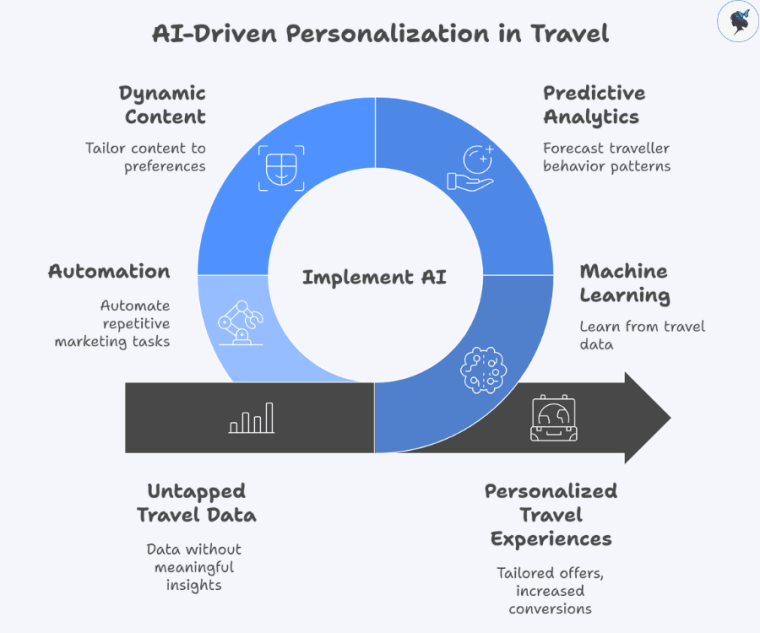
Artificial Intelligence (AI) refers broadly to computer systems that can perform tasks typically requiring human intelligence: learning from data, recognising patterns, making predictions, and sometimes generating content. Within travel marketing, AI often looks like machine-learning models, predictive analytics, dynamic content generation and automation of repetitive tasks.
AI-driven personalization in travel
Relevance of AI in the Travel Industry
The travel industry is awash with data: traveller profiles, booking histories, preferences, search queries, seasonal trends and more. But gathering data isn’t enough — the real value comes from turning that data into meaningful insights and tailored experiences. According to research, the market for AI-driven travel experience personalization was valued at around USD 3.61 billion in 2024, with a projected CAGR of 22.3% from 2025-2032. Furthermore, AI-driven personalisation in tourism marketing has been shown to deliver conversion increases of up to 20-25%. This means for travel agencies: AI isn’t futuristic—it’s already reshaping how travellers engage, how offers convert, and how content must be crafted.
AI-Driven Email Personalization: The Future of Targeted Travel Campaigns
The Role of AI in Email Marketing
Email remains one of the most effective channels for travel agencies: you own the list, you control the message, you can guide travellers from email → landing page → booking. But generic blasts no longer cut it. According to a 2024 study, personalised emails delivered 6× more transactions than non-personalised ones. Here’s how AI upgrades email marketing for travel agencies:
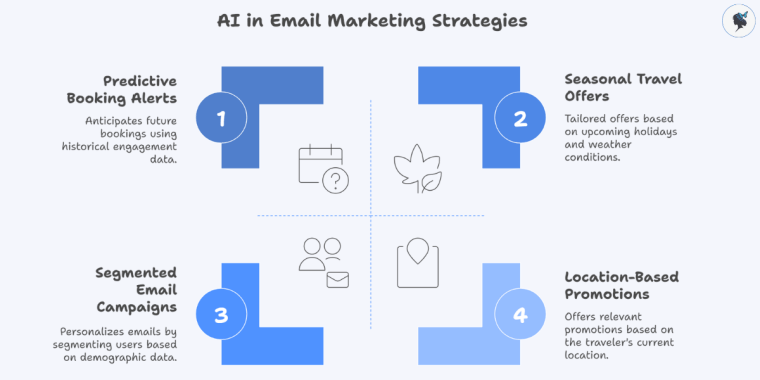
Ai in email marketing strategies
Behavioural analysis: AI examines how travellers have previously engaged — which destinations they viewed, which trip types they booked, what emails they clicked, what content they ignored.
Demographic & profile data: Age, travel frequency, solo vs family, preferred style (luxury, budget, adventure) feed into segmenting and personalising offers.
Contextual data: Seasonality, upcoming holidays, weather, location, time of day — AI uses this to send more timely and relevant messages (for example: “City break escapes for early Autumn” rather than generic “Summer deals”).
Predictive modelling: AI anticipates when a traveller is poised to book again — and sends the right message at the right time.
Dynamic content generation: Email subject lines, body copy, images and CTA buttons can all be tailored per recipient, improving relevance and engagement.
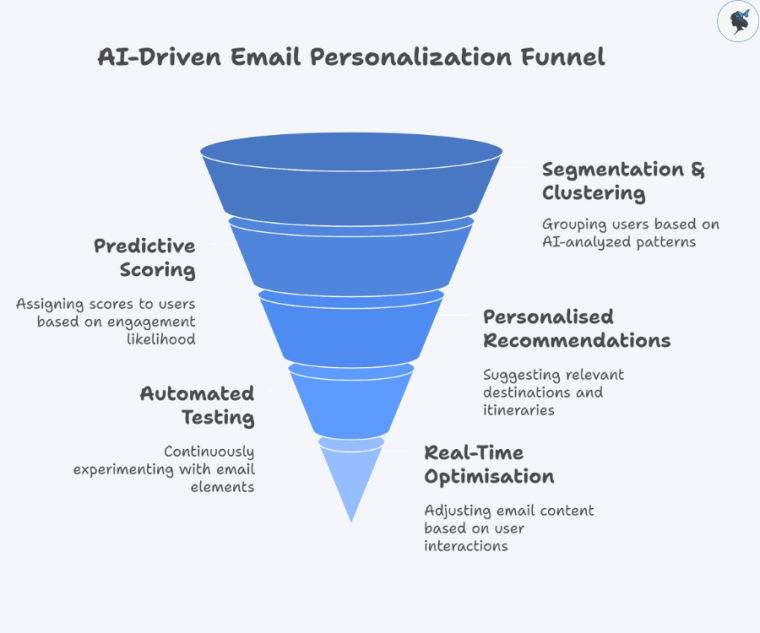
Segmentation & clustering: Rather than manual segments (“families”, “solo travellers”), AI creates ever-changing clusters based on behaviour, intent and patterns.
Predictive scoring: Assigns scores to each user (likelihood to engage, likelihood to book), enabling prioritised targeting.
Personalised recommendations: Based on past behaviour and preferences, the AI suggests destinations or itineraries the traveller is most likely to respond to.
Automated A/B and multivariate testing: AI continuously experiments with subject lines, send times, visuals, copy, and learns which variant performs best — automatically.
Real-time optimisation: If a traveller clicks on a city-break email and visits your site, the next email can adjust its content accordingly (e.g., offering hotel options in that city).
For travel agencies, leveraging AI in email campaigns means the difference between “Here are 100 generic trip deals” and “Here’s a hand-picked 5-day itinerary in Lisbon that matches your food-lover profile, budget and family size”. The latter builds trust, improves conversion, and drives up lifetime value.
Case Study: BrazeAI Decisioning Studio — AI-Powered Optimization for Personalized Engagement
Overview of BrazeAI Decisioning Studio
BrazeAI Decisioning Studio is an AI marketing automation platform that specialises in self-learning personalization for email and other channels. They replace traditional A/B testing with machine-learning models that continuously optimise each offer. Their clients span hospitality, travel, retail and other industries.
How it Works
The AI analyses individual-level data: past transactions, engagement metrics, preference data.
It identifies which offer type (discount vs upgraded package vs loyalty reward) appeals to which user.
It picks the best send time, channel (email, push, SMS) and subject line for each user.
It adapts over time — learning what works for each segment and improving campaign performance.
Application in the Travel Industry
Imagine a travel agency uses BrazeAI Decisioning Studio:
They pull data on who has booked adventure trips versus beach holidays versus city breaks.
The AI segments newsletter recipients by these profiles.
For the “adventure seekers” segment: an email goes out with a subject line like “Ready for your next adrenaline rush? See our Peru trekking deals”, sent on Wednesday morning when this segment historically opens most.
For “family beach holiday” segment: an email offers early-bird booking for summer escapes, subject line “Family summer fun: 3 nights free if you book by June!”.
The results: higher open rates, higher click-throughs, stronger conversions. Travel agencies report boosted engagement and improved ROI thanks to AI-personalized offers.
Why This Matters
Shows real use of AI in automating what was previously manual and guesswork-driven.
Demonstrates how email content becomes “smart” — personalised and adaptive, rather than one-size-fits-all.
Travel agencies gain a strategic asset: targeted messaging based on data and AI insights, not just gut feel.
Benefits of AI-Personalized Emails for Travel Agencies
Let’s break down the advantages your agency can expect when you adopt AI-driven email personalization.
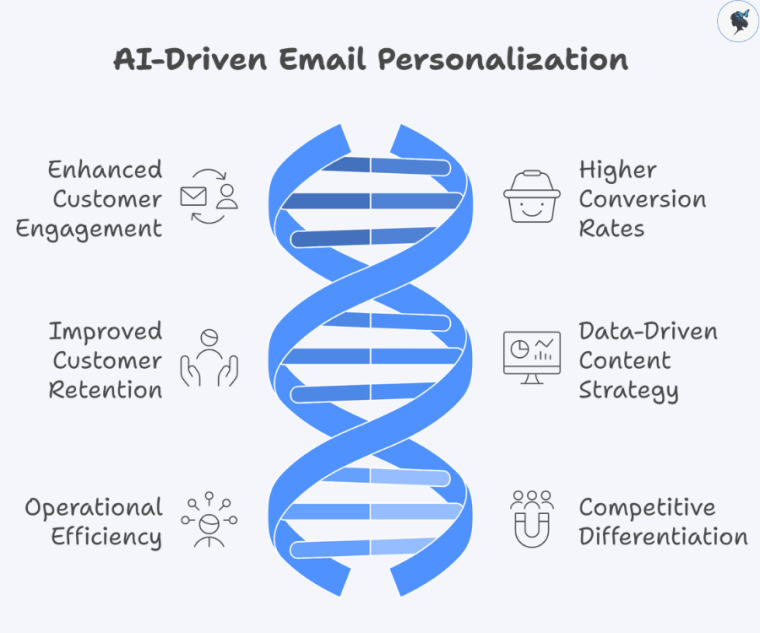
Data-Driven Content Strategy Email AI tools generate insights about what travellers are responding to: destinations, trip types, content formats. This shapes blog topics, landing pages and future campaigns.
Operational Efficiency Automation means less manual segmentation, fewer generic blasts, and more time for creative strategy and high-value client interactions.
Competitive Differentiation Agencies embracing AI-driven personalization position themselves as tech-forward, customer-centric, and likely ahead of competitors still doing mass newsletters.
Implementation Strategies: How Travel Agencies Can Adopt AI-Driven Email Personalization
Here’s a practical step-by-step roadmap to help your travel agency get started.
AI email personalization implementation
Step 1: Audit and Consolidate Your Data
Gather data from your CRM, booking system, website analytics, email engagement history.
Ensure you have permissions, data hygiene and structure in place (GDPR compliance if operating in EU).
Identify key traveler-attributes you want to leverage: destination preferences, trip type, budget, companion type (solo, family, couple), past email engagement.
Step 2: Choose the Right AI Email Personalization Platform
Look for tools that integrate with your existing stack, support dynamic content, predictive modelling and automated optimisation. A few examples:
BrazeAI Decisioning Studio (for automated offer testing & personalization)
Mailchimp (offers AI features for subject lines and send time optimisation)
HubSpot (Marketing Hub with AI email personalization)
Wander Women Hot Tip: Ensure the tool supports your scale, data privacy needs and travel-specific requirements.
Step 3: Develop Dynamic Content Assets
Build a library of destination content, trip types, visuals, itineraries and offers.
Ensure flexible modules in your emails: dynamic placeholders for destination, budget tier, traveller segment.
Create copy templates tuned for traveller personas (family, solo adventure, luxury couple, etc.).
Use the AI platform to pull these modules and assemble tailored emails per recipient.
Step 4: Segment & Test — Start Small, Scale Fast
Pick one segment to start (e.g., “frequent travellers who booked city breaks last two years”).
Send control email (generic offer) and AI-personalised email side-by-side. Measure open, click and conversion rates.
Gradually expand to other segments as you learn what works.
Use AI’s automated testing to refine subject lines, send times and content blocks.
Step 5: Integrate with Your Broader Marketing Ecosystem
Synchronise email personalization with landing pages: the same traveller who clicks “family beach holiday” should land on a page with tailored content.
Integrate with your social media retargeting and chatbot efforts so the message is consistent across channels.
Use email insights to inform blog content: “Top 5 beach locations this segment clicked on” → blog post with tailored content for that audience.
Step 6: Monitor, Analyse & Optimize
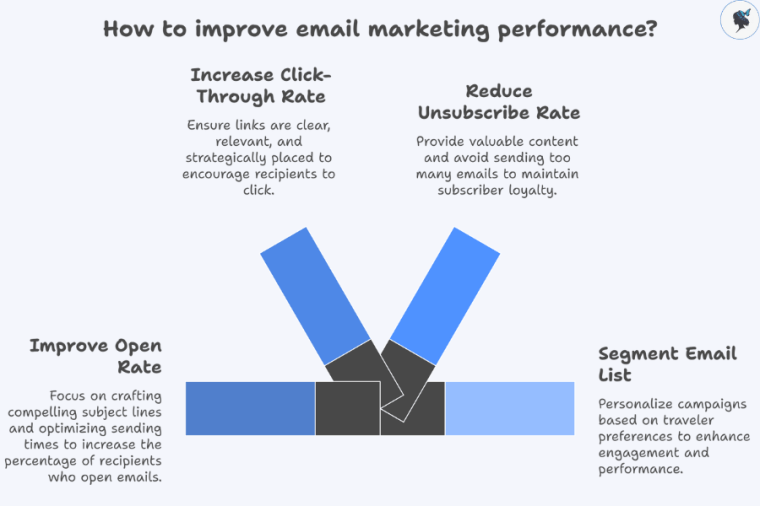
Track KPIs: open rate, click-through rate, conversion rate (bookings from email), engagement depth, unsubscribe rate.
Use AI platform reports to identify what travel segments perform best and what offers resonate.
Ensure data privacy and compliance: travellers may be increasingly sensitive to how their data is used. Maintain transparency.
Conclusion
In a travel world where consumers expect tailored experiences and instant, relevant communications, AI-driven email personalization offers a major leap forward. By leveraging traveller behaviour, preferences and contextual data, travel agencies can transform their email campaigns from “just another deal” into meaningful, customised journeys that resonate. Platforms like OfferFit demonstrate how AI can power smarter segmentation, offer optimisation, dynamic content and clearer ROI. The benefits are clear: higher engagement, improved conversions, stronger loyalty, deeper content insights and operational efficiency. If you’re reading this and wondering “Where do we start?” — here’s your prompt: begin with your data, pick an AI tool, build dynamic content templates, choose one test segment and run a personalised campaign. Measure the results. Then scale. Personalisation is no longer optional — it’s expected. And with AI, your agency can deliver it at scale. Embrace AI for your travel-email strategy and watch your content, engagement and bookings soar.