How to Increase Organic Traffic to Your Travel Blog with Internal Linking


▶ Table of Contents

Introduction

When it comes to growing your travel blog, most people think of writing more content, targeting trending keywords, or sharing posts on social media. But there’s a powerful SEO tactic that many travel bloggers overlook: internal linking. Not only is it free, but it’s also one of the most effective ways to improve your blog’s visibility on Google, keep readers engaged longer, and guide them through your content like a well-planned itinerary.

Internal linking is the practice of linking one page of your website to another. For a travel blogger, this means connecting your Bali packing list to your Bali itinerary post or linking your digital nomad visa guide to your article about working remotely in Portugal. Done strategically, internal linking boosts your site’s structure, helps search engines understand your content hierarchy, and improves keyword rankings.

In this post, we’ll break down how to increase organic traffic to your travel blog using internal linking. We’ll walk you through five key strategies, provide real travel blog examples, and share stats to show just how impactful this technique can be.

So grab your metaphorical backpack—we’re going on an SEO journey!


Section 1: Understand the Power of Internal Linking for SEO
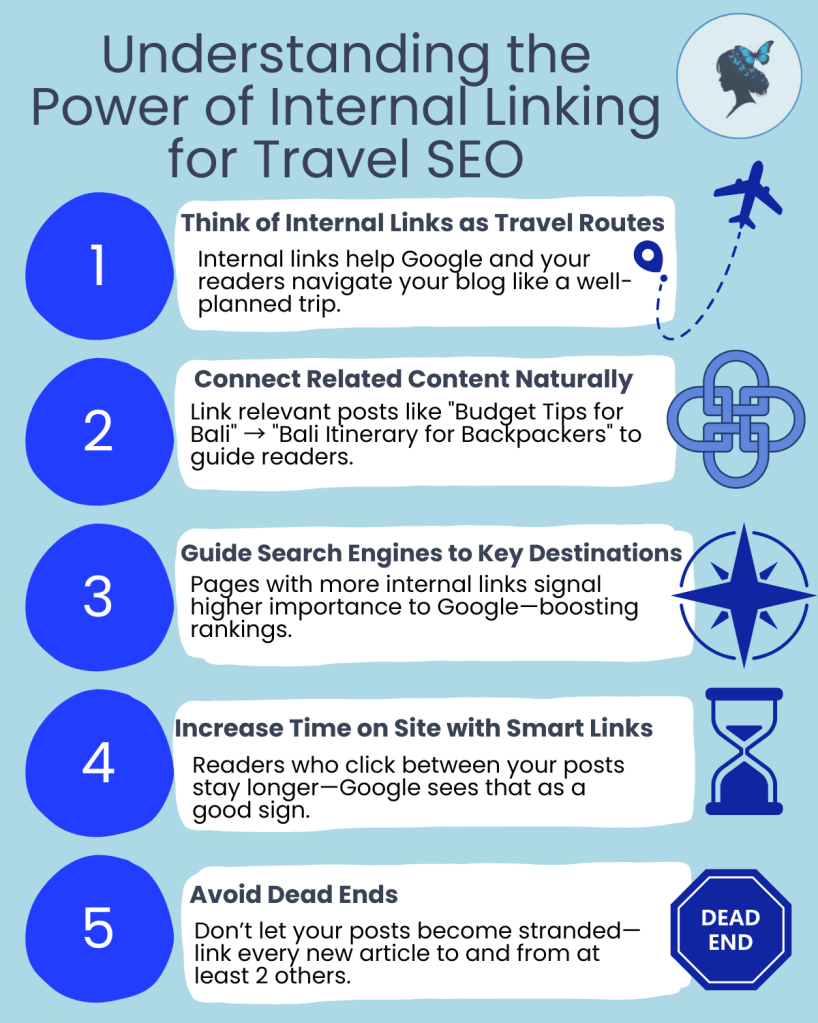
The SEO Backbone of Your Travel Blog Internal linking plays a vital role in helping search engines crawl your site and understand the relationship between your content. When Google finds consistent links pointing to a specific post—say, “10 Things to Do in Tulum”—it begins to view that post as authoritative. Think of internal links as the roads that connect your blog posts into a navigable map. Without them, your blog becomes a maze of isolated pages, harder for both readers and bots to explore.

From One Destination to Another
Imagine you’ve written a post on “Backpacking Through Southeast Asia.” If you mention Thailand in that post, it’s a golden opportunity to link to your guide on “Island Hopping in Thailand.” Not only does this improve SEO by linking relevant content, but it also increases the time readers spend on your site—a signal Google loves.

In fact, Backlinko’s comprehensive guide on internal linking highlights its importance in helping Google discover, index, and understand all the pages on your site. Strategic internal linking can also distribute page authority to important pages, enhancing their visibility in search results.

Why Travel Blogs Benefit More Than Most
Travel content is naturally interconnected. A post about Rome can link to packing tips, gelato recommendations, or rail passes in Italy. This kind of structure mimics the planning process of real travelers. By creating clusters of related posts and linking between them, you’re not just pleasing search engines—you’re enhancing the user experience by making your blog feel like a personal travel assistant.


What Are Topic Clusters?
A topic cluster is a group of related articles built around a core “pillar” post. For example, a “Complete Guide to Japan Travel” could be your pillar page, supported by linked posts on Tokyo food tours, Kyoto temples, and navigating the Shinkansen. This approach creates a strong semantic relationship between your articles, which helps search engines understand your niche expertise.

Japan Cluster
Let’s say your pillar post is “Ultimate Japan Travel Itinerary.” Under that, you’ve written supporting posts like “What to Eat in Osaka,” “Cherry Blossom Season in Japan,” and “How to Use a Japan Rail Pass.” By linking each supporting post back to the main itinerary—and vice versa—you’re signaling to search engines that this is a comprehensive, well-structured topic.
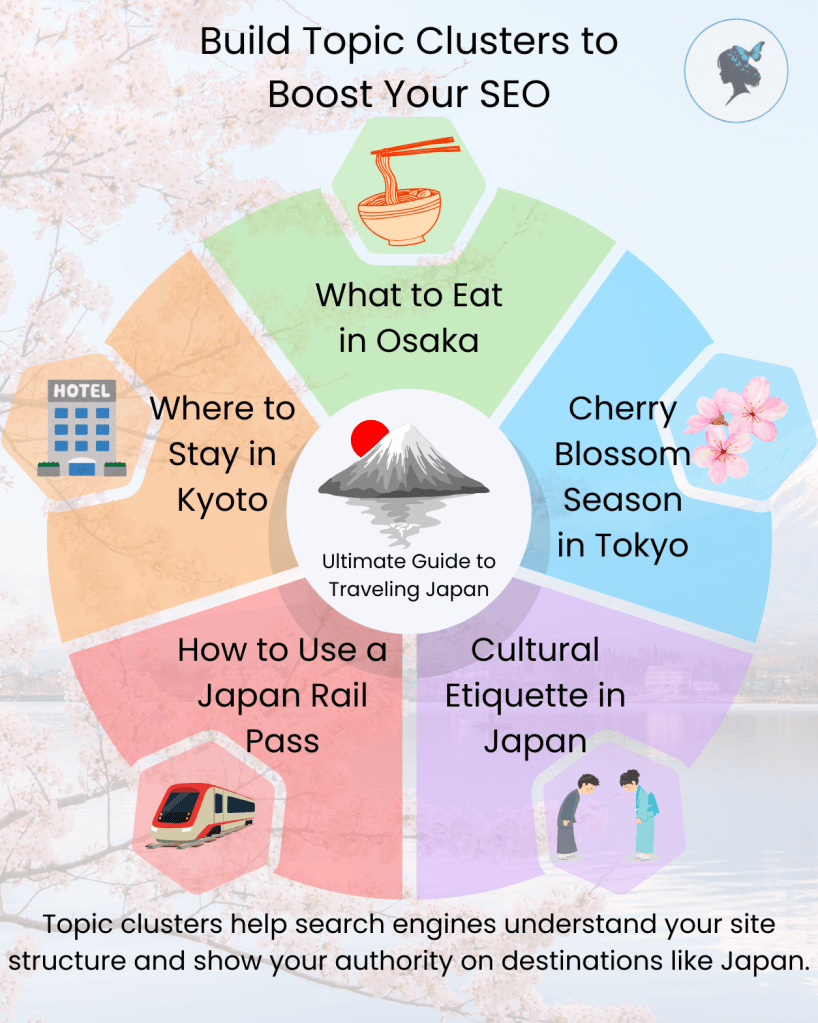
HubSpot reports that topic cluster strategies can improve organic traffic by up to 51% over three months.

Keep It Natural, Not Forced
While it’s tempting to link every time you mention a related destination, overdoing it can feel spammy. Instead, think about how readers actually plan trips. If someone’s reading about budget hostels in Paris, would they also benefit from a link to your post on how to use public transit in France? If the answer is yes, link it! Keep the connections logical and helpful.

You also might be interested in our post: content every travel website should have.


Section 3: Use Anchor Text Strategically (Without Being Spammy)

What Is Anchor Text and Why It Matters
Anchor text is the clickable word or phrase that links to another page—like when you write, check out this Italy itinerary. It tells both users and search engines what kind of content they can expect. Using keyword-rich anchor text can boost SEO rankings for the target page, but only when done naturally.

Smart Anchor Text for Travel Content
Instead of linking phrases like “click here” or “this post,” use descriptive text. For example, rather than writing “read more about it here,” link with “guide to the Amalfi Coast.” This tells Google exactly what the page is about. In the travel niche, strong anchor text might look like: best time to visit Iceland, things to do in Marrakech, or digital nomad visa for Portugal.

According to Google, good anchor text is descriptive, reasonably concise, and relevant to the page that it’s on and to the page it links to.

Avoid Over-Optimization
While using keywords in anchor text is great, don’t use the exact same phrase repeatedly across your blog. Google could view this as manipulative. Mix it up: use variations like “where to stay in Bali,” “top Bali hotels,” or “Bali accommodations.” This keeps your content fresh and user-friendly while avoiding potential penalties.

Why Some Posts Deserve More Links
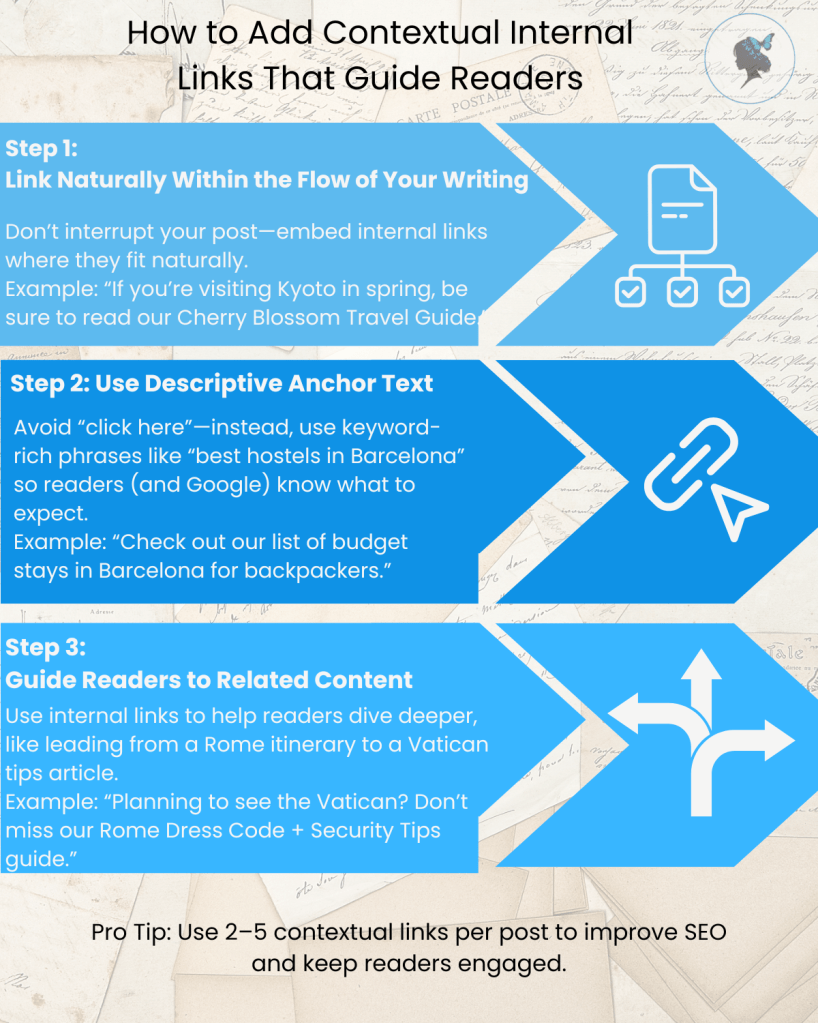
Not all blog posts are created equal. Some consistently bring in traffic, generate email sign-ups, or lead to affiliate conversions. These are your “high-value” pages, and internal linking can help amplify their performance. For example, if your “Ultimate Carry-On Packing List” gets consistent Pinterest traffic, link to it often from other related content.

Monetizing with Affiliate Travel Guides
Let’s say you wrote a post on “Best Travel Backpacks for Europe.” If that post includes affiliate links and converts well, you should link to it from other relevant posts like “2-Week Interrail Itinerary” or “Packing Tips for Hostels.” Every internal link increases the chances of clicks and conversions.

According to a 2021 study by Orbit Media, internal links can increase affiliate page revenue by up to 20%.
Create an Internal Linking Habit
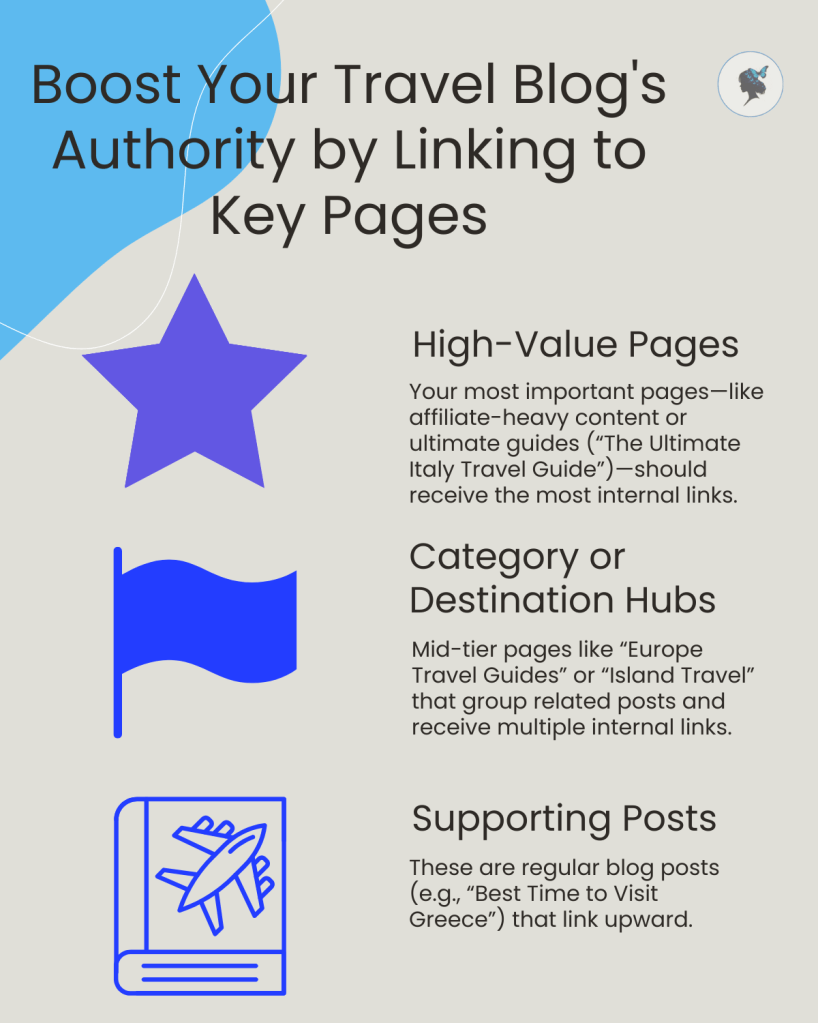
Each time you publish a new travel post, review older posts and look for logical places to insert links. For instance, if you just published “Weekend Getaway in Prague,” go back to your “Best European Cities for Foodies” post and add a link. This ongoing linking habit builds authority across your blog and keeps old content fresh.


Use Google Search Console for Insight
You don’t have to guess whether your internal links are working. Google Search Console shows which pages are getting the most clicks and which internal links lead to traffic increases. Look at which posts rank well and check their “linked pages” to see where you might be missing opportunities.
Adjusting Based on Data
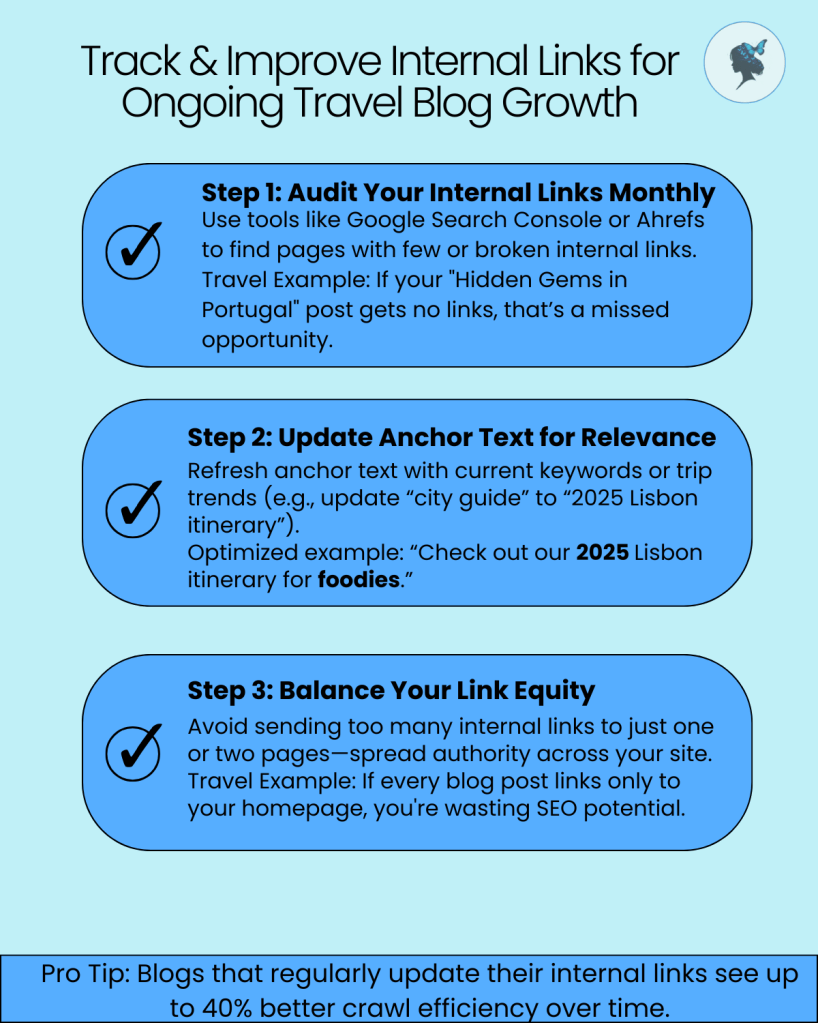
Let’s say your post on “Hiking Cinque Terre” starts ranking higher after you added five internal links pointing to it. That’s no accident—it’s proof that linking strategy works. Over time, you’ll spot patterns. Maybe posts linked in the first paragraph perform better than links buried at the bottom. Keep tweaking!

Use Plugins to Automate and Audit
If you’re on WordPress, plugins like Link Whisper can help automate internal linking suggestions and even show you orphaned posts (pages with no links pointing to them). This is especially useful for larger travel blogs.

According to Search Engine Journal, cleaning up and optimizing internal links can boost traffic by up to 40%. Set a reminder to review and optimize links quarterly—it’s an easy SEO win.


Conclusion

Internal linking might not be as flashy as writing about the latest trending destinations or snapping perfect Instagram photos, but it’s one of the most reliable and scalable ways to grow your organic traffic. By guiding your readers from one helpful post to another, you’re not just boosting your SEO—you’re creating a thoughtful, intuitive travel experience.

Think of it this way: every internal link is like a footpath between two points on a map. The more paths you create, the easier it is for your readers (and Google!) to explore everything your travel blog has to offer. Whether you’re sharing packing tips, destination guides, or digital nomad resources, linking your content together creates a cohesive ecosystem that builds trust and authority.

So next time you hit “publish,” don’t stop there. Revisit old posts. Add meaningful links. Build topic clusters. Track what’s working. These small efforts, done consistently, can lead to big results—like higher Google rankings, more email sign-ups, better affiliate revenue, and a loyal community of readers who stay for the journey.

Need more help with internal linking? Contact us today!

Competitor Keyword Analysis for Travel Companies: Discover Your Competitive Advantage

In today’s highly competitive digital landscape, travel businesses face the constant challenge of standing out online. Whether you’re a luxury tour operator, a travel agency, or an eco-tourism provider, understanding your competitors’ keyword strategies can be the key to gaining an edge in the market. Competitor keyword analysis allows you to identify the terms and phrases that your competitors are targeting, revealing opportunities to enhance your SEO and content strategies.

In this article, we’ll dive deep into competitor keyword analysis, show you how to perform it effectively, and explain its significance for travel companies.


▶ Table of Contents
  1. What is Competitor Keyword Analysis?
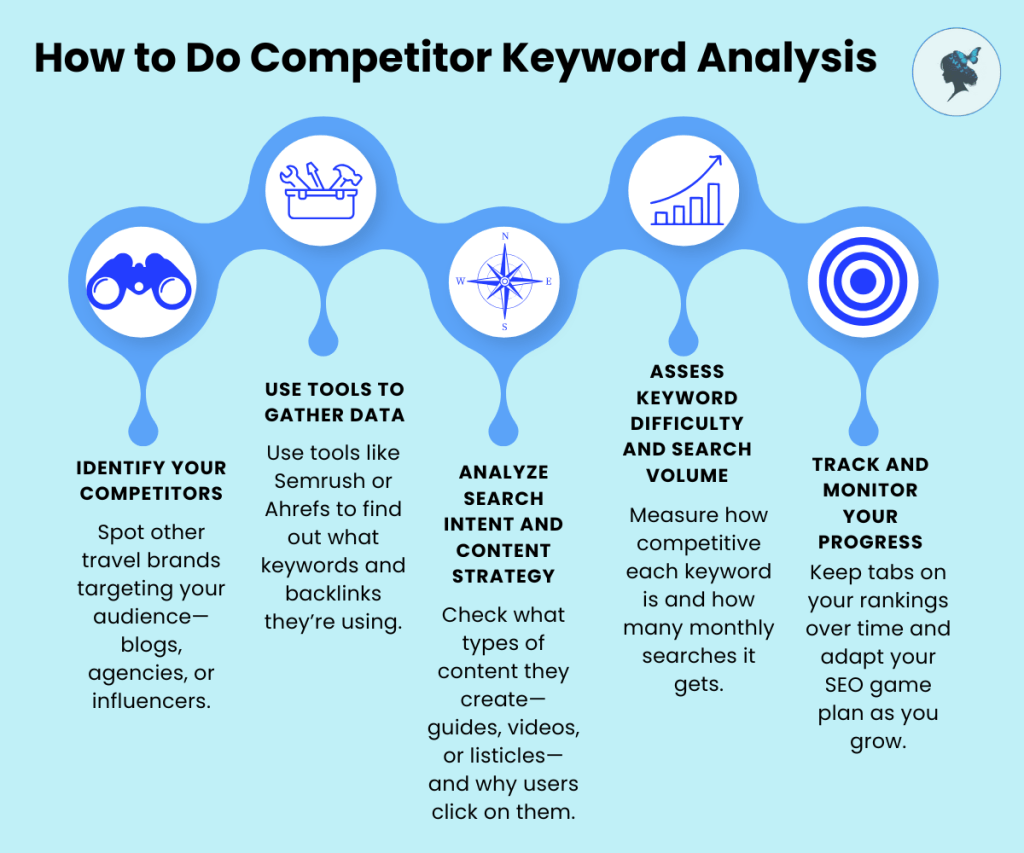
  2. How to Do Competitor Keyword Analysis for Your Travel Company
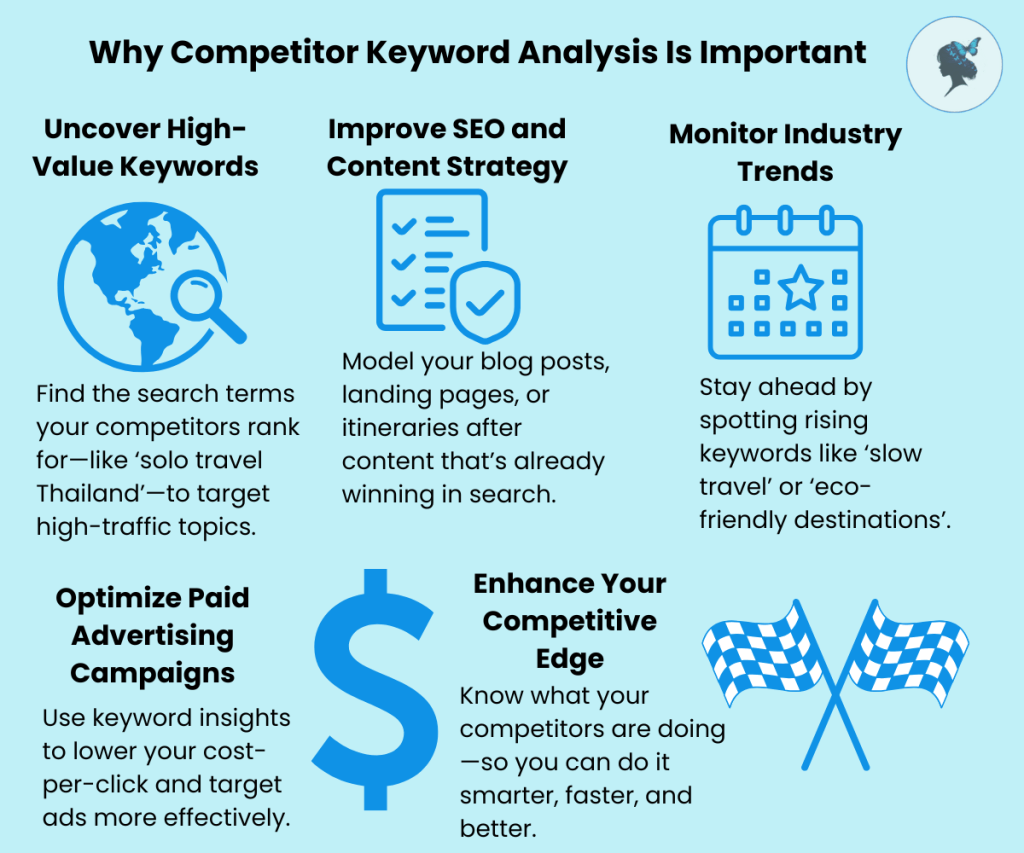
  3. Why Competitor Keyword Analysis is Important for Travel Companies
  4. Take Action with Wanderer’s Watchlist: Start Outranking Your Competitors Today

What is Competitor Keyword Analysis?

Competitor keyword analysis involves researching and examining the keywords that your competitors are ranking for in search engines. By identifying the terms that are driving traffic to their websites, you can gain valuable insights into their SEO strategies and uncover potential opportunities for your own business.

For travel companies, competitor keyword analysis isn’t just about seeing what keywords your rivals are using. It’s about understanding the types of content and services they are offering and how they are positioning themselves within the search results. This process can also highlight keyword gaps—terms or topics your competitors might be missing, which you can leverage to get ahead in search rankings.

The Components of Competitor Keyword Analysis

Competitor keyword analysis typically includes the following components:

  • Identifying Target Keywords: The first step is discovering which keywords your competitors are ranking for, whether through organic search or paid campaigns.
  • Comparing Keyword Difficulty: Understanding how difficult it is to rank for certain keywords and whether they align with your business goals.
  • Tracking Search Volume: Knowing the search volume for keywords to determine their potential to drive traffic to your website.
  • Assessing SERP Features: Analyzing how keywords are appearing on the search engine results pages (SERPs)—for instance, whether they trigger featured snippets, local packs, or video carousels.

By gathering this information, you can better understand where to focus your efforts and which keywords offer the most promise for your travel business.


How to Do Competitor Keyword Analysis for Your Travel Company

Effective competitor keyword analysis requires a systematic approach. Below, we’ll walk you through the steps of conducting a thorough keyword analysis that can boost your travel SEO strategy.

Step 1: Identify Your Competitors

Before you can begin analyzing your competitors’ keywords, you need to identify who they are. As a travel company, your competitors might not only include other businesses in the travel sector but also any site that targets your ideal customer. This could include:

  • Direct Competitors: Other travel companies that offer similar services, such as local tour operators, online travel agencies, or niche travel businesses.
  • Indirect Competitors: Websites, blogs, or review platforms that may not offer direct services but are still competing for your target audience’s attention, such as travel bloggers or influencers in the travel space.

Use tools like Google Search, Semrush, Ahrefs, and Moz to identify who ranks for the keywords you’re interested in. Take note of businesses that show up on the first page, as these are your main competitors for that particular keyword.

For more information, check out our post: competitor identification for travel companies.

Step 2: Use SEO Tools to Gather Competitor Data

Once you’ve identified your competitors, it’s time to gather keyword data. Use SEO tools like Semrush, Ahrefs, SpyFu, and Moz to collect the following information:

  • Organic Keywords: Identify the keywords your competitors are ranking for organically.
  • Paid Keywords: Determine which keywords your competitors are targeting with paid ads (if applicable).
  • Keyword Gaps: Look for opportunities where your competitors are missing out on key keywords that are relevant to your business.

By using tools that provide a detailed overview of your competitors’ keyword strategies, you’ll be able to build a more robust and targeted SEO plan for your own travel business.

Step 3: Analyze Search Intent and Content Strategy

Competitor keyword analysis is not just about the keywords themselves but understanding the search intent behind them. Search intent refers to the goal or purpose behind a user’s search. There are four main types of search intent:

  • Informational: The user is looking for information, e.g., “best places to visit in Paris.”
  • Navigational: The user is looking for a specific website or brand.
  • Transactional: The user is looking to book, buy, or make a purchase, e.g., “book a Bali tour online.”
  • Commercial Investigation: The user is researching options before making a purchase, e.g., “luxury tours in Italy reviews.”

By analyzing the keywords your competitors are targeting and the content they are producing, you can determine if they are focusing on the right search intent for their audience. For example, if your competitors are ranking well for transactional keywords but failing to target informational keywords, this may present an opportunity for your business to capitalize on.

Read our guide: Mastering Search Intent in the Travel Industry.

Step 4: Assess Keyword Difficulty and Search Volume

Not all keywords are created equal. It’s important to evaluate the difficulty of ranking for each keyword as well as its search volume:

  • Keyword Difficulty: This metric tells you how competitive a keyword is. You want to target keywords that have a relatively low difficulty but still drive significant traffic.
  • Search Volume: This refers to the number of searches a keyword gets each month. High search volume is appealing, but highly competitive keywords might be harder to rank for.

Use keyword research tools like Semrush, Ahrefs, or Google Keyword Planner to analyze both metrics. Prioritize keywords that balance lower competition with high search volume, as these are likely to provide the best ROI for your travel business.

Don’t forget about Long-Tail keywords!

Step 5: Track and Monitor Your Progress

Competitor keyword analysis is an ongoing process. SEO trends change, and your competitors’ strategies evolve. It’s essential to continuously track your own rankings and compare them against your competitors. Set up regular checks on keyword rankings, monitor changes in competitor strategies, and adjust your approach accordingly.


Why Competitor Keyword Analysis is Important for Travel Companies

For travel businesses, competitor keyword analysis is a game-changer.

Uncover High-Value Keywords

By analyzing your competitors’ keyword strategies, you can identify profitable keywords that may have been overlooked in your own strategy. These gaps—whether it’s a specific destination, service, or type of travel experience—could drive valuable traffic to your website and increase bookings.

Improve SEO and Content Strategy

Competitor keyword analysis allows you to refine your SEO and content strategy. If you discover that your competitors are ranking well for certain long-tail keywords, you can create high-quality content around these terms to increase your visibility. This approach can help you rank for keywords you may not have targeted initially and attract customers who are looking for exactly what you offer.

By keeping an eye on the keywords your competitors are targeting, you can stay updated on the latest trends in the travel industry. For instance, if multiple competitors are focusing on a specific type of travel, such as solo travel or luxury cruises, it may signal a growing trend that you should capitalize on.

Optimize Paid Advertising Campaigns

If your competitors are using paid search ads, competitor keyword analysis allows you to assess their ad copy, target keywords, and bidding strategies. By understanding their paid strategies, you can better position your own ads to target high-converting keywords and avoid bidding wars on highly competitive terms.

Enhance Your Competitive Edge

By knowing what keywords your competitors are ranking for, you can refine your own SEO strategy to outperform them. Competitor keyword analysis helps you optimize your content for the keywords that matter most, ensuring your travel business stands out in search results.


Ready to Unlock Your Competitive Edge?

If you’re ready to take your travel business to the next level and dominate the search rankings, contact us today to learn more about how we can help you identify the right keywords, optimize your content, and outsmart your competitors.


Travel Marketing Myths

(and Wander Women Hot Takes That Set the Record Straight)


▶ Table of Contents
  1. and Wander Women Hot Takes That Set the Record Straight
  2. SEO Myths Travel Brands Still Believe
  3. Content Strategy Myths Holding You Back
  4. Social Media Myths We Need to Stop Believing
  5. Travel Biz & Marketing Myths That Slow Growth
  6. Conclusion

Why These Myths Matter: In the ever-evolving world of travel marketing, outdated advice is everywhere. SEO “best practices” that once worked, content hacks from 2015, and social media tips from influencers who don’t actually sell travel services. It’s easy for travel brands to fall into traps that cost time, money, and visibility. At Wander Women Strategies, we’re here to clear the fog. Below, we’re breaking down the most common myths in travel marketing—across SEO, content strategy, social media, and business fundamentals. For each myth, we offer a no-fluff reality check: our own Wander Women Hot Take. Let’s dive in.


SEO Myths Travel Brands Still Believe

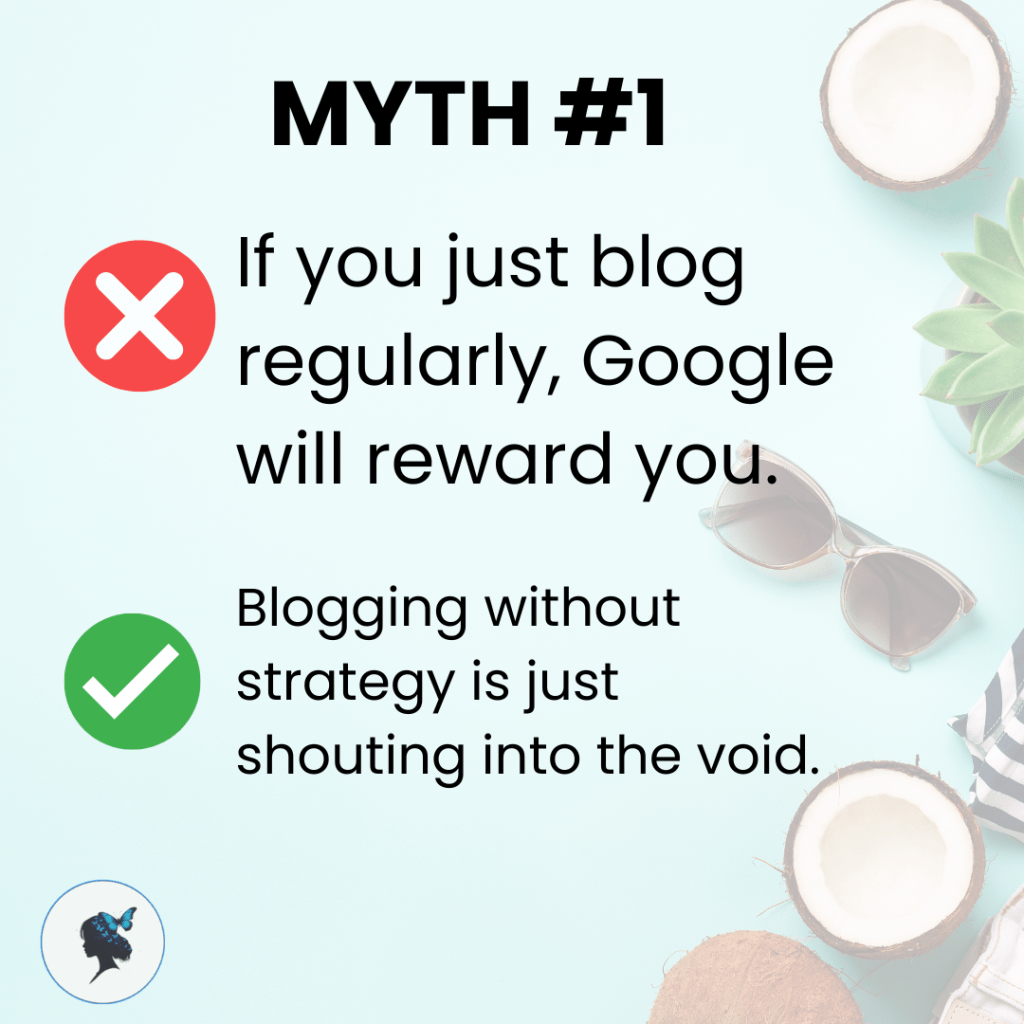
Myth #1: If you just blog regularly, Google will reward you.

Infograph: Myth #1: If you just blog regularly, Google will reward you.

Why it’s wrong:

Publishing weekly won’t matter if you’re not targeting the right search intent, keywords, or value.

Google ranks pages that serve users’ needs, not just those that update often.

Wander Women Hot Take: Blogging without a strategy is like shouting into the void. Create purposeful, search-optimized content aligned with your audience’s journey and questions. A boutique hotel in Tulum blogging every week about “travel inspiration” might not see results. But writing a strategic guide like “Where to Stay in Tulum for Couples: A 3-Day Itinerary” could rank and convert. Need ideas? Check out our post on 5 content types for travel websites.

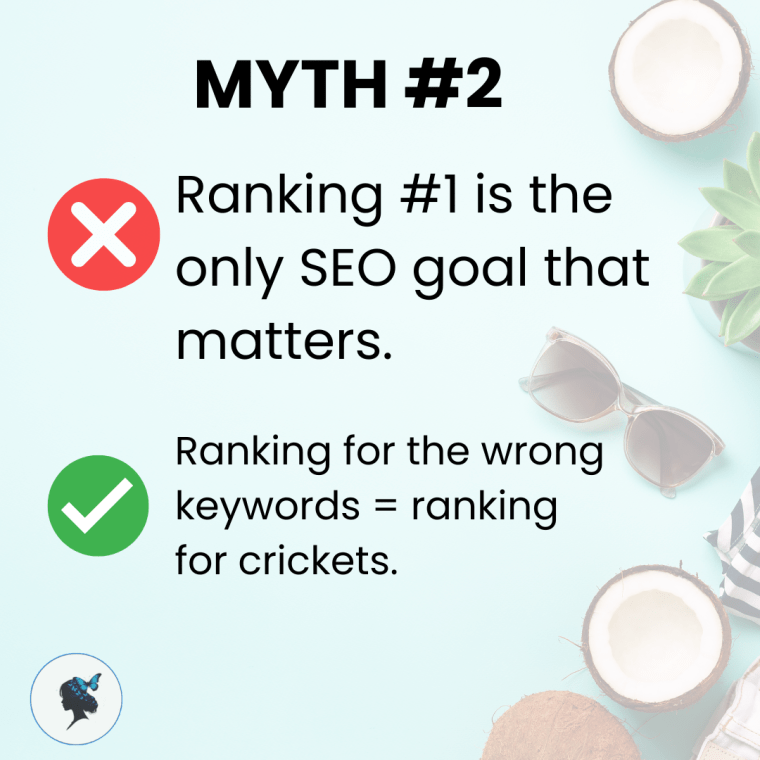
Myth #2: Ranking #1 is the only SEO goal that matters.

Why it’s wrong:

You can rank #1 for keywords no one is searching for.

Visibility only matters if it’s in front of the right people.

Infograph: Myth #2: Ranking #1 is the only SEO goal that matters.

Wander Women Hot Take: Ranking for the wrong keywords = ranking for crickets. Focus on traffic that converts, not just vanity metrics. A safari company ranking #1 for “African wildlife facts” may get clicks, but not bookings. Ranking on page one for “best Kenya safari tours” is what actually drives leads.

Myth #3: Meta descriptions affect rankings.

Infograph: Myth #3: Meta descriptions affect rankings.

Why it’s wrong:

Google has confirmed they don’t use meta descriptions as a ranking factor.

Wander Women Hot Take: They don’t affect rankings, but they do influence clicks. A compelling meta description can boost your CTR dramatically. A dull meta like “Blog about Peru travel” won’t drive clicks. A stronger one: “Discover the 7 hidden spots in Peru most tourists miss (with photos!).” For more about metas, check out our post: Meta description optimization.

Myth #4: SEO is a one-time project.

Why it’s wrong:

SEO requires consistent updates to remain effective—Google’s algorithm evolves, and your competitors do too.

Infograph: Myth #4: SEO is a one-time project.

Wander Women Hot Take: SEO is a garden. Leave it alone and the weeds take over. Tend it consistently for lasting results. A travel agent who hasn’t updated destination pages post-COVID may lose rankings to fresher, more relevant content.

Myth #5: Stuff your destination names everywhere to rank better.

Infograph: Myth #5: Stuff your destination names everywhere to rank better.

Why it’s wrong:

Keyword stuffing is a dated practice. According to Google’s Spam Policies for Google Web Search, keyword stuffing refers to the practice of filling a web page with keywords or numbers in an attempt to manipulate rankings in Google Search results. Google now values natural language and user experience.

Wander Women Hot Take: Google’s smarter than that now—and so are travelers. Focus on storytelling and relevance. Saying “Iceland tour” 12 times in one blog won’t help. Describing the unique experience of an Icelandic glacier hike will.


Content Strategy Myths Holding You Back

Myth #6: Just write what your audience wants to read.

Why it’s wrong:

Writing without research means you’re guessing. Guessing isn’t strategy.

Infograph: Myth #6: Just write what your audience wants to read.

Wander Women Hot Take: Write what your audience is searching for. There’s a difference. Instead of writing “My trip to Greece,” write “Best Greek Islands to Visit in September” with keyword insights. Read our comprehensive guide: mastering search intent.

Myth #7: Longer blogs = better SEO.

Infograph: Myth #7: Longer blogs = better SEO.

Why it’s wrong:

Google’s algorithm favors helpful content, not just long content.

Wander Women Hot Take: Quality > word count. A 600-word article that solves a problem is better than 2,000 words of fluff. A concise, clear blog about “How to Pack for a Safari in 7 Steps” may outperform a long-winded one titled “Everything About Africa.”

Myth #8: One piece of content = one use.

Why it’s wrong:

Content that isn’t repurposed is wasted effort.

Infograph: Myth #8: One piece of content = one use.

Wander Women Hot Take: Turn a blog post into 5 social posts, a newsletter, a video script, and more. Squeeze the juice out of it. A “Top 10 Places to Eat in Lisbon” post can become a Reel series, Pinterest board, and interactive map. More about repurposing content here.

Myth #9: You need to write content every week to grow.

Infograph: Myth #9: You need to write content every week to grow.

Why it’s wrong:

Frequency alone doesn’t build traffic. Relevance, quality, and promotion do.

Wander Women Hot Take: Consistency beats frequency. Stick to a sustainable schedule. A solo travel coach posting bi-weekly, well-optimized travel safety tips can outpace daily fluff posts.

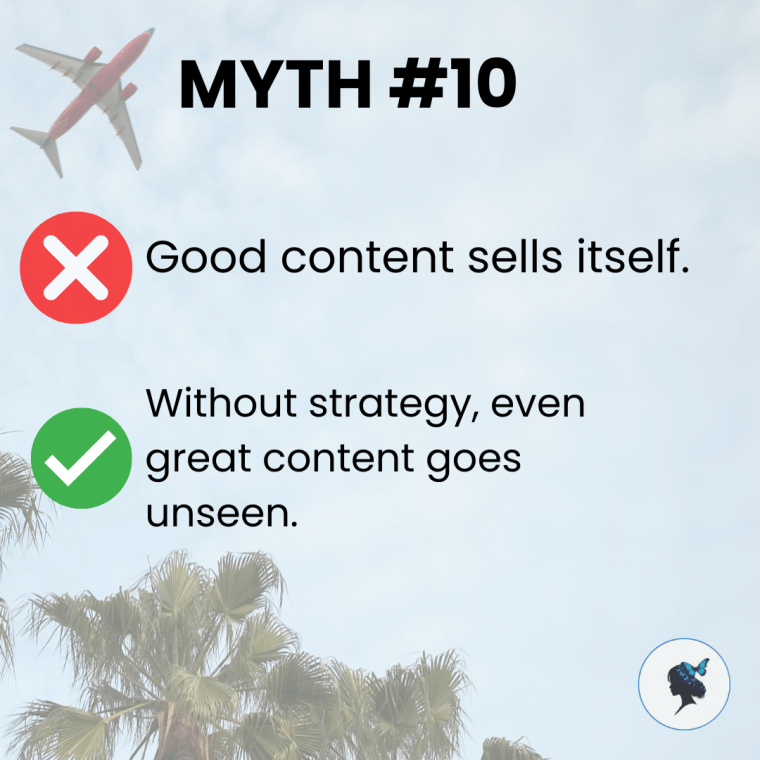
Myth #10: Good content sells itself.

Why it’s wrong:

Even the best blog needs promotion and optimization.

Infograph: Myth #10: Good content sells itself.

Wander Women Hot Take: Strategy is what takes content from invisible to impactful. An in-depth Bali guide won’t rank if it isn’t shared across Pinterest, email, and SEO. Read our guide: how to build a content strategy that converts.


Social Media Myths We Need to Stop Believing

Myth #11: Posting every day is the key to growth.

Infograph: Myth #11: Posting every day is the key to growth.

Why it’s wrong:

Engagement matters more than volume. Posting without connection is just noise.

Wander Women Hot Take: Engagement > frequency. Start conversations, not just broadcasts. A travel planner who posts once a week but asks questions, responds to comments, and uses stories & polls may get more leads than one posting daily photo dumps. More lead magnet ideas here.

Myth #12: Travel brands should be on every platform.

Why it’s wrong:

Spreading thin waters down your message and drains your team.

Infograph: Myth #12: Travel brands should be on every platform.

Wander Women Hot Take: Be exceptional where your people are—not everywhere. A hiking tour company killing it on Instagram and YouTube doesn’t need TikTok until they’re ready. Which one to choose? Here we break down 5 of the most common social media platforms for travel companies.

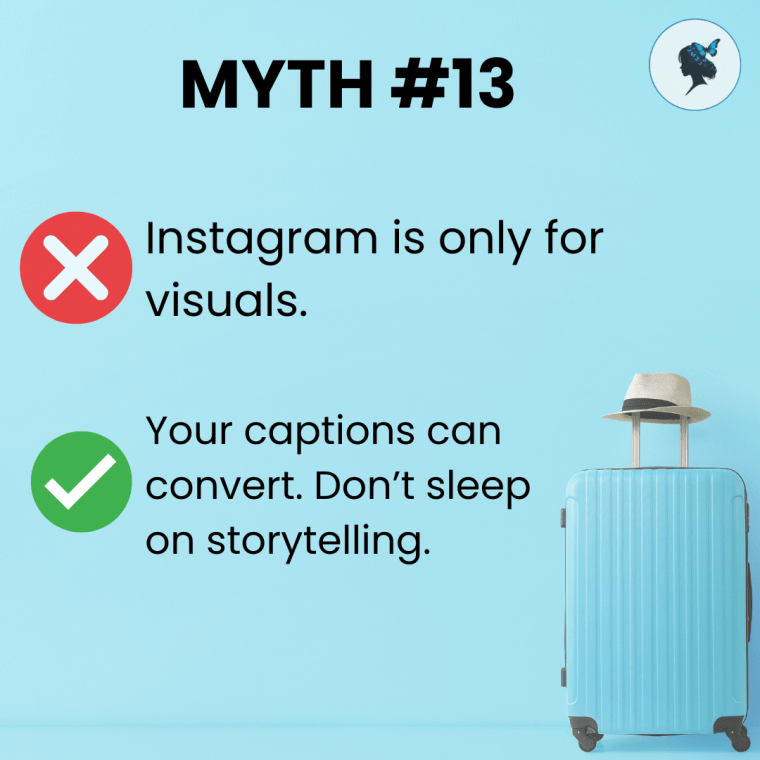
Myth #13: Instagram is only for visuals.

Infograph: Myth #13: Instagram is only for visuals.

Why it’s wrong:

Captions can convert browsers into buyers.

Wander Women Hot Take: Storytelling in captions = emotional connection. Don’t waste that real estate. A heartfelt story of a honeymoon couple on a Santorini tour will sell more than a scenic drone shot with no context. More instagram tips here.

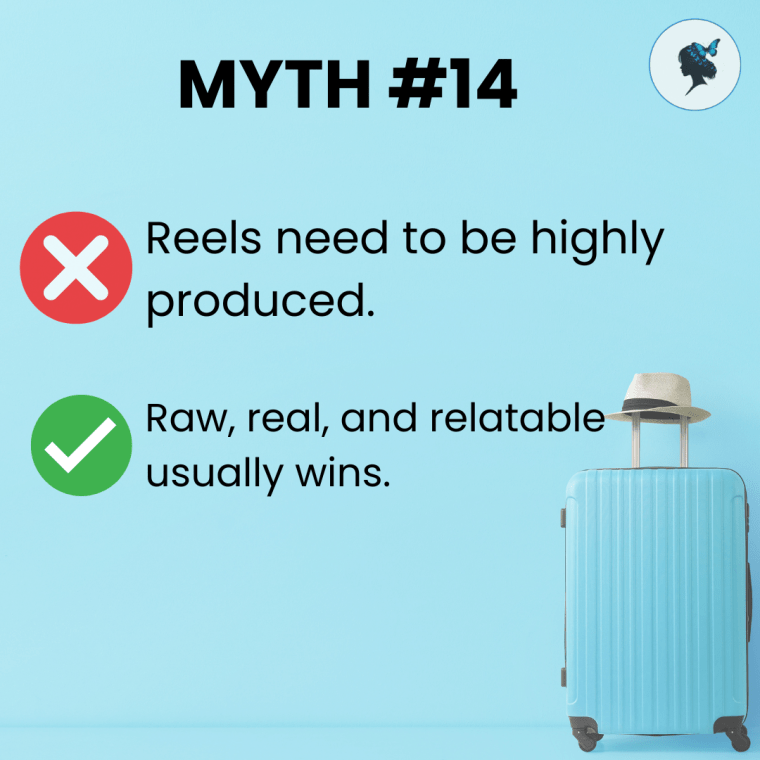
Myth #14: Reels need to be highly produced.

Why it’s wrong:

Overproduction can feel inauthentic or distant.

Infograph: Myth #14: Reels need to be highly produced.

Wander Women Hot Take: Raw, real, and relatable usually wins. Especially in travel. A simple video of a guide introducing themselves on-site in Morocco might outperform a polished montage. Read about the power of visual content.

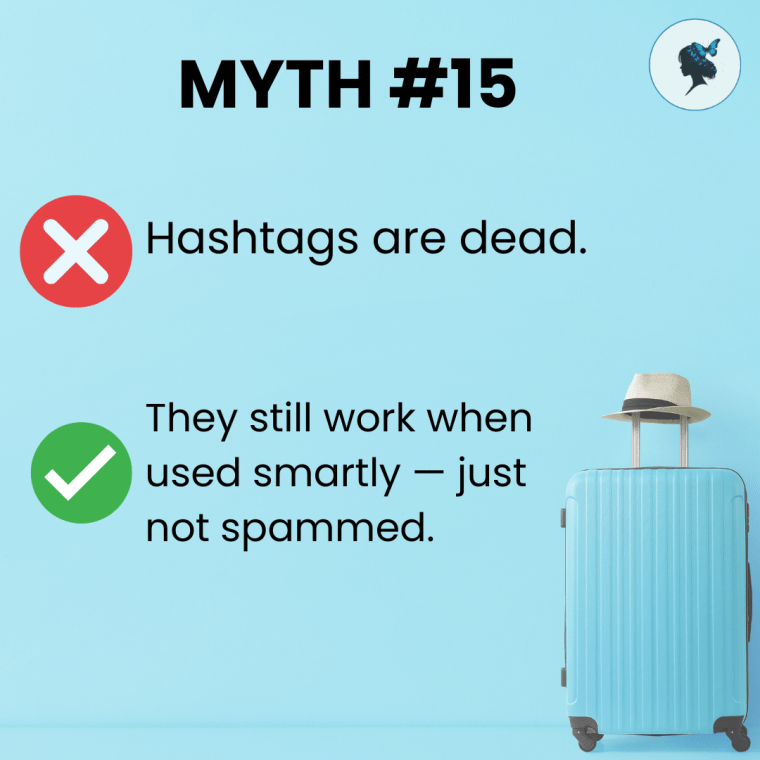
Myth #15: Hashtags are dead.

Infograph: Myth #15: Hashtags are dead.

Why it’s wrong:

Hashtags still drive discovery when used strategically.

Wander Women Hot Take: Hashtags aren’t dead—spammy ones are. Use focused, relevant tags. Instead of #travel #vacation, try #SoloTravelGreece or #BudgetTravelTips.


Travel Biz & Marketing Myths That Slow Growth

Myth #16: Beautiful websites are enough to book clients.

Why it’s wrong:

A pretty site that doesn’t guide action won’t convert.

Infograph: Myth #16: Beautiful websites are enough to book clients.

Wander Women Hot Take: It’s digital eye candy unless it’s optimized for conversion. A luxury villa site with no clear booking button or reviews will lose visitors fast. Read our guide: create high-quality landing pages.

Myth #17: The travel industry is too saturated to stand out.

Infograph: Myth #17: The travel industry is too saturated to stand out.

Why it’s wrong:

Most brands look and sound the same. That’s the real issue.

Wander Women Hot Take: Standing out is a strategy, not luck. A Sri Lanka tour company focused only on female travelers and wellness retreats carves a niche.

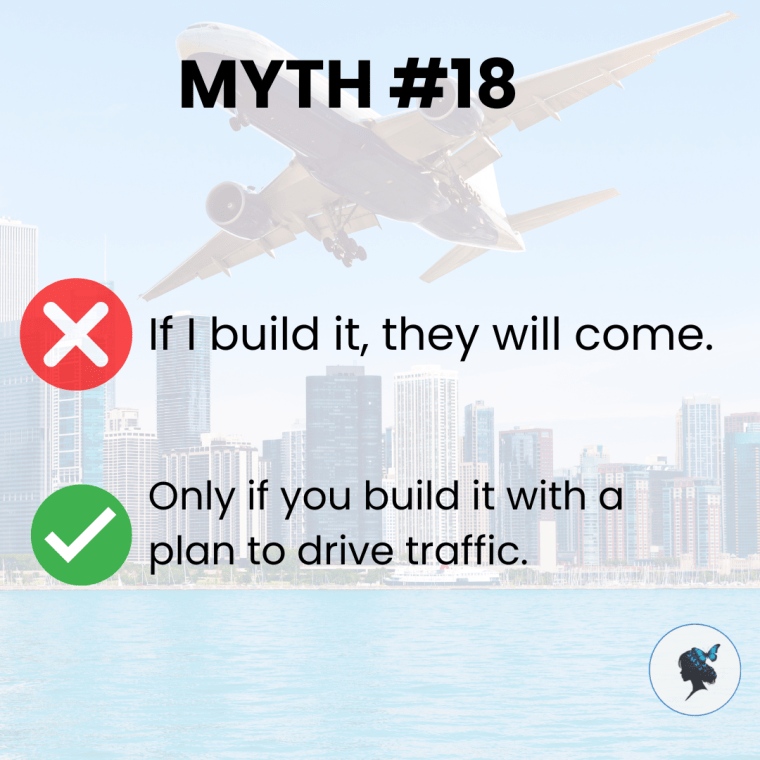
Myth #18: If I build it, they will come.

Why it’s wrong:

Visibility isn’t automatic. It must be earned.

Infograph: Myth #18: If I build it, they will come.

Wander Women Hot Take: Build it, then promote the heck out of it. Creating a travel app or blog without a launch and promo strategy means crickets.

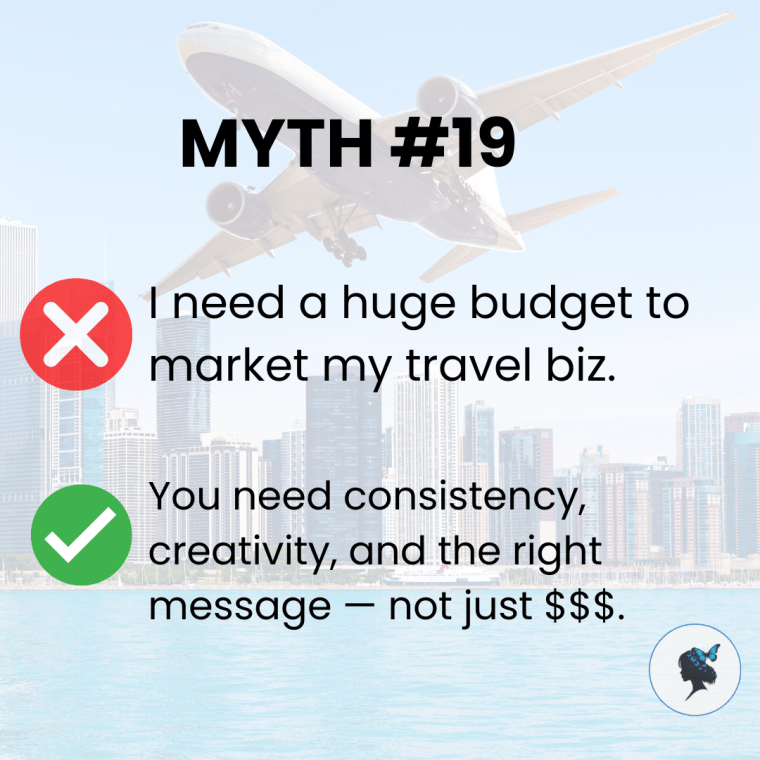
Myth #19: I need a huge budget to market my travel biz.

Infograph: Myth #19: I need a huge budget to market my travel biz.

Why it’s wrong:

Smart strategy often beats big spend.

Wander Women Hot Take: Creativity and clarity > cash. Spend smart, not big. A local walking tour business using Google My Business, SEO, and organic Instagram content can compete with major players.

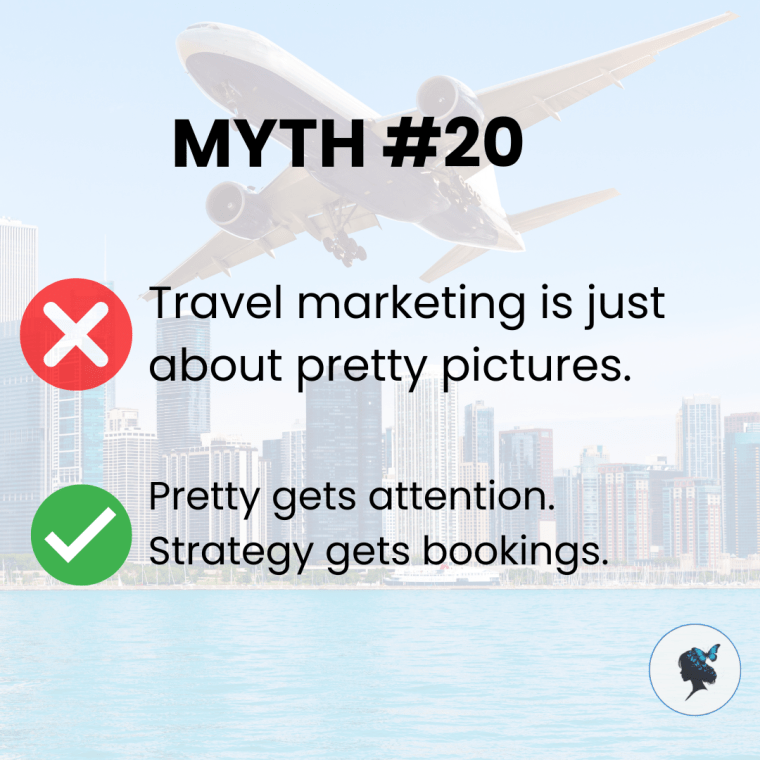
Myth #20: Travel marketing is just about pretty pictures.

Why it’s wrong:

Visuals alone don’t convert without story or strategy.

Infograph: Myth #20: Travel marketing is just about pretty pictures.

Wander Women Hot Take: Pretty gets attention. Strategy gets bookings. A travel advisor sharing carousel posts that break down “How to Plan a Japan Rail Adventure” will drive more leads than sunset pics.


Strategy Over Assumptions. Myths are powerful. They spread because they’re simple, catchy, and sometimes comforting. But they rarely help your business grow. At Wander Women Strategies, we believe in truth-telling, clarity, and evidence-backed strategy. If you’re tired of guessing and ready to make real marketing moves that get real results, we’re here to help.

Ready to ditch the myths and get strategic? Drop us a message to get started. Your bookings deserve more than buzzwords. Let’s get visible—the right way.

Website Speed Optimization for Travel Companies

In the highly competitive world of travel and tourism, the speed of your website can make or break your online presence. With travelers increasingly using mobile devices to research their next vacation, a slow website can lead to high bounce rates, poor user experience, and ultimately lost business. At Wander Women Strategies, we understand the importance of website speed optimization for travel companies and how it can impact everything from SEO rankings to conversion rates.

In this article, we’ll walk you through everything you need to know about website speed optimization, including what it is, how to optimize your site, and why it’s crucial for travel businesses.


▶ Table of Contents
  1. What is Website Speed Optimization?
  2. How to Optimize Website Speed for Travel Websites
  3. Why Website Speed Optimization is Crucial for Travel Companies

What is Website Speed Optimization?

Website speed optimization refers to the process of improving the loading times of your website’s pages. It involves reducing the time it takes for your website to load fully and become interactive for users. Website speed is a critical ranking factor for search engines, as well as a key element in providing a seamless user experience.

A website that loads quickly ensures users stay engaged, can access the information they need, and are more likely to convert—whether that’s making a booking, signing up for a newsletter, or sharing content.

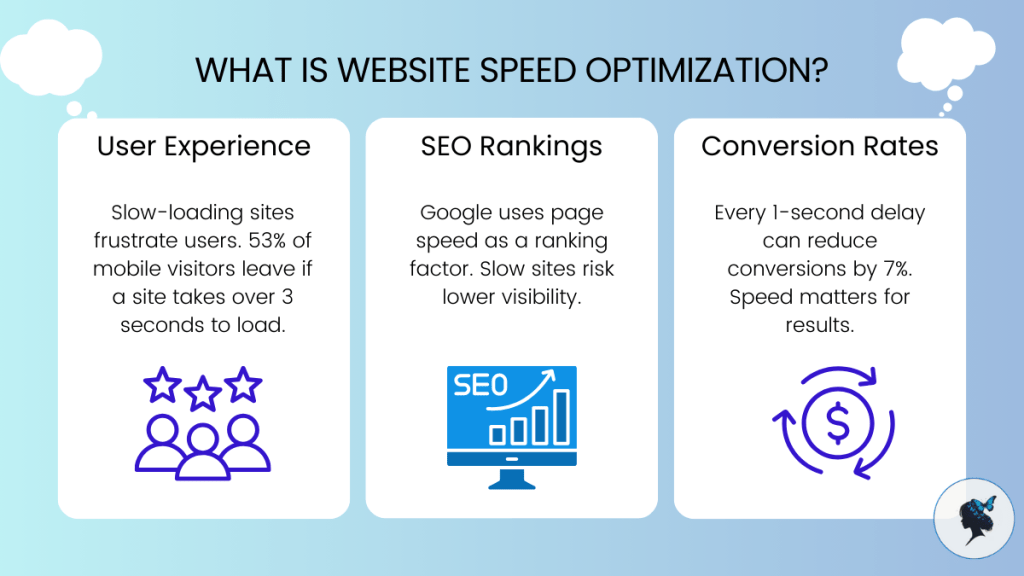
Visual representation of website speed optimization, highlighting methods to enhance loading times and user experience.

Why Website Speed Matters

  • User Experience: A slow-loading website leads to frustration. Users expect fast-loading pages, especially on mobile devices, and they may leave if your website takes too long to load. According to Google, 53% of mobile users will abandon a site if it takes more than 3 seconds to load.
  • SEO Rankings: Google and other search engines prioritize websites with fast load times. Search engines use page speed as one of the ranking factors, and websites that load slower may suffer from lower rankings, making it harder for potential customers to find you.
  • Conversion Rates: The faster your website loads, the more likely users are to take action—whether that’s making a booking or interacting with your content. Studies show that even a 1-second delay in page load time can reduce conversion rates by 7%.

Website speed is not just about having a faster website—it’s about creating an experience that keeps users engaged and satisfied.


How to Optimize Website Speed for Travel Websites

Optimizing website speed involves several techniques and tools.

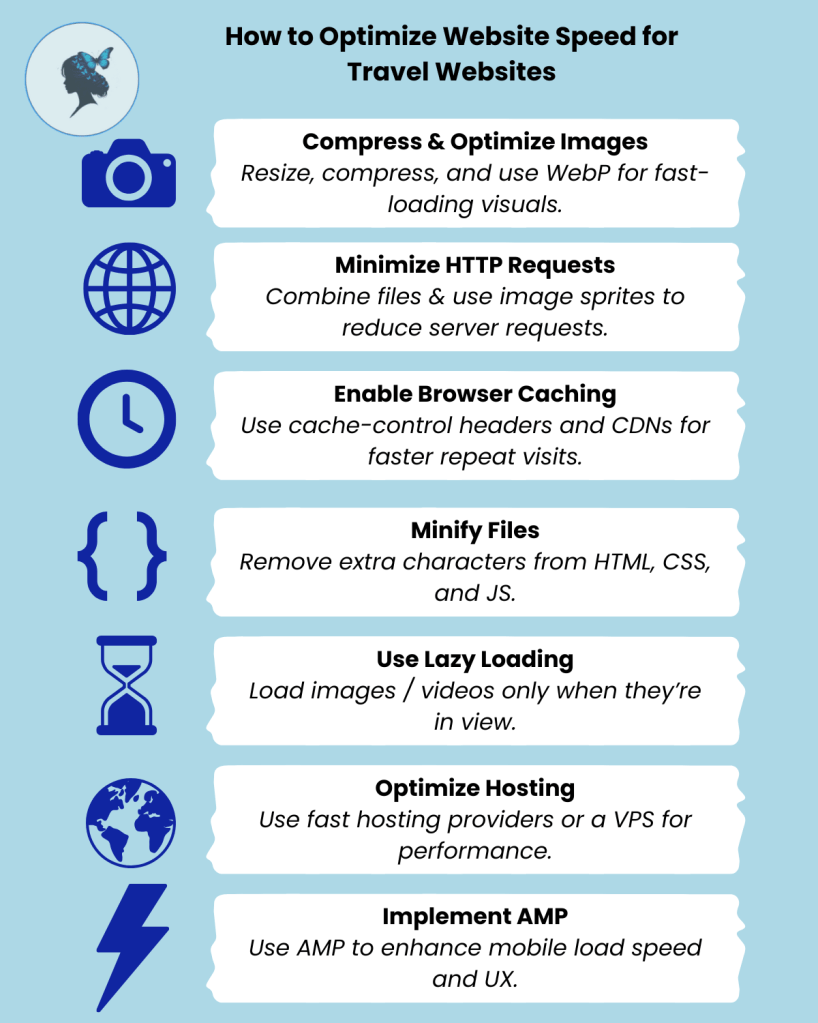
Infographic on optimizing website speed specifically for travel websites, featuring tips and best practices

Let’s look at some key areas where you can improve performance:

Compress and Optimize Images

Travel websites are often image-heavy, featuring breathtaking landscapes, hotels, and destinations that require high-quality visuals. However, high-resolution images can slow down your website if they aren’t properly optimized.

How to Optimize Images:

  • Resize Images: Make sure images are only as large as they need to be. Don’t upload high-resolution images that exceed the required dimensions for your site.
  • Image Compression: Use compression tools to reduce the file size without sacrificing image quality. Tools like TinyPNG, ImageOptim, and JPEG-Optimizer can help compress images without noticeable quality loss.
  • Use Next-Gen Formats: Consider using modern image formats like WebP, which offer superior compression and quality compared to traditional formats like JPEG or PNG.

Optimizing images is one of the most effective ways to speed up your website, as images often account for the largest portion of a page’s total size.

Minimize HTTP Requests

Every element on a page (images, CSS, JavaScript, etc.) requires an HTTP request to the server. The more elements your page has, the more HTTP requests it will need to load, which increases the loading time.

How to Minimize HTTP Requests:

  • Combine CSS and JavaScript Files: Instead of loading multiple CSS and JavaScript files, combine them into one or two files to reduce the number of requests.
  • Use Sprites for Images: If your site uses many small images (like icons), consider using CSS sprites. A sprite combines multiple images into one file, reducing the number of requests.

Enable Browser Caching

Caching is a method of storing static resources like images, CSS, and JavaScript in the user’s browser. When a user visits your site again, the browser doesn’t need to reload these resources, leading to faster load times.

How to Enable Browser Caching:

  • Leverage Cache-Control Headers: Set cache expiration dates for resources that don’t change often, like images and stylesheets.
  • Use a CDN: A Content Delivery Network (CDN) can store copies of your website’s content in multiple locations worldwide. This helps reduce latency by delivering content from the nearest server.

Minify CSS, JavaScript, and HTML Files

Minification is the process of removing unnecessary characters (like spaces, line breaks, and comments) from your code without affecting functionality. Minified code is smaller, which reduces loading time.

How to Minify Code:

  • CSS and JavaScript Minifiers: Tools like UglifyJS (for JavaScript) and CSSMinifier can help you minify these files.
  • HTML Minification: Use HTMLMinifier to compress your HTML files and remove unnecessary whitespace and comments.

Use Lazy Loading

Lazy loading is a technique that delays the loading of images and other media until they are needed, i.e., when they appear in the user’s viewport (visible part of the page). This helps reduce initial load time and saves bandwidth for users.

How to Implement Lazy Loading:

  • Lazy Load Images: Implement lazy loading for images using JavaScript libraries like lazysizes or IntersectionObserver.
  • Lazy Load Embeds and Videos: Apply lazy loading to embedded content, like YouTube videos or maps, to speed up your site.

Optimize Web Hosting

Your website’s hosting environment plays a crucial role in website speed. Poor hosting can cause slow page load times regardless of how optimized your site is.

How to Optimize Hosting:

  • Choose a High-Quality Web Host: Ensure that your web hosting provider offers fast and reliable servers. Managed WordPress hosts like Kinsta or WP Engine are optimized for speed and performance.
  • Use a Dedicated Server or VPS: If your website experiences high traffic volumes, a shared hosting plan may not be sufficient. A VPS (Virtual Private Server) or dedicated server provides better resources and faster performance.

Implement AMP (Accelerated Mobile Pages)

For travel companies, mobile optimization is essential. AMP is an open-source framework that helps create mobile-friendly pages that load extremely fast.

How to Implement AMP:

  • Install AMP Plugin: If you use WordPress, there are AMP plugins available to help set up AMP pages.
  • Follow AMP Guidelines: AMP pages have strict guidelines, so ensure that your content and design comply with AMP standards.

Why Website Speed Optimization is Crucial for Travel Companies

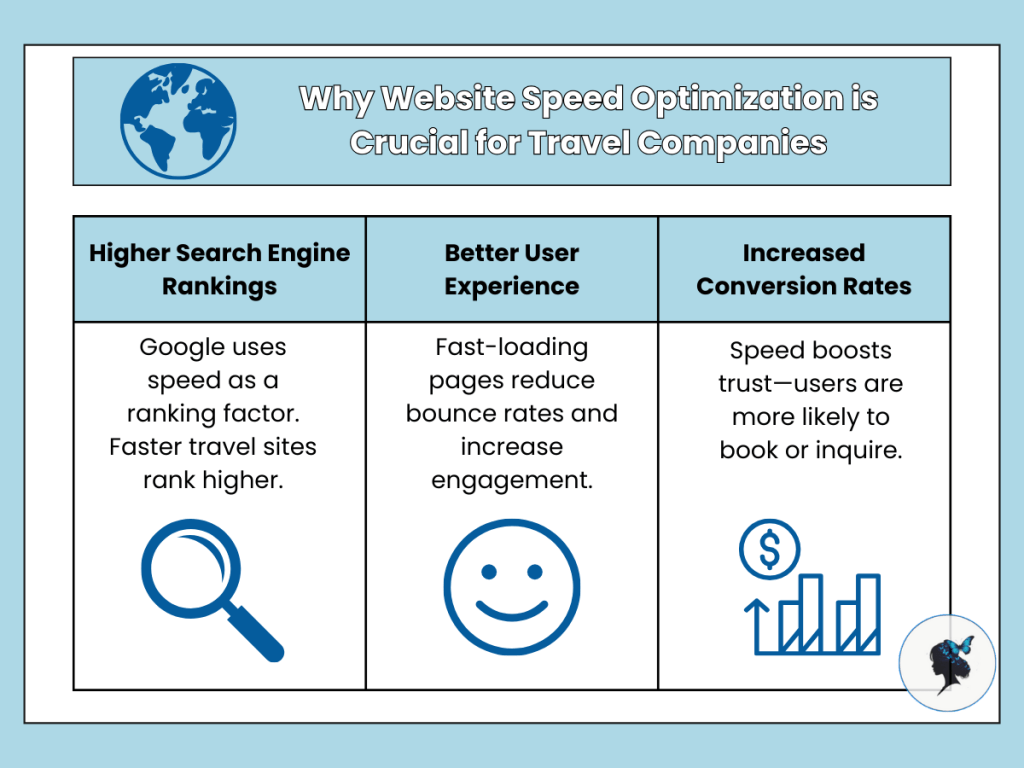
Graphic illustrating the importance of website speed optimization for better user experience and search engine ranking.

Higher Search Engine Rankings

Google has explicitly stated that website speed is a ranking factor. A faster website not only improves the user experience but also helps with SEO. With more travel websites entering the digital space, a faster site has a competitive edge.

Better User Experience

For travel companies, providing a positive user experience is essential. Slow websites frustrate potential customers, and they may abandon your site in favor of faster competitors. Optimizing your site for speed ensures that users can access information quickly, which is especially important for travel-related searches.

Increased Conversion Rates

As mentioned earlier, a faster website means higher conversion rates. Whether it’s booking a flight, reserving a hotel, or simply reading about a travel destination, faster loading speeds mean users are more likely to complete their desired actions. For travel companies, this can directly translate into more bookings and higher revenue.

Mobile Optimization for On-the-Go Travelers

Travelers are often on the go, and mobile optimization is crucial. A slow-loading mobile site can be detrimental to your business, especially considering that mobile traffic accounts for a large portion of web visits. With Google’s mobile-first indexing, ensuring fast mobile load times is more important than ever.


Is your website ready to load faster and rank higher?

Contact us today to learn how we can help you optimize your website for better SEO, enhanced user experience, and increased conversions.

AI Overviews & SERP Integration: What’s Changing?


▶ Table of Contents
  1. Introduction
  2. What Are AI Overviews?
  3. How AI Overviews Work
  4. Impact on Travel Companies
  5. Tips for Travel Companies
  6. Conclusion

Introduction

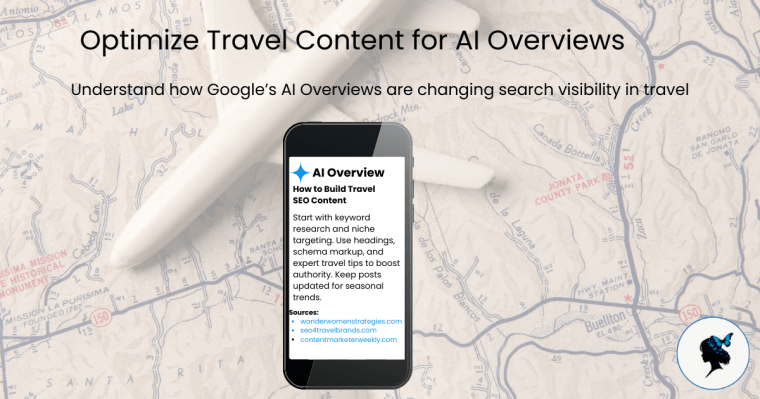
Google’s AI Overviews are short, AI-generated summaries that appear at the top of search results, giving users quick answers without clicking through to websites. While this makes finding information faster, it can also lower click-through rates (CTR) for travel sites by around 34.5% on informational queries, and these overviews now show up on roughly 42.5% of searches.

Visual guide on optimizing travel content for AI overviews, showcasing effective strategies and techniques.

For travel companies, this means less free traffic from Google when people research destinations or itineraries. To stay visible, travel brands need to structure content so AI can easily pull summaries, boost their trust signals, and explore other channels like video or paid ads.

What Are AI Overviews?

AI Overviews (formerly part of Google’s Search Generative Experience) are brief, 2–5 sentence summaries that appear in a card at the top of the search page.
They pull key points from several web pages and cite those sources directly beneath the summary.
Sometimes they include images or lists to make the answer clearer, especially for recipe or itinerary-style queries.

How AI Overviews Work

  1. Content Aggregation
    The AI reads multiple top-ranking pages and picks out the main facts.
  2. Summary Generation
    It writes a short paragraph that answers the user’s question.
  3. Source Citations
    It links to the web pages it used, giving users a path to learn more.
  4. Interactive Features
    Users can simplify or expand the summary, and even send it to Google Docs or Gmail.
  5. Ads Integration
    For commercial queries, Google now includes sponsored suggestions directly in the AI Overview, marked as “sponsored”.
Infographic depicting the workflow of AI, highlighting data analysis and response generation steps.

Impact on Travel Companies

Lower Click-Through Rates

  • Organic CTR Drops: When an AI Overview appears, CTR to the first organic result can fall by about 34.5%.
  • Non-Branded Queries Hit Hardest: Informational searches like “best beach in Bali” see CTR declines near 20% on average.
  • Paid Ads Also Affected: Paid search ads can lose about 12 percentage points in CTR whenever an AI Overview shows up.

Reduced Visibility for Travel Research

Travelers often start with “where to go” or “what to see” queries. Since AI Overviews answer these questions directly, fewer people scroll down to organic listings. Major travel brands like Kayak and TripAdvisor are already adjusting their strategies to feed content directly into AI systems, hoping to stay in the AI-sourced summaries.

Authority and Trust Signals Matter More

Google leans on E-E-A-T (Experience, Expertise, Authoritativeness, Trustworthiness). Sites that clearly show author credentials, publish fresh reviews, and use structured data are more likely to be cited in AI Overviews.

Tips for Travel Companies

  1. Add Clear “Quick Facts” Sections
    Place a bullet-point list or short paragraph at the top of your page that directly answers common travel questions.
  2. Use FAQ Schema
    Mark up FAQs with structured data so Google’s AI can easily find and use your answers.
  3. Highlight Experts
    Show author bios with real credentials and local expertise.
  4. Keep Content Fresh
    Update guides and itineraries seasonally and date-stamp them clearly.
  5. Diversify Channels
    • YouTube & Video: Video content can be featured in AI Overviews and on Google’s video carousel.
    • Non-Google AIs: Publish content optimized for ChatGPT or Perplexity to capture referral traffic.
  6. Consider Paid Placements
    Explore Google Ads extensions that appear alongside AI Overviews to maintain visibility.

Conclusion

AI Overviews are changing how people search and how clicks are distributed. Travel companies must adapt by making their content AI-friendly, boosting trust signals, and branching out into video and paid channels.

If you’re in the travel business and need help staying visible in this AI-driven world, contact Wander Women Strategies. We specialize in SEO, content strategy, and social media for travel brands, and we’re here to help you thrive when Google’s AI takes the lead.

On-Page Optimization: Keyword Optimization for Travel Companies


▶ Table of Contents
  1. What is On-Page Keyword Optimization?
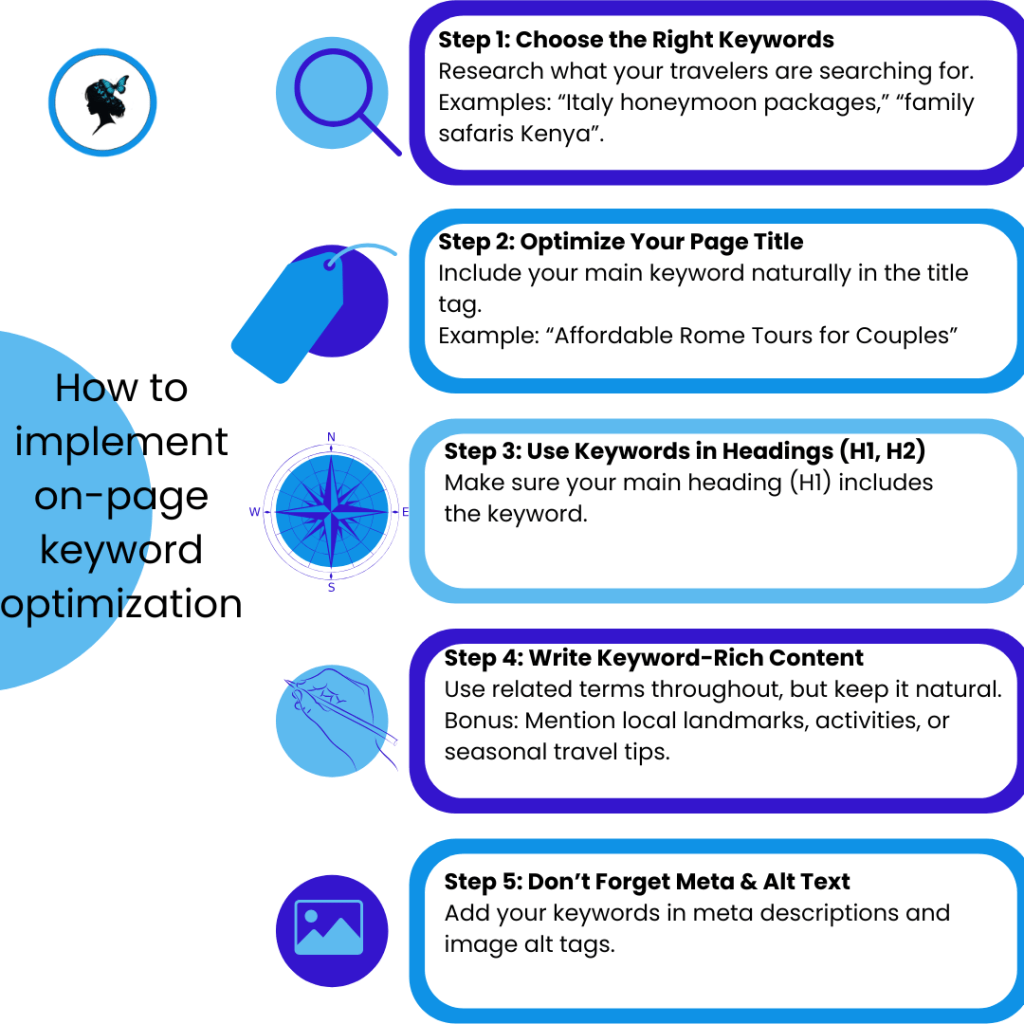
  2. How to Implement On-Page Keyword Optimization
  3. Why On-Page Keyword Optimization is Important for Travel Companies
  4. Start Your Keyword Optimization Journey with Wander-Ready Web

Introduction

In this article, we’ll dive deep into On-Page Optimization and Keyword Optimization, explain how to effectively implement them, and highlight why they are vital for travel companies.

In the ever-evolving travel industry, having an online presence that ranks high on search engines is crucial to attracting customers. One of the fundamental aspects of SEO that influences rankings is On-Page Optimization, particularly Keyword Optimization. If your travel business isn’t optimizing the keywords on your website, you may be missing out on valuable organic traffic that could drive bookings, inquiries, and brand awareness.

What is On-Page Keyword Optimization?

On-Page Keyword Optimization refers to the strategic placement of relevant keywords within your website’s content and HTML source code to enhance its search engine ranking. These keywords are the words and phrases your target audience uses when searching for services like yours.

For travel businesses, keyword optimization means identifying the right travel-related terms such as “luxury vacation in Hawaii”, “adventure tours in Costa Rica”, or “budget-friendly European getaways” and optimizing web pages, blog posts, and other content around those terms.

On-Page optimization goes beyond just throwing in keywords. It’s about using those keywords strategically, ensuring that your content provides value to users, while also signaling to search engines that your page is relevant for the search query.


How to Implement On-Page Keyword Optimization

Implementing on-page keyword optimization requires careful planning and execution.

Here’s a step-by-step guide to optimize your travel website effectively:

Step 1: Conduct Keyword Research

Before you can optimize your website for keywords, you need to know which ones to target. Effective keyword research involves finding the terms that your ideal customers are searching for.

  • Use Tools: Leverage keyword research tools such as Google Keyword Planner, Semrush, and Ahrefs to identify relevant search terms with a good balance of search volume and low competition.
  • Consider User Intent: Keyword research isn’t just about finding high-volume terms. You need to think about user intent: Are users looking for travel inspiration, booking services, or specific activities? Target keywords that align with your business goals (i.e., transactional or informational queries).
  • Look for Long-Tail Keywords: For travel businesses, long-tail keywords like “luxury cruises to Alaska for families” or “best time to visit Bali with kids” are valuable. They typically have lower search volume but higher conversion rates.

Step 2: Incorporate Keywords in Strategic Areas

Once you’ve identified your target keywords, it’s time to incorporate them in the key on-page elements of your website. Here are the areas to focus on for keyword placement:

  • Title Tags: Your title tag is one of the most important SEO elements. It should accurately describe the page content while including your target keyword. For example, instead of just “Vacation Packages,” use a title like “Best Family Vacation Packages in Florida – Wander Ready”.
  • Meta Descriptions: While meta descriptions don’t directly impact rankings, they do influence whether users click on your website in search results. Include your primary keyword and make the description compelling. Example: “Discover the best family vacation packages in Florida. Explore kid-friendly resorts and activities for an unforgettable holiday.”
  • Headings (H1, H2, H3): Structure your content by including keywords in your headings (H1, H2, and H3). The H1 tag should contain your primary keyword, while H2 and H3 tags can have variations or related keywords. For example: H1: “Top Family-Friendly Vacation Spots in Florida” and H2: “Best Resorts for Family Vacations in Florida”.
  • URLs: Create clear and descriptive URLs that include keywords. For example, instead of “www.example.com/package1,” use “www.example.com/family-vacation-florida.”
  • Content Body: Naturally incorporate your keywords within the body of the content. Aim for high-quality, informative content that answers the user’s query. Avoid keyword stuffing, which can negatively impact readability and SEO.
  • Image Alt Text: Images on your travel site should be optimized with descriptive alt text that includes keywords. For example, an image of a beach resort can have alt text like “Luxury beach resort in Bali”.
  • Internal Linking: Add internal links to other relevant pages on your website. This helps with SEO and also enhances the user experience by guiding them to related content. For instance, linking to other resort pages or tour packages on your website will keep visitors engaged.

Step 3: Focus on Content Quality

Keyword optimization doesn’t mean just inserting keywords into every corner of your page. The content needs to be valuable and engaging for users. Here’s how to maintain quality while optimizing for keywords:

  • Answer User Questions: Craft content that directly answers the questions your target audience has. For example, if your target keyword is “best eco-tourism destinations in Costa Rica,” you should provide detailed answers about eco-friendly travel options in Costa Rica.
  • Avoid Keyword Stuffing: Keyword stuffing—repeating keywords unnaturally in content—can result in penalties from search engines. Instead, aim for a natural, conversational tone that provides real value to your audience.
  • Use LSI Keywords: Latent Semantic Indexing (LSI) keywords are related terms that reinforce your primary keywords. For example, if your target keyword is “adventure tours in Costa Rica,” related terms might include “Costa Rica hiking tours” or “outdoor adventure vacations.”

Step 4: Optimize for Mobile and Site Speed

Search engines like Google prioritize websites that offer a great user experience. Since most users access websites via mobile devices, it’s essential that your site is mobile-friendly.

  • Responsive Design: Make sure your website has a responsive design, meaning it adjusts seamlessly to different screen sizes. This is especially important for travel websites, as potential customers may browse on mobile while planning trips on the go.
  • Site Speed: Page speed is another ranking factor. Slow-loading pages can hurt both user experience and SEO. Use tools like Google PageSpeed Insights to check your website’s speed and make improvements where needed.

Read our post on website speed optimization for more information.


Why On-Page Keyword Optimization is Important for Travel Companies

For travel businesses, on-page keyword optimization is critical for attracting the right audience, standing out from competitors, and driving qualified traffic to your website. Here are a few reasons why it’s particularly important for the travel industry:

1. Enhanced Visibility in Search Engines

Travel is one of the most competitive industries online, with thousands of websites targeting similar keywords. Properly optimized pages are more likely to rank higher in search engine results, increasing your visibility.

2. Attracts the Right Audience

By targeting keywords that align with user intent, on-page keyword optimization ensures that you attract visitors who are genuinely interested in what your travel business offers. For example, targeting “affordable luxury tours in Paris” will bring in visitors who are actively looking for that specific service.

3. Improves User Experience

Effective on-page optimization improves the user experience by ensuring that content is easy to find, relevant, and engaging. When your website answers the questions and needs of your target audience, they’re more likely to stay on your page and take action, whether that’s booking a tour, subscribing to your newsletter, or reaching out for more information.

4. Increases Conversions

When you target specific long-tail keywords with transactional intent, you’re likely to see higher conversion rates. A user searching for “best all-inclusive resorts in Mexico” is more likely to book than someone just searching for “vacation destinations.”

Ready to take your travel business to new heights? Contact us today to get started!

Backlink Audits: The Key to Building a Strong SEO Foundation for Travel Companies


▶ Table of Contents
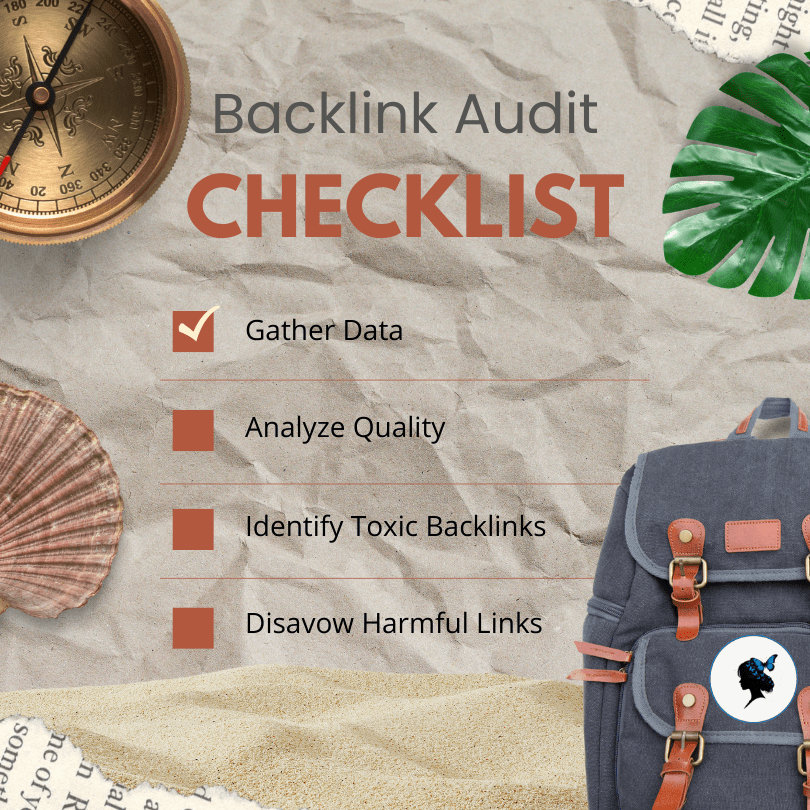
  1. What is a Backlink Audit?
  2. How to Conduct a Backlink Audit
  3. Why Backlink Audits Are Important for Travel Companies
  4. Start Optimizing Your Backlink Profile with WanderLinks

In today’s competitive travel industry, having a strong online presence is more important than ever. While on-page SEO and high-quality content are essential, backlinks remain one of the most influential ranking factors for search engines. However, not all backlinks are created equal. To ensure that your travel company is benefiting from its backlink strategy, you need to perform regular backlink audits.

A backlink audit allows you to evaluate the quality of your backlinks, remove any harmful ones, and discover new opportunities to improve your link profile. With a package like WanderLinks, your travel company can stay on top of your backlink strategy and ensure it supports your long-term SEO goals.

A backlink audit is the process of reviewing and analyzing the backlinks pointing to your website. Backlinks, also known as inbound links, are links from external websites that point to your pages. These links are a signal to search engines that other sites trust your content. As such, backlinks are one of the most important ranking factors in SEO.

However, not all backlinks are beneficial. While some backlinks from reputable, high-authority sites can improve your website’s ranking, low-quality, spammy, or toxic backlinks can have the opposite effect. A backlink audit helps you identify:

  • Good backlinks: Links from authoritative websites that contribute positively to your website’s credibility.
  • Toxic backlinks: Links from unreliable, low-quality, or irrelevant websites that could negatively affect your rankings.
  • Opportunities: Identifying gaps in your backlink profile where you could earn more high-quality backlinks.

A backlink audit is a crucial step in maintaining a clean, effective, and healthy link profile that will help you climb the search engine rankings.


Conducting a backlink audit may seem complex, but breaking it down into manageable steps makes it easier to handle. Here’s how you can perform a thorough backlink audit for your travel company:

Step 1: Gather Your Backlink Data

The first step in conducting a backlink audit is collecting a list of all the backlinks pointing to your website. You can use SEO tools such as:

  • Google Search Console: This is a free tool from Google that allows you to see which websites are linking to your site and provides information about the quality of those links.
  • Ahrefs: Ahrefs is an excellent tool for analyzing backlinks and viewing detailed reports about link quality, link type, and anchor text.
  • SEMrush: SEMrush provides a comprehensive backlink audit tool that identifies both toxic and high-quality backlinks. It can also help you assess competitors’ backlink profiles.
  • Moz: Moz’s Link Explorer provides valuable backlink data, including domain authority, page authority, and the number of linking root domains.

By gathering data from these tools, you can compile a list of all backlinks pointing to your site, both nofollow and dofollow links.

Step 2: Analyze the Quality of Each Backlink

Once you’ve gathered your backlink data, the next step is to assess the quality of each backlink. Factors that determine the quality of a backlink include:

  • Domain Authority: Backlinks from high-authority domains (websites that have a strong online reputation and high trustworthiness) are generally more valuable.
  • Relevance: Backlinks should come from sites that are relevant to your travel business, such as travel blogs, tourism websites, or local tourism authorities.
  • Anchor Text: The anchor text of a backlink is the clickable text that links to your site. Ideally, it should be natural and relevant to the content on the linked page.
  • Traffic: A backlink from a site with high traffic is likely to have more value because it can drive referral traffic to your website.

Step 3: Identify Toxic or Harmful Backlinks

One of the most important parts of a backlink audit is identifying toxic backlinks. These are links that come from low-quality, spammy, or irrelevant websites. Toxic backlinks can come from:

  • Link farms: Websites created specifically to sell backlinks in bulk, often low-quality links that are irrelevant to your site.
  • Spammy websites: Websites that violate Google’s quality guidelines, such as those that promote illegal or unethical activities.
  • Irrelevant industries: Backlinks from websites that have nothing to do with your travel niche can hurt your rankings.

You can use tools like Ahrefs or SEMrush to identify potentially toxic backlinks. Pay attention to the following red flags:

  • Backlinks from sites with a low domain authority
  • Backlinks with over-optimized or irrelevant anchor text
  • Links from websites in unrelated industries

Step 4: Disavow Harmful Links

Once you have identified toxic backlinks, it’s essential to disavow them to avoid any negative impact on your SEO performance. The Google Disavow Tool allows you to tell Google to ignore these harmful backlinks.

Here’s how you can disavow harmful backlinks:

  1. Create a file that includes the links you want Google to ignore.
  2. Upload the file to the Google Disavow Tool.
  3. Google will disregard the disavowed links when calculating your website’s ranking.

Step 5: Build a Plan to Acquire More High-Quality Backlinks

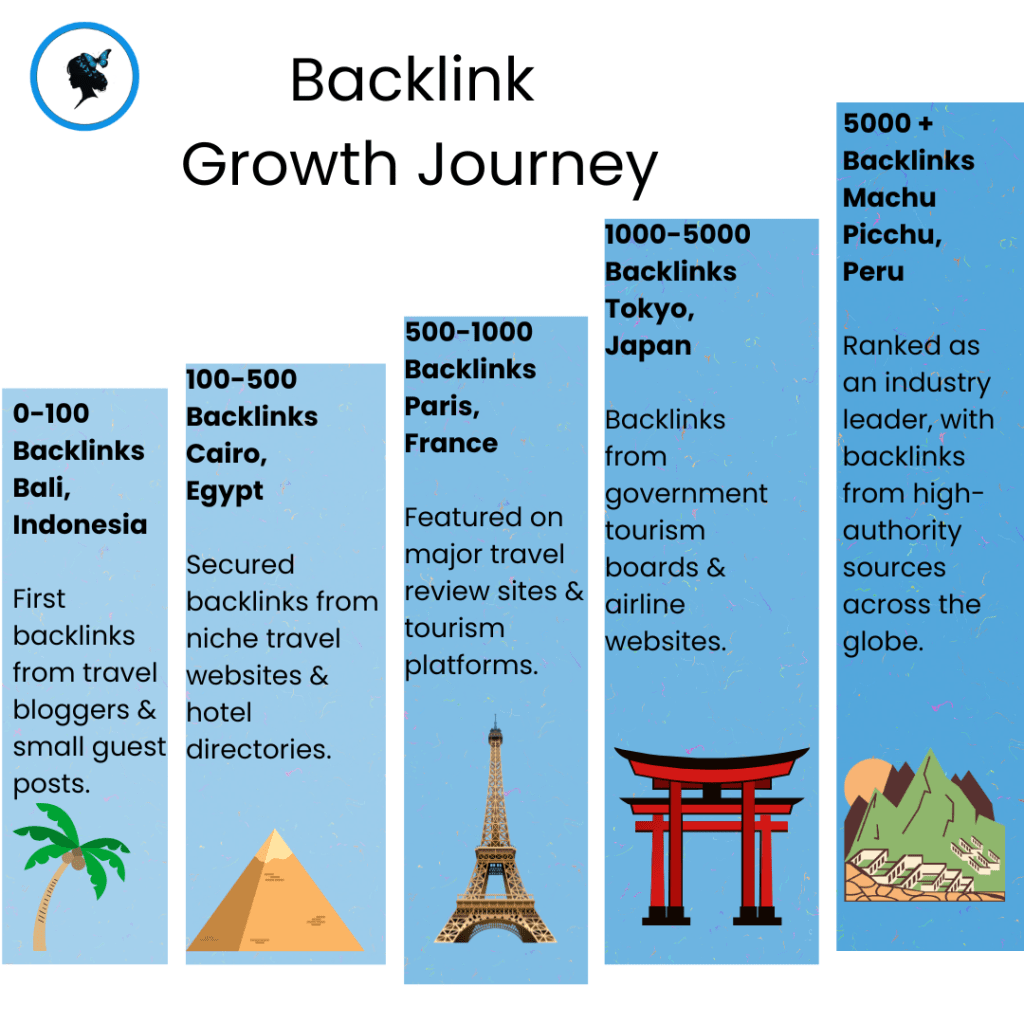
Now that you’ve cleaned up your backlink profile, it’s time to focus on building more high-quality backlinks. You can:

  • Reach out to authoritative websites in the travel industry for guest posting opportunities, collaborations, or content partnerships.
  • Create shareable content such as infographics, blog posts, or destination guides that naturally attract backlinks.
  • Monitor your competitors to see where they’re getting backlinks and identify new link-building opportunities.

Backlink acquisition is an ongoing process, and regularly auditing your backlinks ensures that you are constantly improving the quality of your backlink profile.


For travel companies, backlinks play a crucial role in enhancing SEO performance and boosting organic traffic.

Here’s why regular backlink audits are vital for travel businesses:

1. Boost Your Website’s Authority

High-quality backlinks from reputable websites help establish your travel company as an authority in the industry. When authoritative travel blogs, media outlets, or tourism websites link to your content, it signals to search engines that your site is a credible source of information.

2. Improve Search Engine Rankings

Search engines like Google prioritize websites with strong backlink profiles in their rankings. By regularly auditing your backlinks and removing toxic links, you ensure that search engines view your site favorably, improving your chances of ranking higher for relevant keywords.

3. Increase Organic Traffic

When you have high-quality backlinks, you’re not only boosting your SEO rankings but also increasing the likelihood that visitors from those sites will click through to your travel website. This leads to an increase in referral traffic, which can drive more potential customers to your site.

4. Protect Your Website from Penalties

Toxic backlinks can harm your website’s reputation, and Google can penalize websites with unnatural link profiles. By conducting regular backlink audits, you can catch harmful backlinks before they impact your rankings and ensure your site remains compliant with Google’s quality guidelines.

5. Stay Competitive in the Travel Industry

In the highly competitive travel industry, a solid backlink strategy can make all the difference. By auditing your backlink profile and identifying new opportunities, you can outmaneuver your competitors and attract more visitors to your travel site.


Need help? Contact us Today!


How to Create Local Guides That Rank + Convert


▶ Table of Contents

Page updated 26th April, 2026.

A Step-by-Step Framework for Small Businesses

If you run a small business, you don’t need more blog posts—you need pages that bring in customers.

That’s where local guides come in.

In 2026, nearly 46% of all Google searches have local intent, and 76% of people who search locally visit a business within 24 hours.

That means your content isn’t just marketing—it’s directly tied to real-world revenue.

This guide will show you how to create high-intent, local content that ranks in search, appears in AI results, and converts readers into customers.

What a “Guide” Actually Is Now

A guide is no longer just informational content.

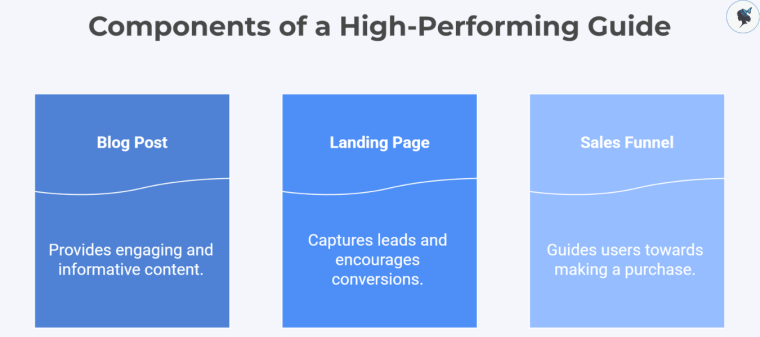
Today, a high-performing guide is:

  • Part blog post
  • Part landing page
  • Part sales funnel

It helps people choose, compare, and take action.

infograph: Components of a high-performing guide
Components of a high-performing guide

Examples of modern guides:

  • Best coworking spaces in Austin
  • Top hair salons for curly hair in Toronto
  • Cafés in Berlin where you can work remotely

Why this works: Most local searches are decision-stage queries, not browsing. Nearly 78% of local mobile searches lead to offline purchases, making them some of the highest-converting searches online.


Step 1: Start With Intent (Not Just Keywords)

Most businesses target broad keywords.

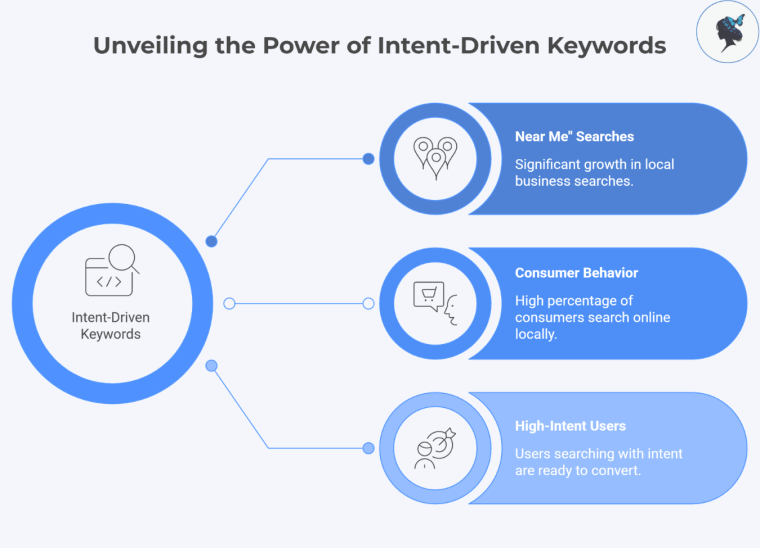
But high-performing guides focus on intent-driven, specific searches.

infograph: Unveiling the power of intent-driven keywords
Unveiling the power of intent-driven keywords

Use this formula:

Best / Top / Affordable / Near me + Service + Location + Detail

Examples:

  • best Pilates studio for beginners in Vancouver
  • affordable wedding photographer in Lisbon
  • quiet cafés to work from in Amsterdam

Why this matters:

These are high-intent, ready-to-act users.

More about search intent here.


Step 2: Structure Your Guide for Conversions

People don’t read—they scan.

And in 2026, search engines (and AI tools) scan too.

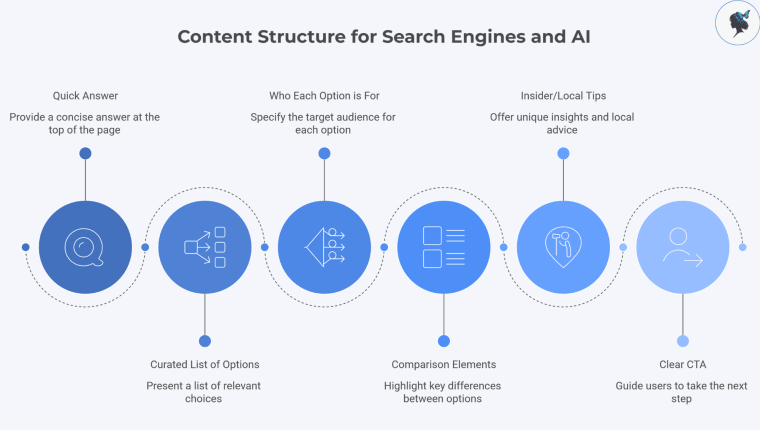
infograph: Content structure for search engines and AI
Content structure for search engines and AI

Use this structure:

1. Quick answer (above the fold)
2. Curated list of options
3. Who each option is for
4. Comparison elements
5. Insider/local tips
6. Clear CTA

Why this works: Google increasingly surfaces structured content in AI summaries, which now appear in a growing percentage of queries.

If your content is easy to extract, it’s more likely to be shown.


Step 3: Optimize for AI + Search Engines

Search behavior has changed fast.

AI tools now:

  • Summarize answers
  • Reduce clicks
  • Prioritize clarity

In fact, AI-generated answers now appear in a significant portion of search results and are expanding rapidly across countries.

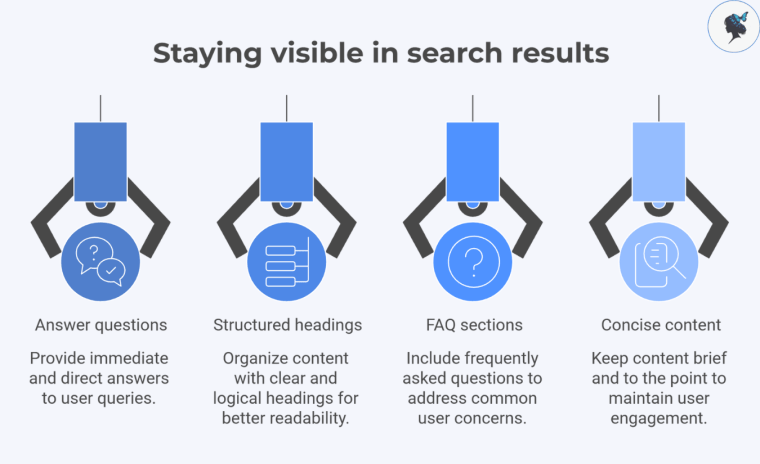
infograph: Staying visible in search results
Staying visible in search results

To stay visible:

  • Answer questions immediately
  • Use structured headings
  • Add FAQ sections
  • Keep content concise

Think: “Can this be pulled into an answer box or AI summary?”

More about on-page SEO for local service businesses here.


Step 4: Add a Local SEO Layer

This is where small businesses win.

Because local search isn’t just traffic—it’s action.

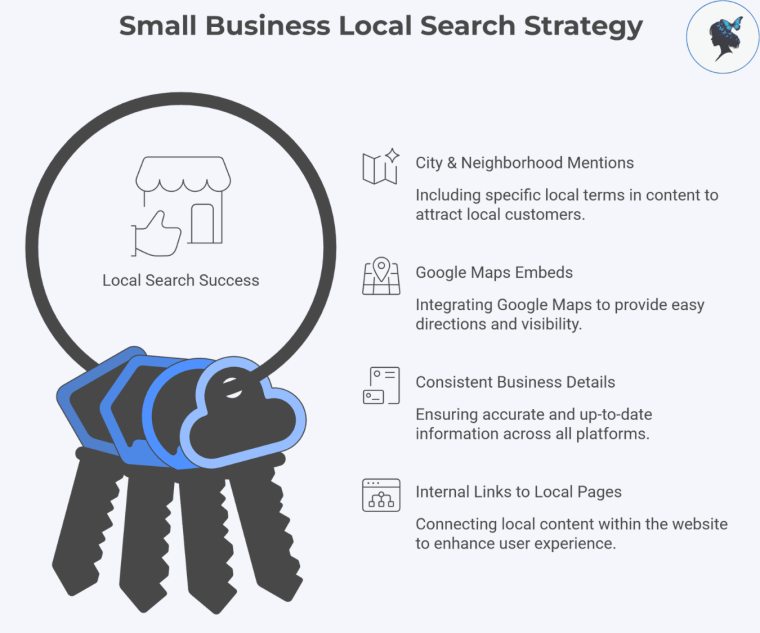
infograph: Small business local search strategy
Small business local search strategy

Include:

  • City + neighborhood mentions
  • Google Maps embeds
  • Consistent business details
  • Internal links to local pages

Why this matters:

And most importantly: Google Business Profile drives real conversions, with actions like calls, directions, and bookings increasing 41% year-over-year.


Step 5: Build Trust Into Every Section

Traffic doesn’t convert without trust.

And in 2026, trust is measurable.

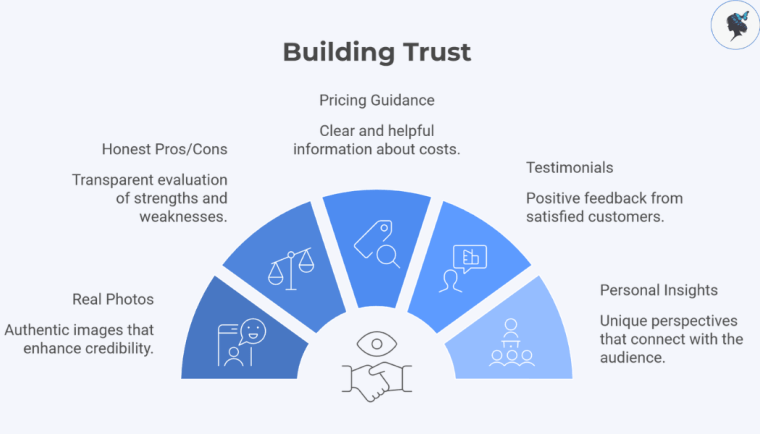
infograph: Building trust
Building trust

Add:

  • Real photos
  • Honest pros/cons
  • Pricing guidance
  • Testimonials
  • Personal/local insights

This is your advantage over AI: Real experience + credibility

More about the role of trust signals here.


Step 6: Turn One Guide Into a Content System

One guide is good. A network is better.

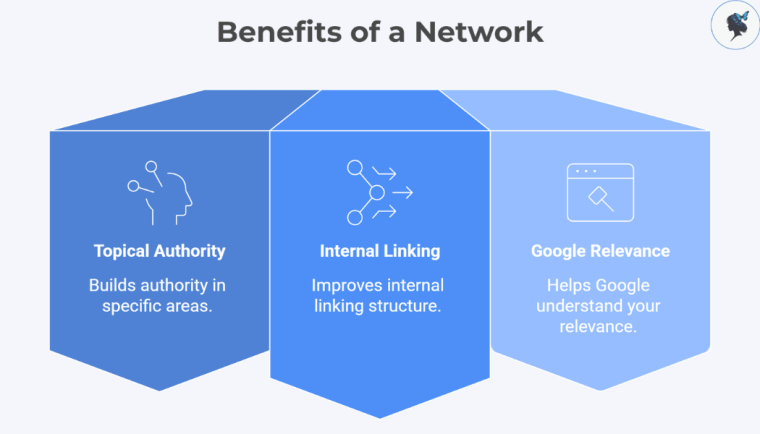
infograph: Benefits of a network
Benefits of a network

Example:

  • Chicago hub page
    • Best brunch spots in Chicago
    • Best gyms in Chicago
    • Best coworking spaces in Chicago

Why this works:

  • Builds topical authority
  • Improves internal linking
  • Helps Google understand your relevance

Local Pack results can capture a significant share of clicks—with studies showing top local listings often receiving a large portion of mobile and local search traffic, sometimes exceeding organic results depending on query intent.


Step 7: Add Strategic CTAs (Without Being Pushy)

Local search is high intent. People are ready to act.

That’s why:

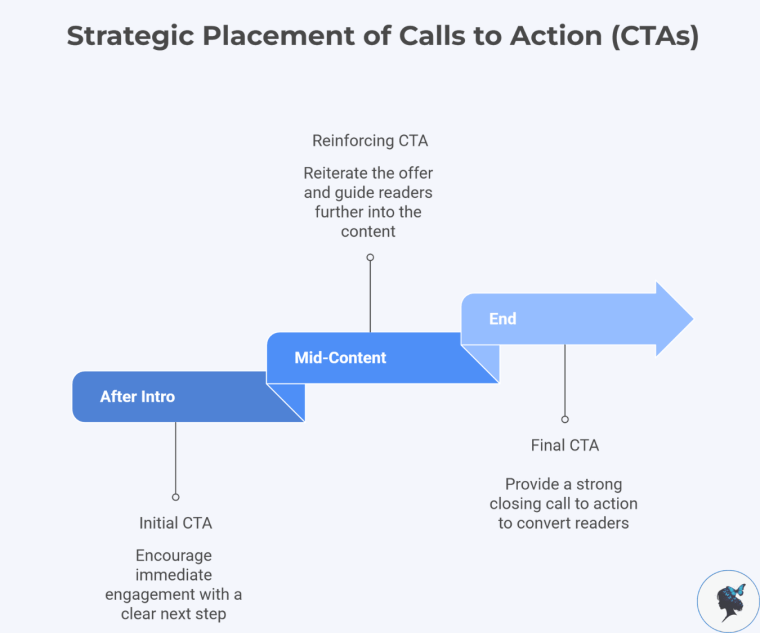
infograph: Strategic placement of CTAs
Strategic placement of CTAs

Place CTAs:

  • After intro
  • Mid-content
  • End

Examples:

  • Book a consultation
  • Reserve a spot
  • Call now
  • Get directions

Make the CTA feel like the natural next step.

More about the importance of clear CTAs here.


Step 8: Make It Feel Current (2026 Reality)

Search isn’t what it was 2 years ago.

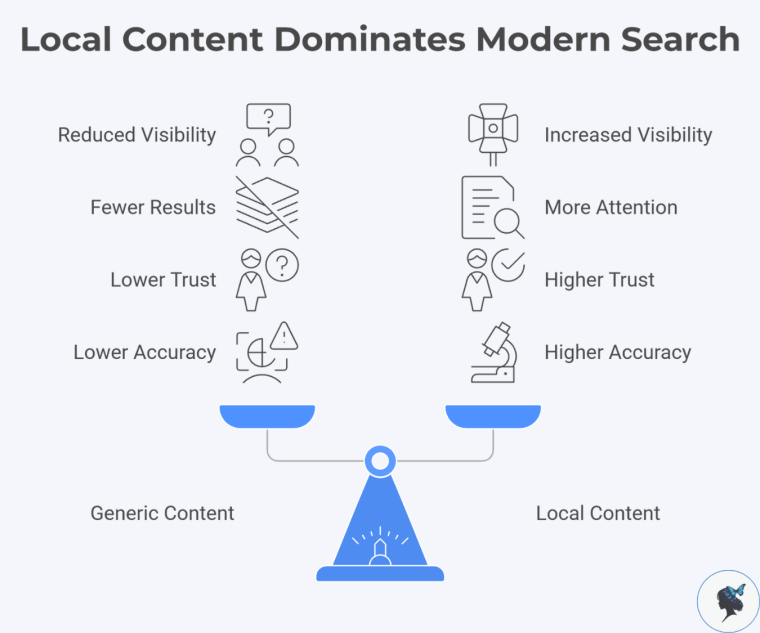
infograph: Local content dominates modern search
Local content dominates modern search

What’s changed:

  • AI answers reduce visibility for generic content
  • Fewer results get attention
  • Trust + accuracy matter more than ever

Local SEO today is driven by:

  • Proximity
  • Reviews
  • Business activity
  • Data consistency

Generic content loses.
Specific, local, experience-based content wins.


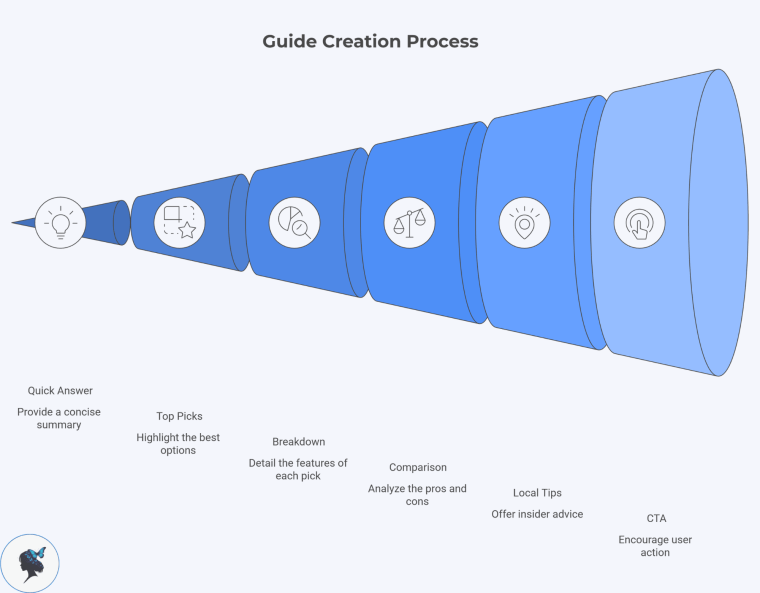
Step 9: Example Guide Template

infograph: Guide creation process
Guide creation process

Title: Best [Service] in [City] (2026 Guide)

Example: Best Independent Bookstores in Edinburgh

Structure:

  • Quick answer
  • Top picks
  • Breakdown
  • Comparison
  • Local tips
  • CTA
  • FAQ

Step 10: Small Business Guide SEO Checklist (2026)

Before publishing:

  • One clear keyword focus
  • Local modifier included
  • Strong intro with quick answer
  • Structured headings
  • Internal links
  • Real photos
  • CTA included
  • FAQ section
  • Mobile optimized

Because today: Visibility = clarity + trust + local relevance


Final Thought

Local guides aren’t content.

They’re conversion assets.

With nearly half of all searches being local and the majority leading to real-world actions, the opportunity is massive.

The goal isn’t just to rank.

It’s to create something so useful that people think: “This is exactly what I needed—I’ll go with them.”

Need help? Contact us today!
Common SEO Mistakes Small Businesses Make (and How to Fix Them)


▶ Table of Contents

Updated May 25, 2026.

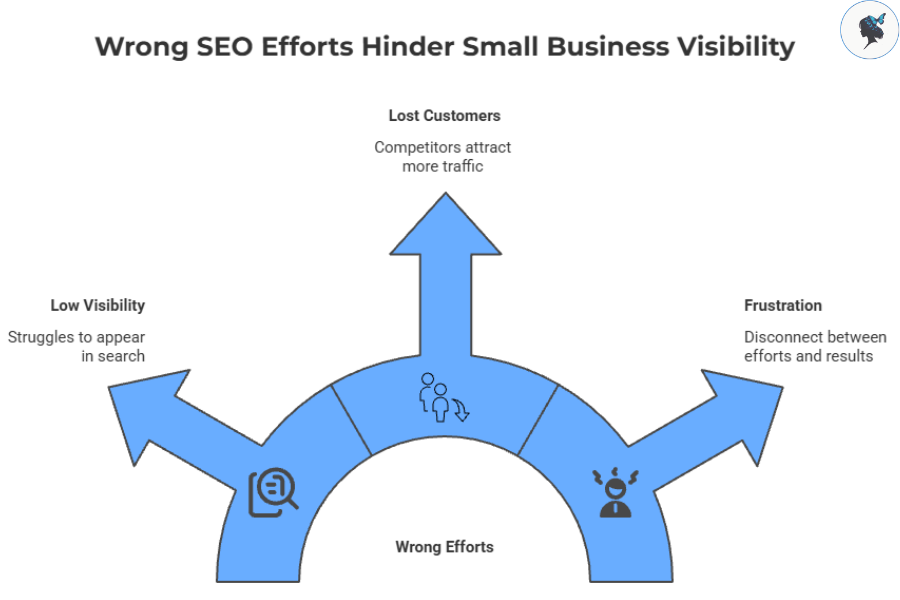
Small businesses rarely fail at SEO because they do nothing. More often, they fail because they spend time on the wrong things.

A business owner updates blog posts, posts regularly on social media, tweaks keywords, maybe even pays for an SEO plugin—and still struggles to appear in search results. Meanwhile, competitors with simpler websites somehow attract more traffic and more customers.

That disconnect has become even more frustrating in 2026.

infograph: Wrong SEO efforts hinder small business visibility
Wrong SEO efforts hinder small business visibility

Search engines no longer reward websites simply for inserting keywords into pages. They increasingly prioritize useful content, trustworthy information, fast user experiences, and businesses that genuinely answer customer questions well. AI-generated search summaries are also changing how people discover companies online, making visibility more competitive than ever.

The good news is that most SEO problems small businesses face are fixable.

You do not need a massive budget or a full-time marketing team to improve your visibility. You need clarity, consistency, and a better understanding of how customers actually search online.

Here are the most common SEO mistakes small businesses make today—and practical ways to fix them.


Trying to Rank for Everything

One of the biggest mistakes small businesses make is attempting to compete for broad, highly competitive search terms.

A local accounting firm wants to rank for “finance.”
A bakery wants to rank for “desserts.”
A fitness coach targets “workout plans.”

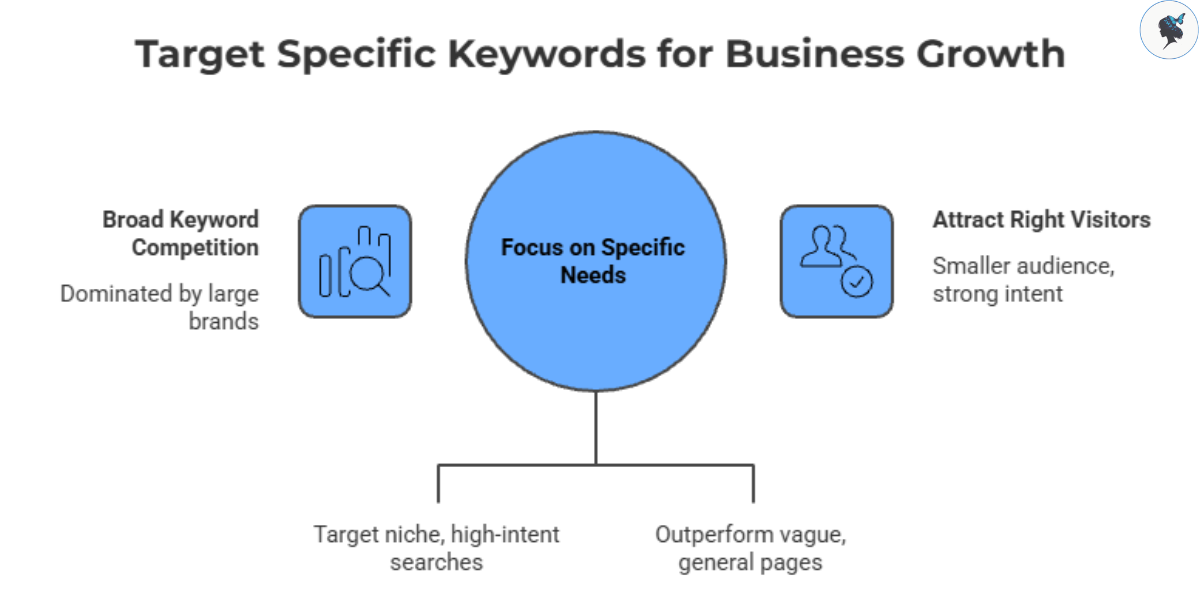
These terms are too broad and often dominated by large brands with huge marketing budgets. More importantly, broad searches usually attract people who are browsing, not buying.

Search engines increasingly prioritize intent and topical relevance over sheer keyword volume. Focused, useful content consistently outperforms vague, general pages.

infograph: Target specific keywords for business growth
Target specific keywords for business growth

How to fix it

Instead of targeting broad terms, focus on highly specific customer needs.

For example:

  • “custom vegan birthday cakes”
  • “bookkeeping for freelance designers”
  • “strength training for beginners over 40”

Specific searches may attract fewer visitors, but they often attract the right visitors.

A smaller audience with strong intent is usually more valuable than large amounts of unfocused traffic.

Read our guide: mastering long-tail keywords.


Writing Content for Algorithms Instead of Humans

Some small business websites still sound like they were written for search engines instead of actual people. You see pages repeating the same phrase over and over:

This kind of writing creates a poor experience for readers — and increasingly, for rankings too.

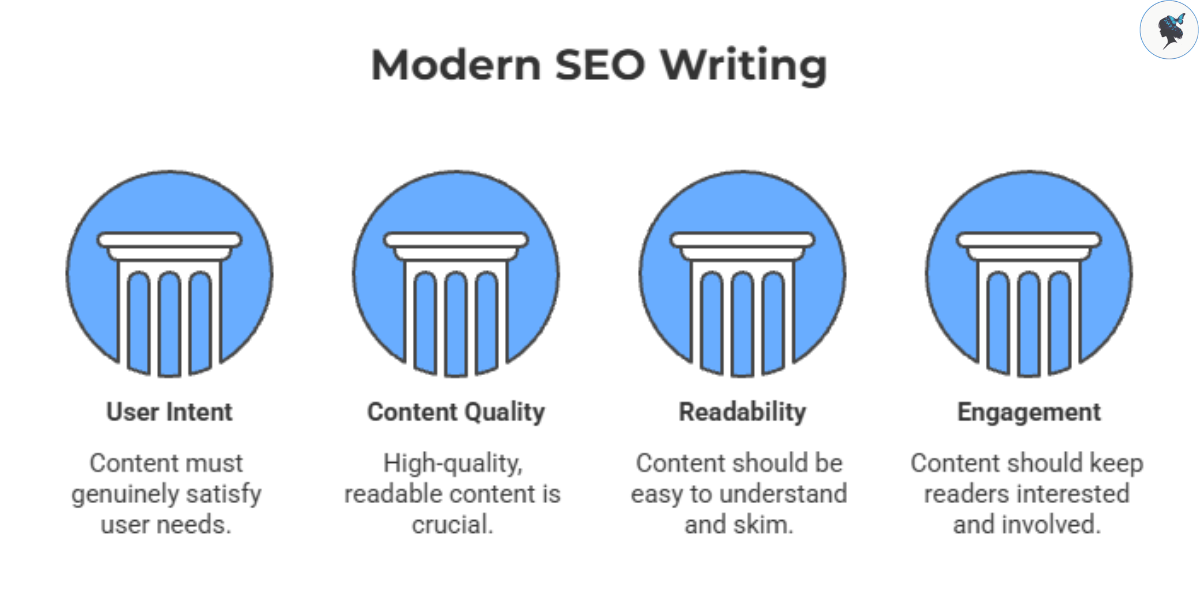
Modern search systems evaluate whether content genuinely satisfies user intent. Content quality, readability, and engagement matter far more than repetitive keyword placement.

infograph: Modern SEO writing
Modern SEO writing

How to fix it

Write the way you naturally explain your business to customers.

A simple test helps: If the wording would sound strange in a face-to-face conversation, rewrite it.

Good SEO writing is usually:

  • clear
  • specific
  • helpful
  • easy to skim
  • free from unnecessary jargon

The goal is not to “sound optimized.” The goal is to answer questions clearly.


Ignoring What Customers Actually Search For

Many businesses create content based on what they think matters instead of what customers are actively searching for. That creates a mismatch between the website and real-world demand.

For example, a landscaping company might publish pages about “premium outdoor environmental enhancements” while customers are simply searching for:

  • “backyard drainage help”
  • “small patio ideas”
  • “easy garden maintenance”

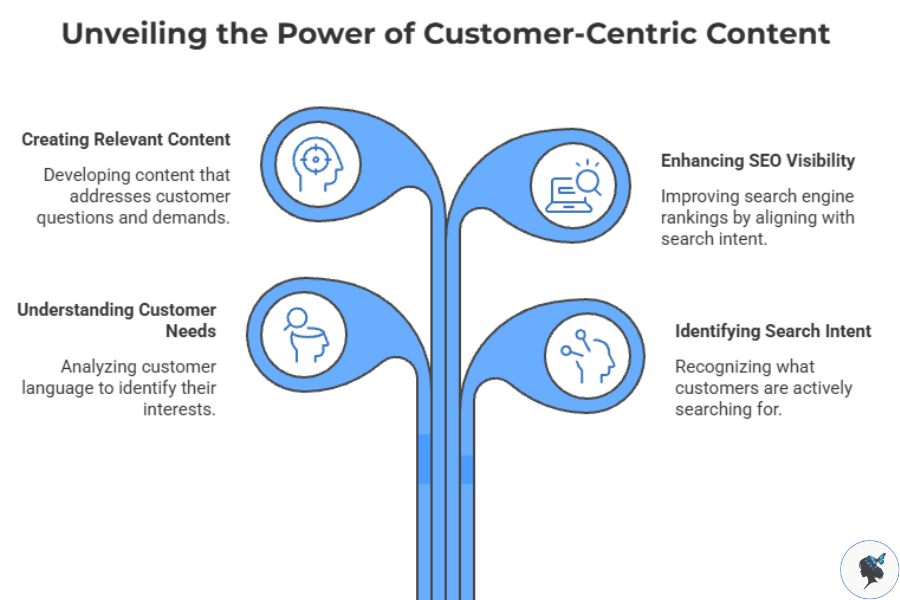
Intent alignment has become one of the strongest visibility signals in modern SEO.

infograph: Unveiling the power of customer-centric content
Unveiling the power of customer-centric content

How to fix it

Start listening to customer language more carefully.

Useful sources include:

  • customer emails
  • live chat questions
  • sales calls
  • online reviews
  • autocomplete suggestions in search engines

If five customers ask the same question, that question probably deserves its own page or article.

The simplest SEO strategy is often the most effective: answer real questions better than competitors do.

More about search intent here.


Having a Slow Website

Many small business websites lose customers before visitors even see the content.

Slow loading times frustrate users, especially on mobile devices. Search engines also continue to use page experience and performance signals as ranking factors.

Even a visually attractive website can underperform if it feels sluggish.

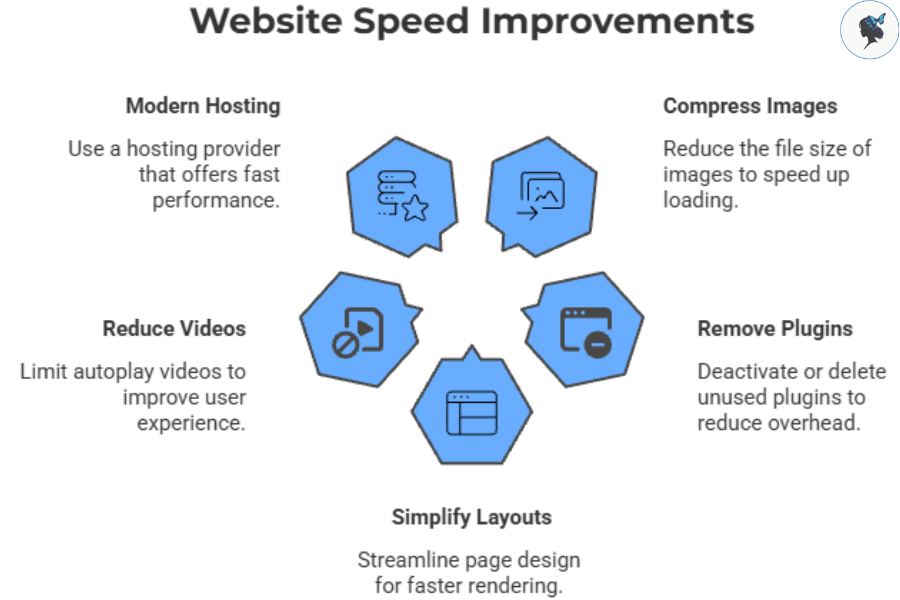
infograph: Website speed improvements
Website speed improvements

How to fix it

You do not need a complicated rebuild to improve speed.

Start with practical improvements:

  • compress large images
  • remove unnecessary plugins
  • simplify page layouts
  • reduce autoplay videos
  • use modern website hosting

A fast, simple website often performs better than an elaborate one packed with effects.

More about website speed optimization here.


Treating Mobile Users as an Afterthought

Most people now discover businesses through phones first, not desktop computers.

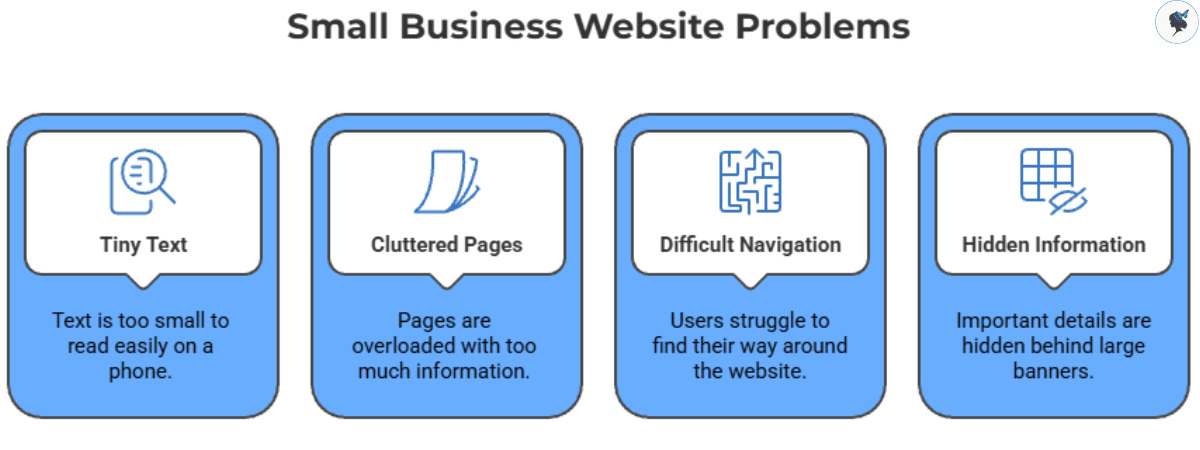
Yet many small business websites still:

  • use tiny text
  • overload pages with clutter
  • create difficult navigation
  • hide important information below large banners

Search systems increasingly evaluate mobile usability as part of overall user experience.

infograph: Small business website problems
Small business website problems

How to fix it

Open your website on your own phone and ask:

  • Can I navigate this quickly?
  • Can I contact the business easily?
  • Is the text readable?
  • Does the page feel frustrating?

Small changes matter:

  • larger buttons
  • shorter paragraphs
  • clearer menus
  • faster loading images

Good mobile experiences are rarely flashy. They are simply friction-free.

More about mobile optimisation here.


Publishing Blog Posts Without a Purpose

Many businesses start blogging because they heard “content helps SEO.”

That part is true.

But random blog posts without strategy rarely produce meaningful results.

A restaurant posting “Top Summer Trends” or a consultant publishing generic motivational articles often creates content disconnected from customer needs.

Search engines increasingly reward topical depth and usefulness over random publishing frequency.

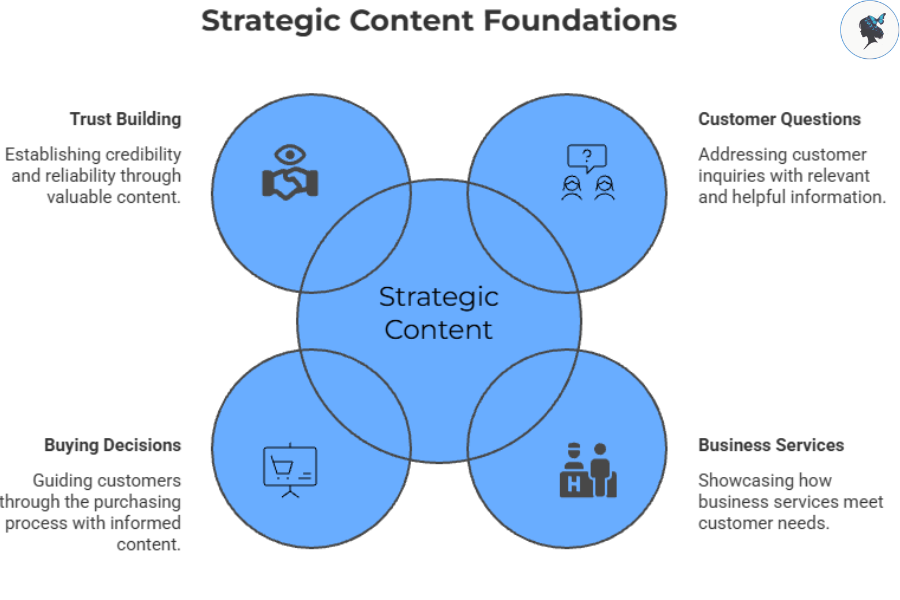
infograph: Strategic content foundation
Strategic content foundation

How to fix it

Every piece of content should connect to:

  • a customer question
  • a business service
  • a buying decision
  • a trust-building opportunity

Before publishing an article, ask: “What practical problem does this solve?”

Good content usually helps customers:

  • understand
  • compare
  • decide
  • avoid mistakes
  • feel confident

Ignoring Reviews and Reputation Signals

Reviews are no longer just customer feedback. They are visibility signals.

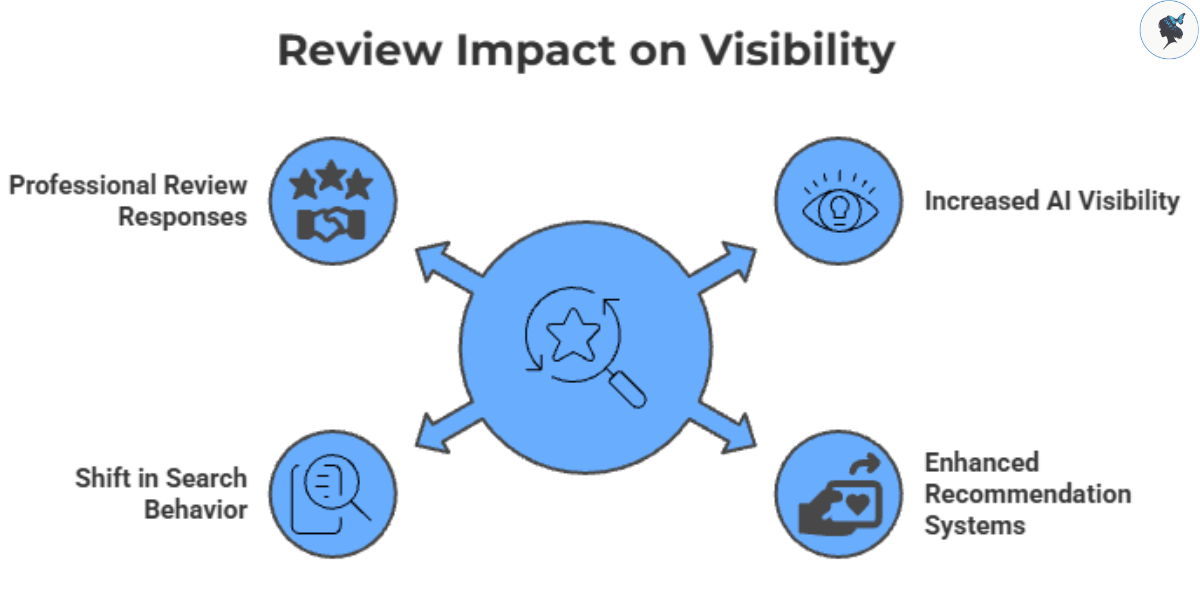
Recent reporting in 2026 suggests businesses with stronger review profiles appear more frequently in AI-generated search responses and recommendation systems. That shift matters because search behavior itself is changing.

People increasingly rely on AI summaries, maps, reviews, and aggregated recommendations before ever visiting a website.

infograph: Review impact on visibility
Review impact on visibility

How to fix it

Make review collection part of normal operations. Simple methods work best:

  • ask after successful purchases
  • send short follow-up emails
  • make review links easy to access

Equally important: respond professionally to reviews, including negative ones. Potential customers often judge businesses more by how they handle criticism than by perfect ratings.


Neglecting Local Search Visibility

Many small businesses underestimate how much search behavior is locally driven.

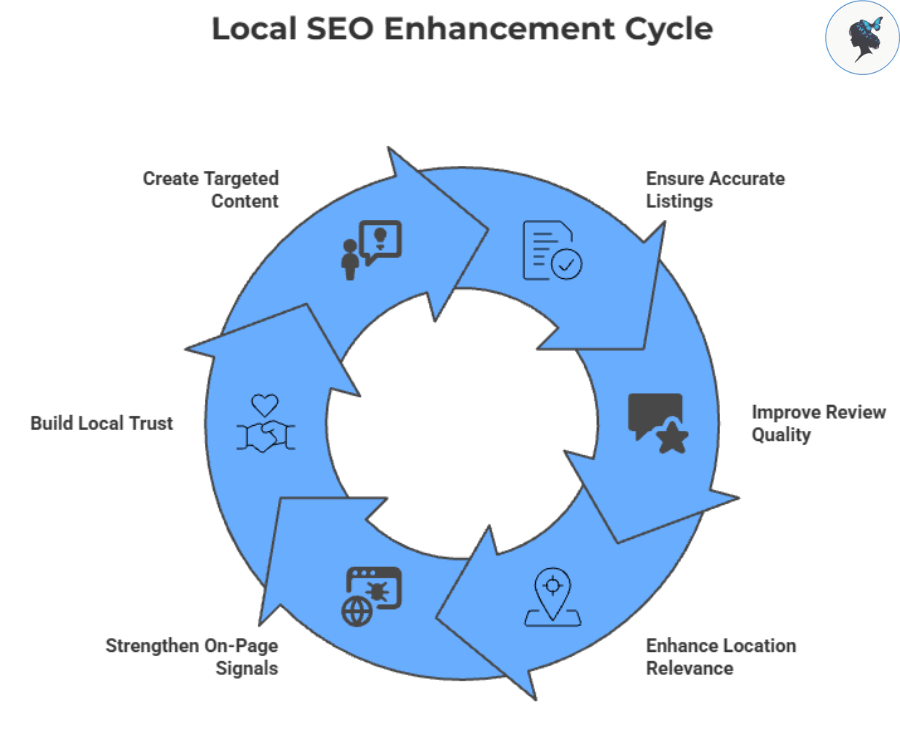
Research on local SEO ranking factors in 2026 continues to show the importance of:

  • accurate business listings
  • review quality
  • location relevance
  • on-page local signals

Even businesses serving broader markets benefit from local trust signals.

infograph: Local SEO enhancement cycle
Local SEO enhancement cycle

How to fix it

Make sure your:

  • contact information is consistent everywhere
  • business hours are updated
  • service areas are clearly explained
  • business profiles are fully completed

Also create pages around real customer needs tied to local intent. For example:

  • “same-day emergency electrician”
  • “family-friendly brunch spot”
  • “wedding florist consultation”

Specificity usually beats generic marketing language.


Expecting SEO to Work Instantly

This may be the most emotionally exhausting mistake. Small businesses often invest in SEO for a few months, see limited results, then abandon the effort completely.

But SEO compounds slowly.

A useful article published today may continue generating leads for years. Meanwhile, inconsistent stop-and-start efforts rarely build momentum.

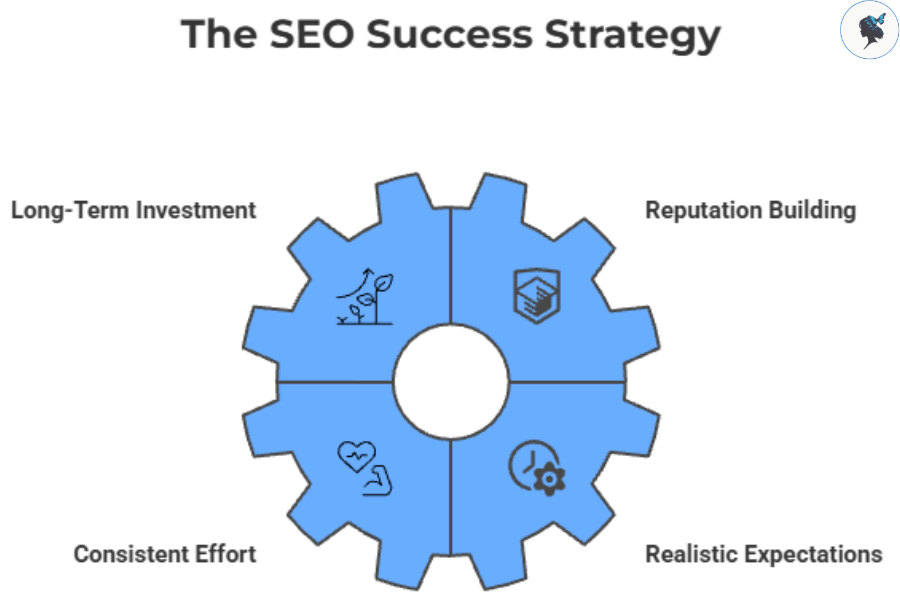
infograph: The SEO success strategy
The SEO success strategy

How to fix it

Treat SEO like reputation building, not advertising.

Paid ads can create immediate traffic.
SEO creates accumulated visibility over time.

Set realistic expectations:

  • 3 months for early movement
  • 6–12 months for stronger authority
  • ongoing improvements for long-term growth

Consistency matters far more than intensity.


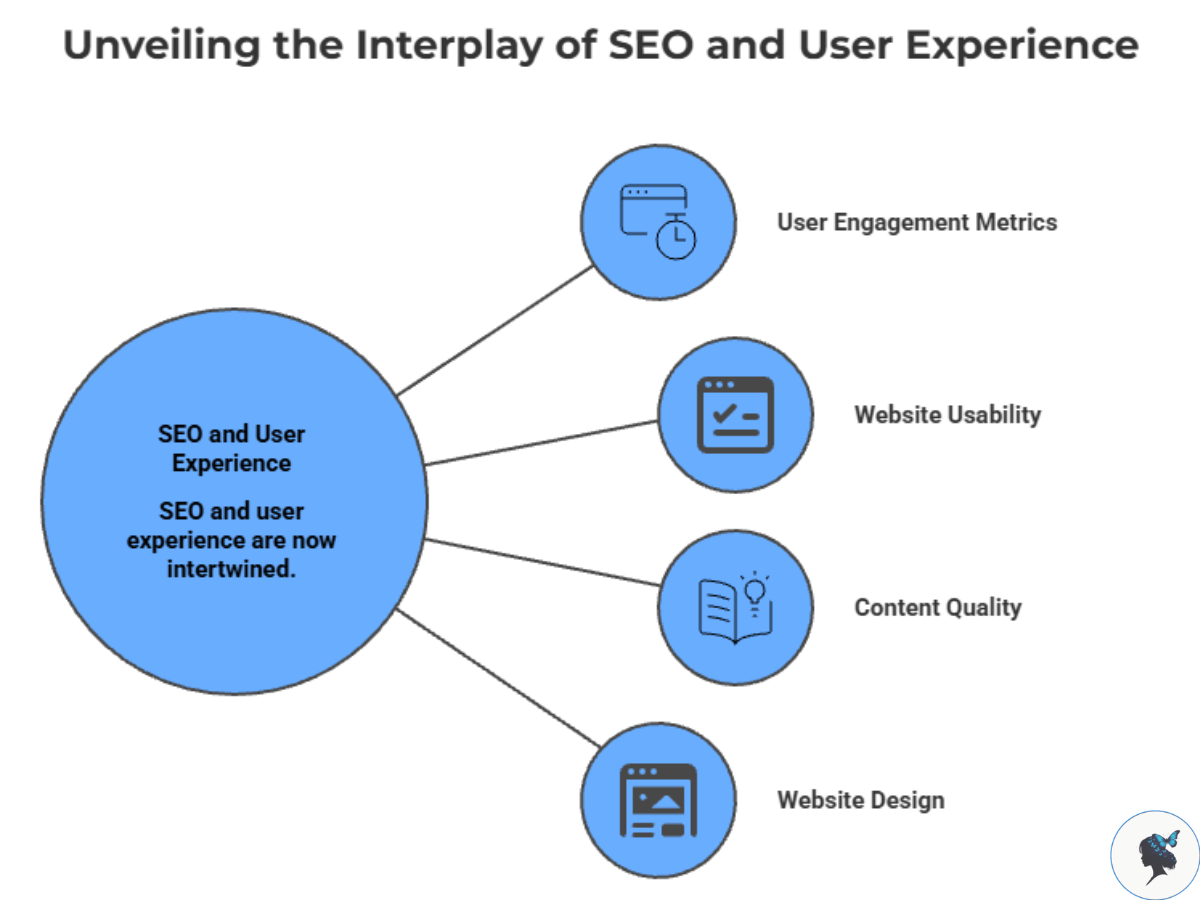
Forgetting That User Experience Is Part of SEO

SEO and user experience are no longer separate conversations. Search systems increasingly evaluate how people interact with websites:

  • how long they stay
  • whether pages are easy to navigate
  • whether content feels satisfying
  • whether users quickly leave and return to search results

This is one reason outdated “SEO tricks” are becoming less effective.

infograph: Unveiling the interplay of SEO and user experience
Unveiling the interplay of SEO and user experience

How to fix it

Focus on making your website genuinely easier to use.

That means:

  • clear navigation
  • readable formatting
  • useful headings
  • concise explanations
  • practical examples
  • fewer distractions

Helpful websites tend to outperform clever ones.

You might like our post: Using Color & Layout to Improve Navigation


Relying Too Heavily on AI-Generated Content

AI tools can absolutely help small businesses create content faster.

But publishing large amounts of generic AI-written material without editing often creates shallow, repetitive pages that add little value.

Search systems increasingly reward originality, experience, and trustworthiness over mass-produced content.

infograph: AI content creation process for small businesses
AI content creation process for small businesses

How to fix it

Use AI as a drafting assistant, not a replacement for expertise. The strongest content usually includes:

  • real examples
  • firsthand experience
  • customer insights
  • practical lessons
  • unique perspectives

A short, genuinely useful article will often outperform a longer generic one.


Practical SEO Improvements Small Businesses Can Make This Month

SEO becomes less overwhelming when broken into small operational improvements. Here are examples of practical adjustments businesses could realistically implement.

Coffee shop in New York

Instead of optimizing for “best coffee,” the business creates pages answering:

  • “quiet cafés for remote work”
  • “best coffee shop for study sessions”
  • “late-night espresso bar”

Result: more relevant traffic and longer visit times.


Boutique hotel in Tokyo

The hotel adds detailed FAQs covering:

  • check-in process
  • transportation tips
  • nearby attractions
  • luggage storage policies

Result: fewer customer uncertainties and stronger search relevance for traveler questions.


Fitness studio in London

The studio publishes beginner-focused content:

  • “what to expect in your first class”
  • “best workouts for office workers”
  • “how to start strength training safely”

Result: improved engagement from hesitant first-time visitors.


Retail store in Sydney

The business rewrites product pages using simpler language and clearer descriptions instead of manufacturer copy.

Result: better readability, improved trust, and stronger conversion rates.


The Bigger Shift Happening in SEO

SEO in 2026 is increasingly about credibility, usefulness, and clarity.

Search engines — and AI search systems — are moving away from rewarding pages that merely look optimized.

They are increasingly prioritizing:

  • trustworthy information
  • strong user experiences
  • real expertise
  • customer satisfaction
  • structured, easy-to-understand answers

That shift actually benefits small businesses in many ways.

Large companies often struggle to sound human. Smaller businesses can move faster, communicate more personally, and answer customer concerns more directly.

That is a competitive advantage.


Conclusion

Most small businesses do not need “advanced SEO hacks.”

They need:

  • clearer messaging
  • faster websites
  • more useful content
  • stronger customer trust
  • better alignment with real search behavior

The businesses that improve online visibility today are rarely the ones chasing algorithms most aggressively.

They are usually the ones making life easier for customers.

If you want better SEO results, start there.

Pick two or three problems from this article and improve them over the next month. Then measure what changes:

  • website traffic
  • calls
  • inquiries
  • bookings
  • customer engagement

SEO is not magic. It is accumulated clarity and trust over time.

Need help? Contact us today!