How to Structure and Maintain Evergreen Destination Seasonal Content Hubs for Travel Sites

▶ Table of Contents
  1. Introduction
  2. Understanding Evergreen Content for Travel Destinations
  3. Why Build a Destination Content Hub
  4. Structuring a Seasonal Evergreen Content Hub
  5. Maintaining Seasonal Relevance
  6. Integrating User‑Generated Content (UGC)
  7. Promoting and Leveraging Seasonal Hubs
  8. Measuring Success and Iterating

Introduction

In the fast‑moving world of travel content, where every destination feels ten minutes away from being “over‑covered,” a smart approach is to build evergreen destination seasonal content hubs. These hubs combine the stability of timeless content with the freshness of seasonal relevance — creating resources that attract search engine traffic, engage travellers consistently, and stay top‑of‑mind year after year.

Why bother? Evergreen content continues to deliver long after publication; in fact, for many websites, evergreen content consistently drives more than a third of total organic traffic. In travel specifically, with seasonal patterns and shifting consumer habits, this hybrid approach of evergreen + seasonality gives you both resilience and relevance.

Wander Women Hot Tip: Start with a “destination hub” strategy rather than hundreds of disconnected blog posts. Think big, centralised, modular — build the library now so that future updates are smoother.


Understanding Evergreen Content for Travel Destinations

1. What Makes Content Truly Evergreen in Travel

infograph: Evergreen travel content
Evergreen travel content
  • Evergreen travel content covers topics that remain relevant regardless of year, season, or fleeting trends: e.g., “How to get to X destination,” “What you must pack for X,” “Cultural norms and local etiquette in X.”
  • It avoids being too tied to a fixed date (e.g., “Summer 2025 deals”) and instead focuses on enduring user needs.
  • In a travel‑destination hub, evergreen pieces can be the “core” of the hub: destination overview, transport and logistics, “must sees,” best time to go (with caveats), local culture, food, safety tips, etc.

2. SEO Benefits of Evergreen Content

infograph: Benefits of Evergreen Content for SEO
Benefits of Evergreen Content for SEO
  • Because it remains relevant, evergreen content drives consistent organic traffic. Search engines favour pages that continue to satisfy user intent, rather than topics that die out.
  • Evergreen pages give excellent internal‑linking opportunities (they become pillars that link out to seasonal or more specific pieces). That strengthens your site architecture and authority.
  • You save resources: you don’t have to constantly churn brand‐new content; instead you maintain and update. One guide noted companies prioritising evergreen content see a 5× higher return on investment than those focusing only on trend‑based content.

Wander Women Hot Tip: Identify 8–12 evergreen “pillar” pages for each destination (e.g., Getting There, Where to Stay, Food & Drink, Culture & Customs, Best Time to Visit, Practical Tips). These become the foundation of your hub. Then seasonal content layers on top.


Why Build a Destination Content Hub

1. Benefits Over Stand‑alone Blog Posts

infograph: Destination hub benefits
Destination hub benefits
  • A hub creates structure: instead of random blog posts, you have a parent page (“destination hub”) and child pages (evergreen + seasonal) that nest logically.
  • Search engines see this structure as topical authority: you’re demonstrating your site knows all about destination X, not just that you occasionally wrote about it.
  • For users, it’s better: if someone lands on your hub for “Visit X”, they find everything in one place — not just a blog post bouncing them out. This increases engagement, time on site, and reduces bounce rates.
  • Stand‑alone posts may generate a short‑term spike but then fade. A hub is more sustainable.

More about content clusters (hubs) here.

2. How Content Hubs Improve User Experience

infograph: Hub content suggestions
Hub content suggestions
  • Use the parent hub as a gateway: quick snapshot of destination + links to deeper dives (seasonal activities, upcoming festivals, itineraries, FAQs).
  • Provide navigation aids: e.g., a “Select your season” filter so travellers see what to do in spring vs winter.
  • Include rich content: maps, image galleries, interactive features (quiz: “Which season at X fits you best?”).
  • Add CTAs (calls to action): newsletter signup for seasonal updates, booking enquiry, user photo gallery submission.

Wander Women Hot Tip: Design the hub UI/UX like a mini‑magazine: think “Explore Destination X” homepage with cards for each season, “In this month”, “Insider tips”, “Traveller stories.” Make it visually appealing and scannable.


Structuring a Seasonal Evergreen Content Hub

1. Hub Architecture and Layout

infograph: How to structure the travel hub website?
How to structure the travel hub website?
  • Parent Hub Page: the first destination page a traveller lands on. It includes the overview, key selling points (“Why go here”), quick links to seasons, top experiences, and a “Start planning” CTA.
  • Child Pages — Evergreen Layer: logistics (how to get there, travel documents), accommodations, local culture, cuisine, “must‑do experiences”.
  • Child Pages — Seasonal Layer: each major season (Spring, Summer, Autumn, Winter) gets its own guide: best activities, events, weather guide, seasonal pros & cons, suggested itineraries.
  • Cross‑links and modules: On each seasonal page, link back to the evergreen pages (“Need to know about travel documents? Visit our logistics guide”). Likewise the evergreen page can link to each seasonal page (“Check what’s happening this winter”).
  • Sidebar / module widgets: “Upcoming festival in X”, “Traveller photo of the month”, social feed.
  • Consider a year‑round calendar of events embedded or linked.

2. Balancing Evergreen and Seasonal Content

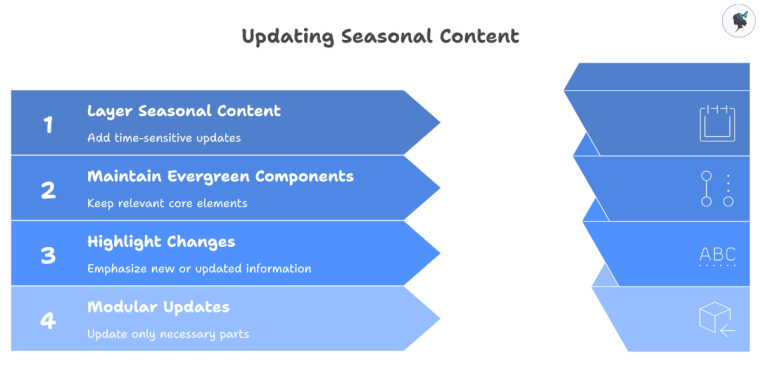
infograph: Updating seasonal content
Updating seasonal content
  • Start with the evergreen core — this remains mostly stable year‑to‑year.
  • Then layer seasonal content — which may require annual updates (dates of festivals, seasonal deals, weather variations, new experiences).
  • Ensure seasonal pages maintain some evergreen components (e.g., “Spring in X: what you can do” still relevant from year to year) but highlight what changes.
  • Use a modular update approach: only parts of the seasonal pages change (dates, deals, new venues); rest remains. That keeps maintenance manageable.

3. Internal Linking Strategy

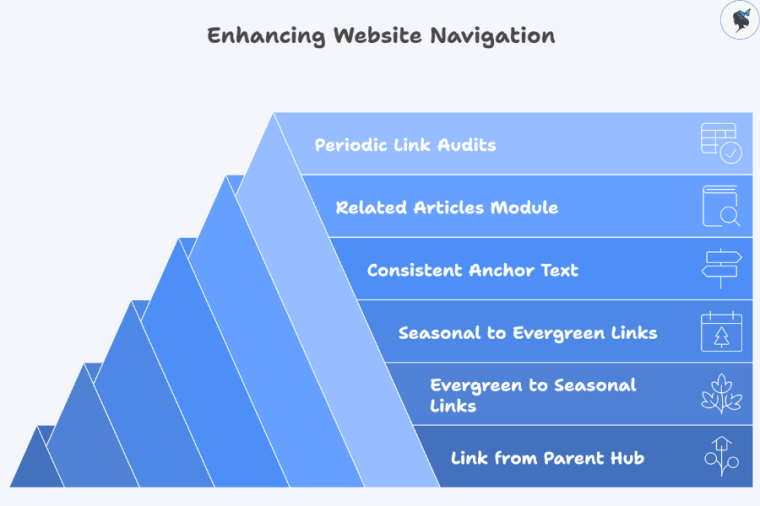
infograph: Enhancing website navigation
Enhancing website navigation
  • Link from parent hub – evergreen pages – seasonal pages.
  • On evergreen pages, include “Explore this destination by season” links.
  • On seasonal pages, include “Also check: full destination guide” links.
  • Use consistent anchor text: e.g., “Visit X in autumn” or “Autumn activities in Destination X”.
  • Use a “Related articles” module at bottom of every page to suggest deeper reads (which helps dwell time).
  • Perform periodic audits of links to ensure seasonal pages still point to correct evergreen pages and vice versa.

Wander Women Hot Tip: Set up a mini‑site‑map or interactive menu within the hub that lets users jump to “Summer activities”, “Winter festivals”, “Family travel”, etc. The clearer your internal linking, the more search engines (and travellers) see the depth of your coverage.


Maintaining Seasonal Relevance

1. Updating Content for Each Season

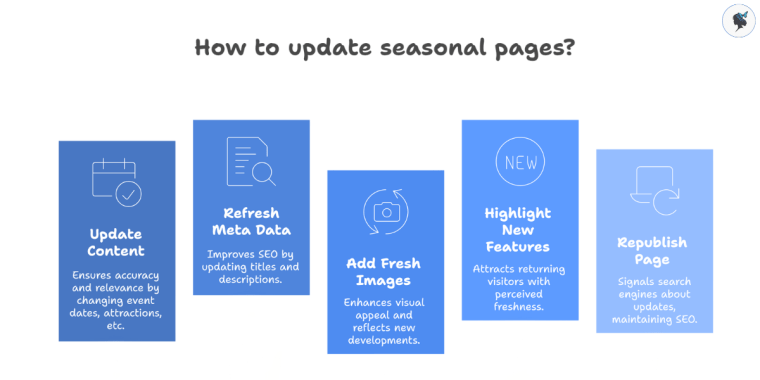
infograph: How to update seasonal pages?
How to update seasonal pages?
  • At set intervals (quarterly or annually), review each seasonal page: update event dates, new attractions, closures, weather data, deals.
  • Refresh meta titles/descriptions when changes occur (e.g., “What’s new for Autumn 2026 in Destination X”).
  • Add fresh images or user‑submitted photos to reflect updates (e.g., new festival venue).
  • Highlight “What’s new this season” inside each seasonal page — creates perceived freshness for returning visitors.
  • Republish or refresh the page (even if URL remains same) to signal search engines it’s current.

2. Automating Seasonal Updates

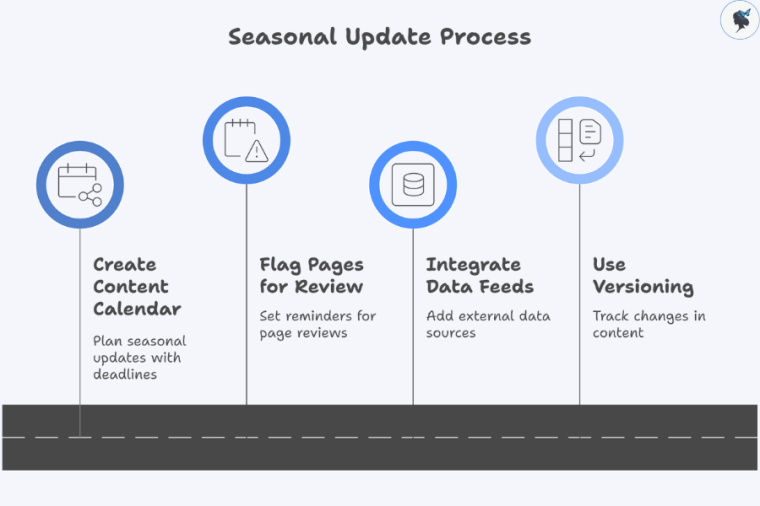
infograph: Seasonal update process
Seasonal update process
  • Maintain a content calendar: at the start of the year list all hubs + seasonal updates with deadlines.
  • Use CMS features to flag when a page is due for review (6‑12 months after last update).
  • Consider integrating data feeds: e.g., event partner API, weather service widget, local tourism board feed for upcoming events.
  • Use versioning: keep a revision log so you know what changed from last season — helpful during audits.

Wander Women Hot Tip: Create a “Seasonal update checklist” for each destination: events, weather, closures, new attractions, traveller tips changes. Use it year after year with tweaks — saves time and ensures nothing is overlooked.


Integrating User‑Generated Content (UGC)

1. Benefits of UGC in Travel Content

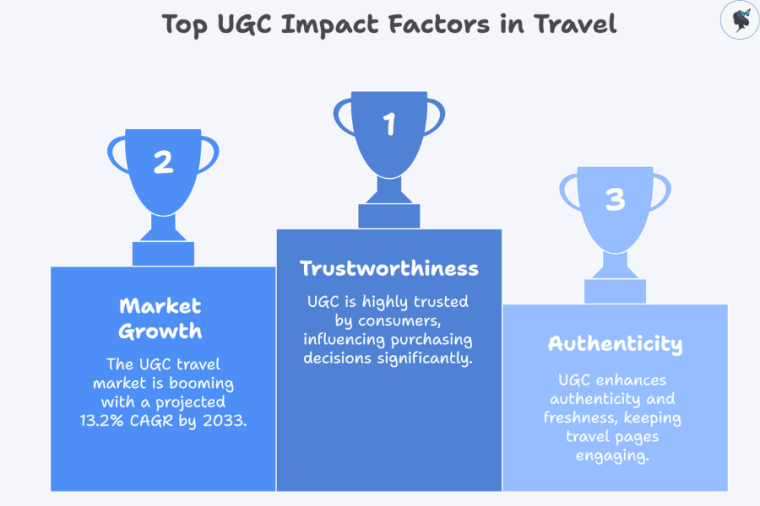
infograph: Top UGC impact factors in travel
Top UGC impact factors in travel
  • UGC is seen as highly trust‑worthy: a study found 79% of consumers say user‑generated content significantly influences their purchasing decisions.
  • In the travel market, the global user‑generated content for travel market size was US$10.4 billion in 2024, with a projected compound annual growth rate (CAGR) of 13.2% out to 2033.
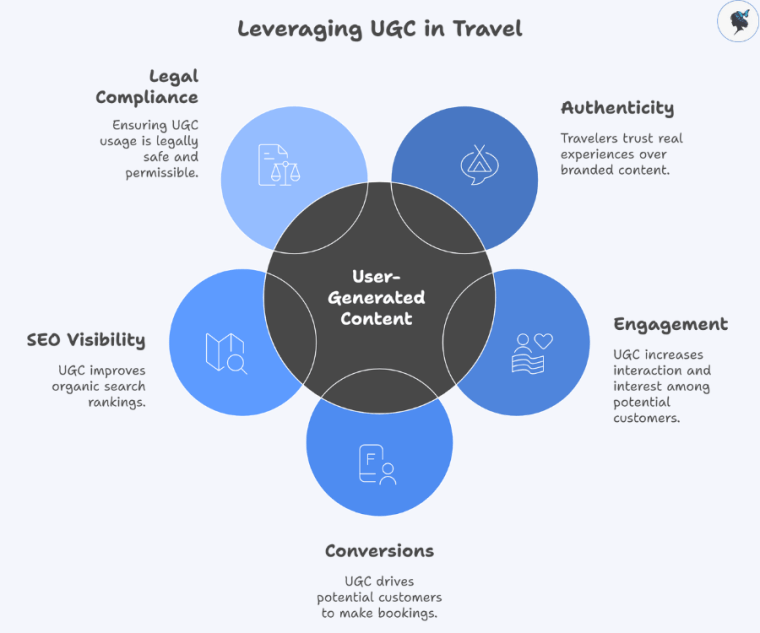
  • UGC enhances authenticity and freshness, and when naturally embedded in a hub, keeps pages alive and engaging.

Read our post: Use User‑Generated Content as SEO Assets

2. Sources of UGC

infograph: Types of user-generated content
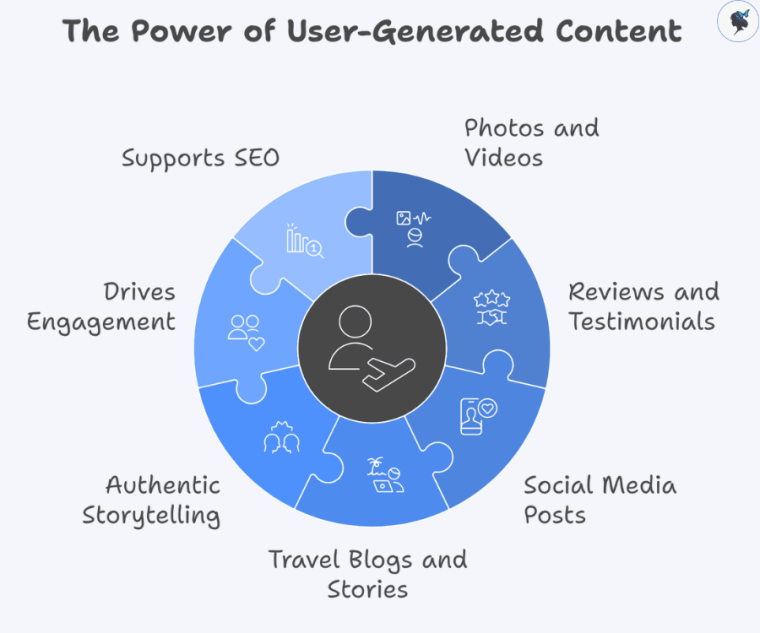
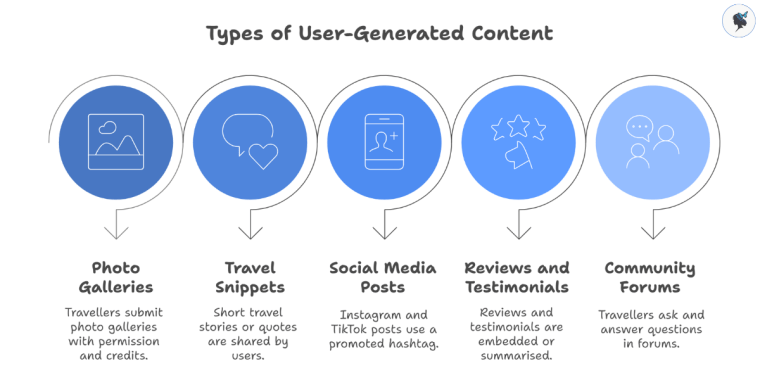
Types of user-generated content
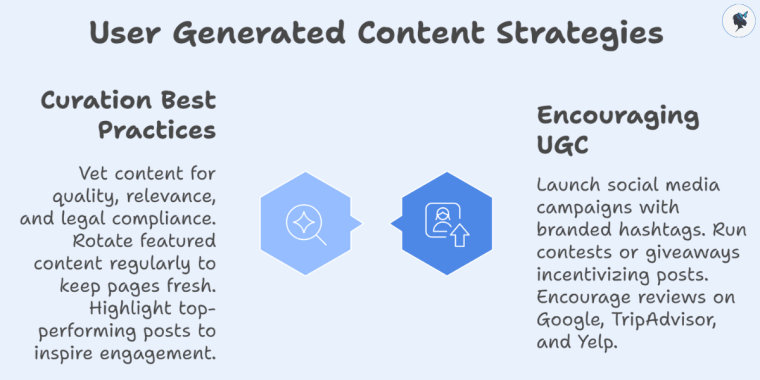
  • Photo galleries submitted by travellers (with permission/credits).
  • Short travel‑story snippets or quotes (“I loved sunrise at X”).
  • Instagram / TikTok posts using a hashtag you promote (e.g., #MyTripToX).
  • Reviews and testimonials — embed or summarise within seasonal/evergreen pages.
  • Community Q&A or forums on your site: travellers ask and answer.

3. Displaying UGC Effectively

infograph: UGC integration strategies
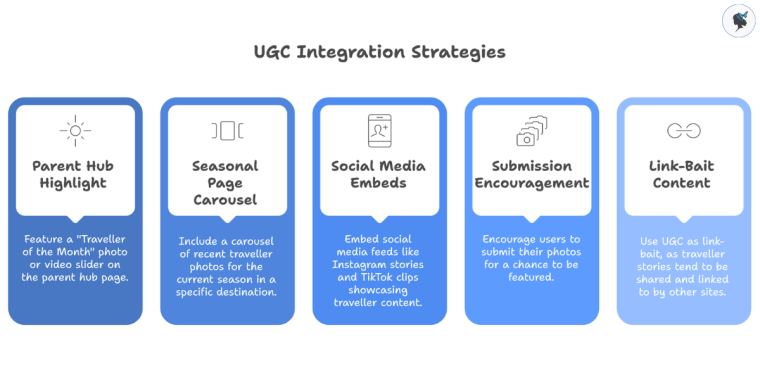
UGC integration strategies
  • On the parent hub page: highlight a “Traveller of the Month” photo or video slider.
  • On seasonal pages: include a carousel of “Recent traveller photos this (season) in Destination X”.
  • Embed social media feeds (Instagram stories, TikTok clips) with traveller content.
  • Encourage submission by offering spotlight features (“Submit your photo and be featured”).
  • Use UGC as link‑bait: published content with traveller stories tends to be shared and linked to by other sites.

Wander Women Hot Tip: Create a monthly “UGC roundup” blog/article inside the hub: “5 real traveller stories from this season at Destination X” — this keeps content fresh, supports the hub and encourages community participation.


Promoting and Leveraging Seasonal Hubs

1. Social Media Integration

infograph: Social media strategies
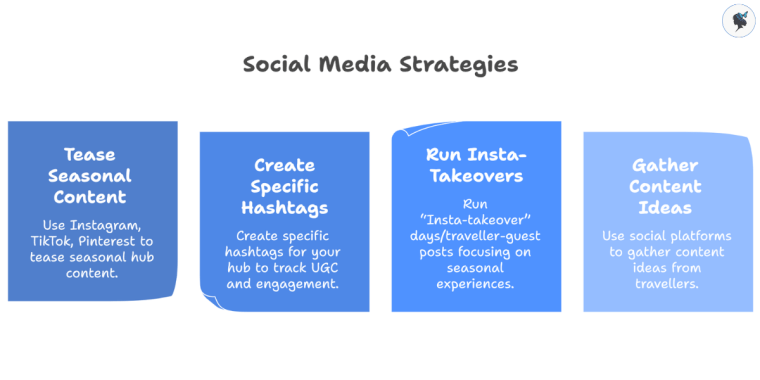
Social media strategies
  • Use Instagram, TikTok, Pinterest to tease seasonal hub content: e.g., short video “Top winter tips for Destination X”, linking to the seasonal page. Note that travel‑related content on TikTok has increased by about 410% since 2021.
  • Create specific hashtags for your hub (e.g., #ExploreXSpring2026) to track UGC and engagement.
  • Run “Insta‑takeover” days/traveller‑guest posts focusing on seasonal experiences at the destination.
  • Use social platforms to gather content ideas: ask travellers “What are your top tips for Destination X in autumn?” and then build blog content from that.

2. Email Marketing & Newsletter Tie‑Ins

infograph: How to effectively engage email subscribers?
How to effectively engage email subscribers?
  • Segment your email list by interest or season (e.g., subscribers interested in “Summer X”).
  • Send a seasonal hub update email: “What’s new for summer 2026 at Destination X” linking into the hub.
  • Use evergreen content as the basis for an automated “Welcome sequence” for new subscribers (“Start with our ultimate destination guide”) and then nurture into seasonal offers.

3. Cross‑Promotion Across Platforms

infograph: Hub promotion strategies
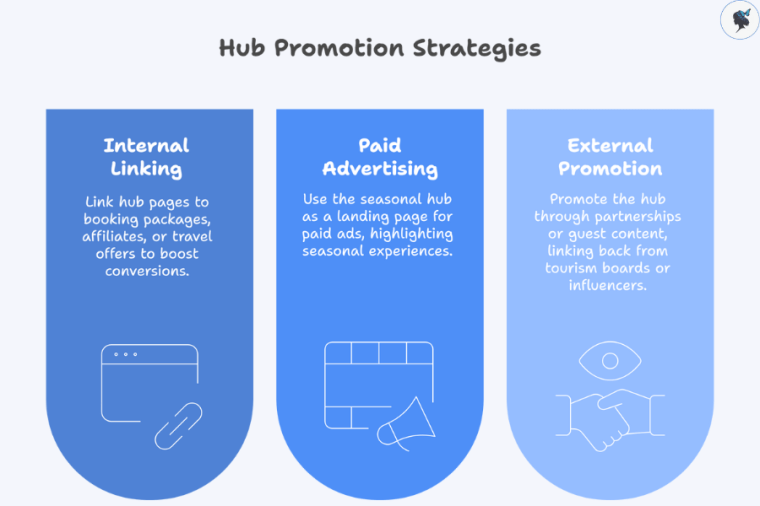
Hub promotion strategies
  • Link from hub pages to your booking/itinerary packages, affiliate partners, or travel‑offer pages — this increases conversion opportunities.
  • Use the seasonal hub as a campaign landing page for paid ads: e.g., “Visit X this winter – see our winter hub and book the best experiences”.
  • Promote the hub in partnerships or guest‐content: have local tourism boards or influencers link back into your hub.

Wander Women Hot Tip: Treat each seasonal page like a micro‑campaign asset: plan one social post, one community challenge (e.g., share your winter hiking photo), one newsletter trigger, one site update per season. That creates a rhythm.


Measuring Success and Iterating

1. Key Metrics to Track

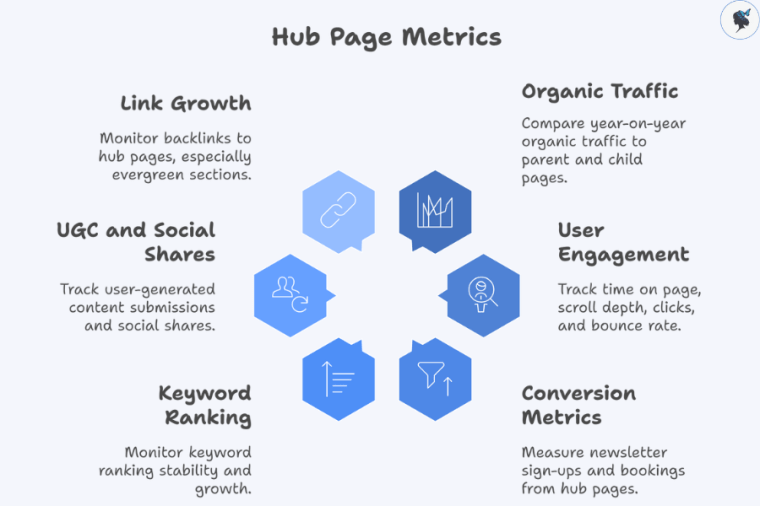
infograph: Hub page metrics
Hub page metrics
  • Organic traffic to the parent hub page and each seasonal child page (compare year‑on‑year).
  • User engagement metrics: average time on page, scroll depth, clicks to other hub pages, “bounce” from hub.
  • Conversion metrics (if applicable): newsletter sign‑ups, enquiries/bookings from hub pages.
  • Keyword ranking stability/growth for core evergreen and seasonal keywords.
  • UGC submission volume and social shares of hub content.
  • Link growth/backlinks to hub pages (especially evergreen sections).

2. Continuous Improvement

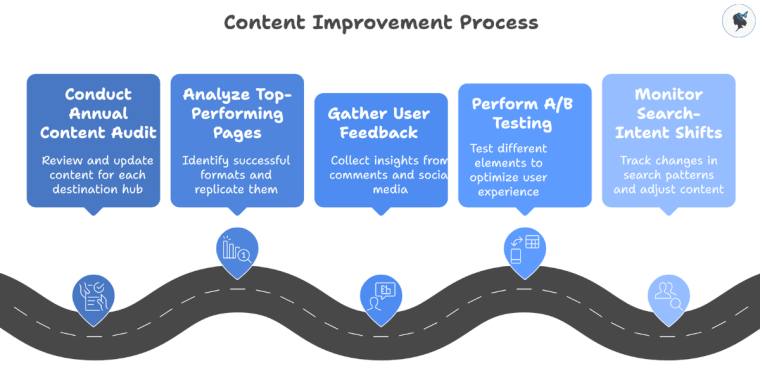
infograph: Content improvement process
Content improvement process
  • Perform an annual content audit for each destination hub: update what’s outdated, remove links to dead external pages, correct event dates.
  • Review top‑performing pages (seasonal and evergreen) and replicate formats for other destinations.
  • Use user feedback: comments, social shares, DMs can hint at what travellers want more of (e.g., “I wish you covered off‑season travel tips”).
  • Use A/B testing for CTA placements, interactive modules, UGC display formats.
  • Monitor search‐intent shifts: if a seasonal keyword’s search pattern changes, update your page accordingly.

Wander Women Hot Tip: Build a “hub health dashboard” for each destination: seasonal update indicator, link check status, top UGC item this month, traffic vs last year. Review quarterly.


Conclusion

Building and maintaining evergreen destination seasonal content hubs is one of the smartest investments a travel brand can make. You get the enduring power of evergreen content — which drives consistent organic traffic and builds authority over time. And you also gain the relevance and freshness of seasonal content that keeps your destination top of mind with travellers.

By structuring your hub thoughtfully, layering seasonal content on top of an evergreen foundation, integrating user‑generated content and social media, and keeping your updates systematic and measurable, you simultaneously build a resource that helps visitors now and continues helping visitors next year and the year after.

Wander Women Hot Tip: Start now. Pick your priority destinations, build one hub thoroughly — with your pillar pages, seasonal pages, UGC modules — then roll the model out to the next destination. The compounding benefits will snowball.

Need help? Contact us today!

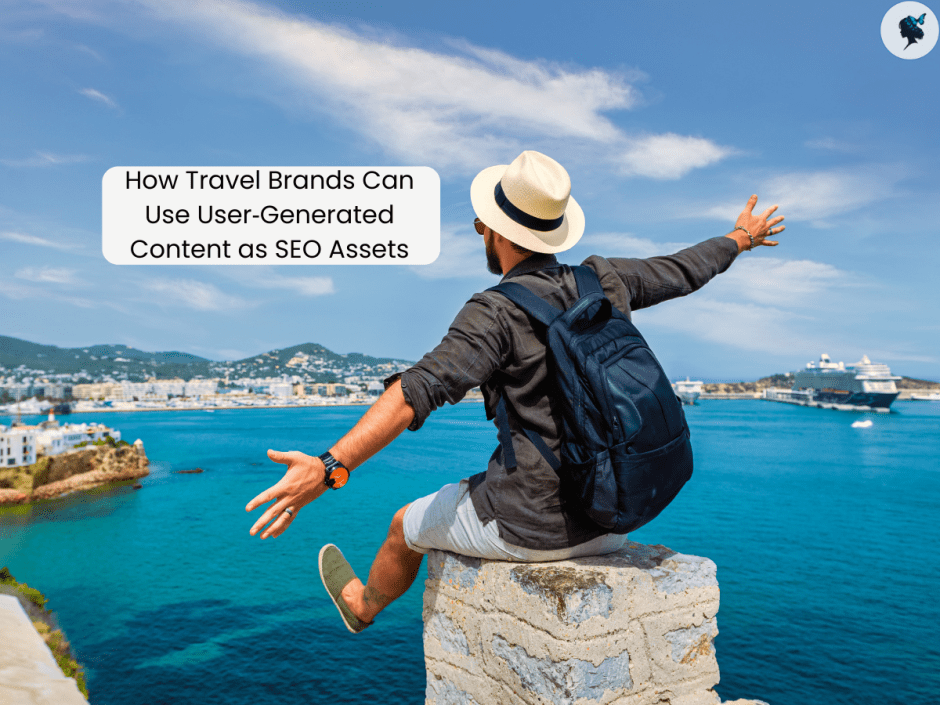
How Travel Brands Can Use User‑Generated Content as SEO Assets

▶ Table of Contents
  1. Introduction
  2. The Strategic Significance of UGC in Travel
  3. Best Practices for Leveraging UGC as SEO Assets
  4. Effective Strategies for Soliciting UGC from Travellers
  5. Techniques for Optimising UGC for Search Engines
  6. Real‑World Examples of Travel Companies Using UGC to Drive SEO & Engagement
  7. Conclusion

Introduction

In the travel industry, we’re seeing a tectonic shift in how travellers discover, evaluate and book trips. Rather than simply absorbing branded content, today’s (and tomorrow’s) travellers rely heavily on user‑generated content (UGC)—photos, videos, reviews, social posts from real travellers—to inspire, inform and influence their decisions. According to one 2025 statistic, 86% of travellers said they were inspired to visit a location after seeing user‑generated content.
Meanwhile, the market for UGC in travel is estimated at around USD 279.8 million in 2025, with a projected growth to USD 1,132.1 million by 2035. (Future Market Insights)
For travel agencies and destination brands, this means UGC isn’t just “good to have” — it’s a high‑impact asset for content marketing, social media, and SEO. When properly solicited, curated and optimised, UGC drives engagement, improves search visibility, and builds trust with prospective travellers.

Wander Women Hot Tip: View UGC as a dual‑purpose tool: 1) social engagement and inspiration, 2) SEO asset and web content amplifier. Plan both uses whenever you request or reuse traveller content.


The Strategic Significance of UGC in Travel

1.Why UGC is a High‑Value Asset for Travel Brands

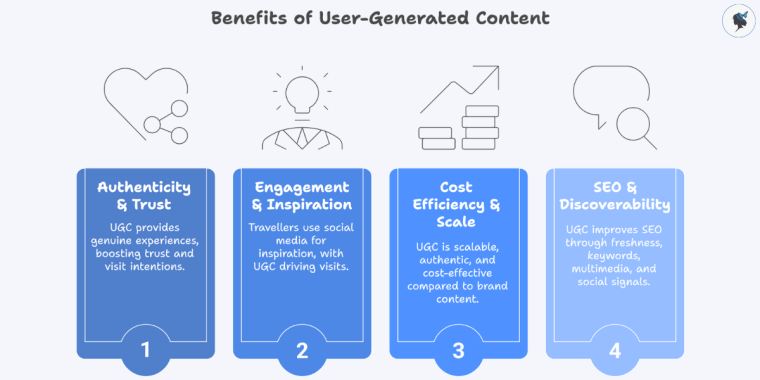
infograph: Benefits of User-Generated Content
Benefits of User-Generated Content
  • Authenticity & trust: UGC offers “real people, real experience” rather than polished brand messages. A 2025 study found UGC has a significant positive effect on destination imagery and tourist visit intentions.
  • Engagement and inspiration: In the travel sector particularly, 83% of travellers use social media for trip inspiration. Another stat: 86% of travellers were inspired to visit a location after seeing UGC.
  • Cost efficiency & scale: Compared with high‑production brand content, UGC can be more scalable, authentic and cost‑effective. For example, a marketing stat notes that visual UGC is considered more impactful by 85% of marketers compared to professional photography.
  • SEO & discoverability: UGC contributes to freshness signals, real traveller language (long‑tail keywords), multimedia content (photos/videos) and social signals that help search engines and users alike.

You might like our post: Use UGC to Enhance Your Travel Brand’s Trust

2. How UGC Impacts SEO & the Travel Funnel

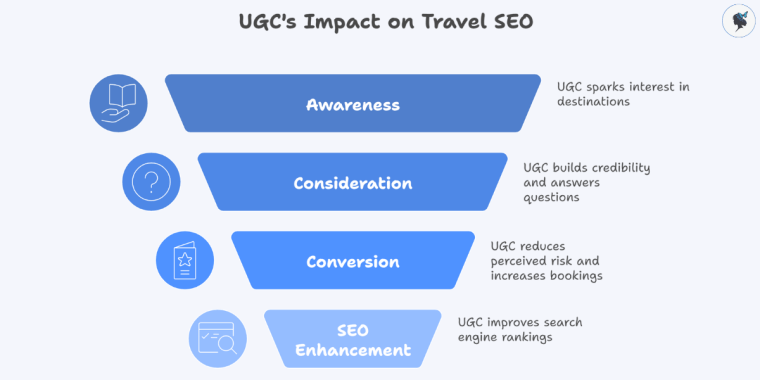
infograph: UGC's impact on travel SEO
UGC’s impact on travel SEO
  • Awareness phase: UGC helps travellers discover destinations (“I saw this Instagram reel and now want to go”).
  • Consideration phase: Reviews, photos, videos from travellers build credibility and answer questions (“What’s it really like staying at this hotel?”).
  • Conversion phase: Real‑traveller content reduces perceived risk, making bookings more likely.
  • SEO in action:
    • Fresh UGC updates signal to search engines a page is current and relevant.
    • Traveller language captures long‑tail, conversational keywords (e.g., “what it was like to stay in a tree house in Costa Rica”). More about Long-Tail Keywords here.
    • Multimedia UGC supports rich search results (image/video search, Google Discover).
    • Internal linking of UGC pages into destination/service hubs strengthens topical authority.
  • Metric improvements: UGC often leads to longer time on page, deeper scrolls (since people enjoy real‑traveller content), better engagement metrics—all of which can support rankings.

Wander Women Hot Tip: Build your content funnel around UGC touchpoints:

  • For TOFU (top‑of‑funnel) create “traveller story” pages and galleries.
  • For MOFU (middle) embed UGC into destination/service hub pages (real review + service link).
  • For BOFU (bottom) use UGC testimonials and case studies that push toward booking.
    Map your internal linking so that UGC feeds into your commercial pages.

Check out: The Complete Digital Marketing Funnel for Travel


Best Practices for Leveraging UGC as SEO Assets

1. Curate and Showcase UGC Strategically

infograph: UGC integration strategies
UGC integration strategies
  • Create dedicated sections on your site for UGC: e.g., “Traveller Gallery”, “Real Stories”, “Trip Highlights”. Use these as entry‑points and link into hub/destination/service content.
  • Use UGC in blog posts: integrate traveller quotes, photos, video snippets to humanise content and make it richer.
  • Build content clusters: For example, a destination page that includes brand content + embedded UGC streams (photos/videos) + links to sub‑pages. This boosts structure and authority.
  • Maintain quality control: Not all UGC will be suitable. Filter for relevance, authenticity, and brand fit. Research shows UGC influences tourist image and behaviour only when perceived as genuine.
  • Refresh UGC often: A destination page that embeds new traveller posts signals freshness to search engines and encourages repeat visits.
  • Align UGC showcase with user‑intent: E.g., if the page is “Adventure Travel in Iceland”, select UGC showing adventure contexts rather than leisure pool images.

2. Integrate UGC with On‑Page SEO Elements

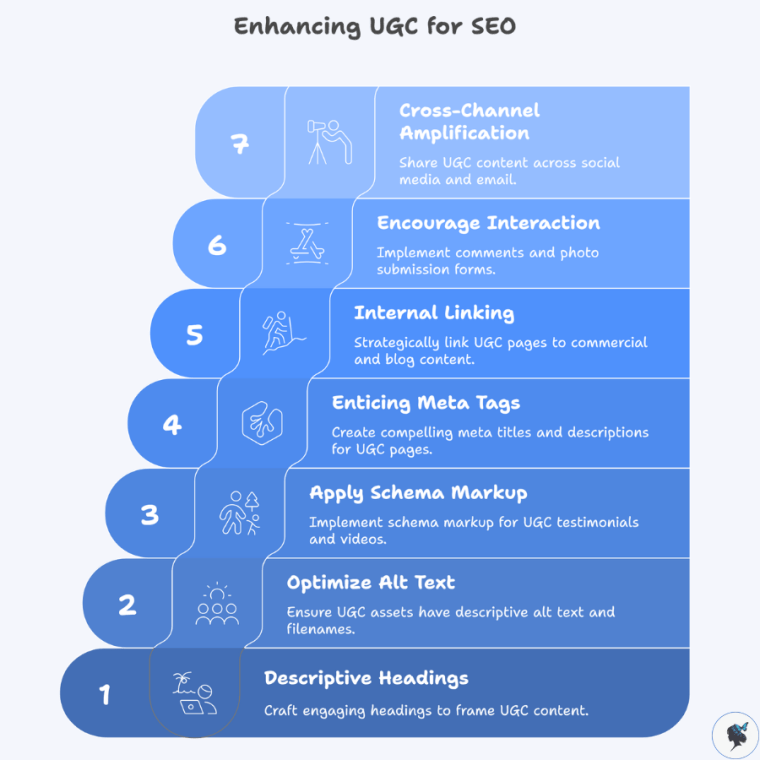
infograph: Enhancing UGC for SEO
Enhancing UGC for SEO
  • Use descriptive headings/sub‑headings that frame UGC: e.g., “See real traveller photos from our Maldives resort”, “What guests say: tree‑house experience in Belize”.
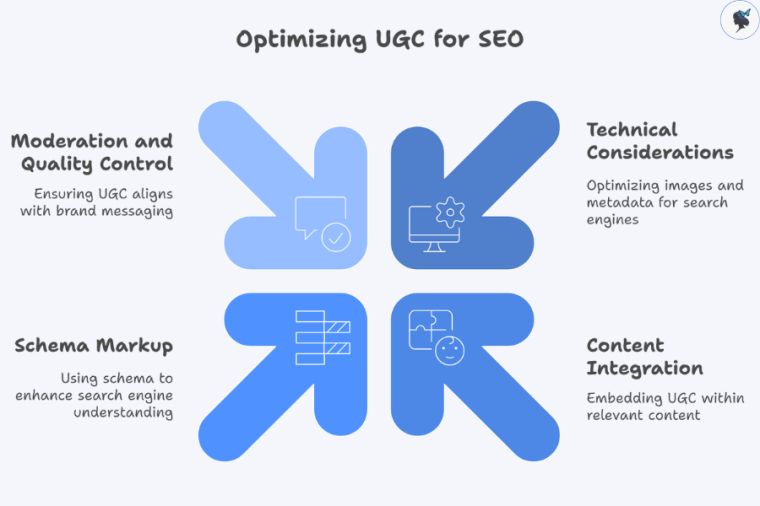
  • Optimize alt text and filenames of UGC assets: eg “solo‑female‑traveller‑hiking‑Torres‑del‑Paine.jpg” or “family‑trip‑senior‑couple‑Santorini‑sunset.png”.
  • Apply schema markup where relevant: Review schema around UGC testimonials, VideoObject schema for traveller videos.
  • Meta tags: Create enticing meta titles/descriptions for UGC‑rich pages (“Real traveller photos & reviews of XYZ resort – see what it’s really like”).
  • Internal linking strategy: Link from UGC pages to commercial/service pages (“Book the same villa our guest visited”), and from blog content into UGC pages for deeper engagement.
  • Encourage user‑interaction: Optional comments or “submit your photo” forms increase dwell time and activity on page.
  • Cross‑channel amplification: Use UGC‑led content in social media, email, newsletters to drive traffic back to on‑site pages (which improves search signals).

3. Monitor & Optimize Performance

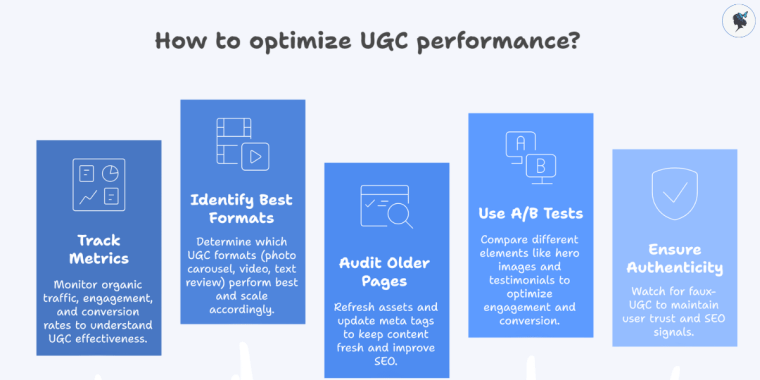
infograph: How to optimize UGC performance?
How to optimize UGC performance?
  • Track metrics: organic traffic to UGC pages, engagement (time on page, scroll depth), conversion from UGC content (clicks to booking).
  • Identify which UGC formats perform best (photo carousel vs video vs text review) and scale accordingly.
  • Audit older UGC pages: refresh assets, update meta tags, add new traveller posts to keep content fresh (search engines reward recent updates).
  • Use A/B tests: e.g., UGC gallery hero vs brand hero image, UGC testimonial vs no testimonial. Compare engagement and conversion outcomes.
  • Watch for faux‑UGC or irrelevant content—it may harm user trust and SEO signals. Authenticity matters.

Wander Women Hot Tip: Maintain a UGC content calendar: schedule quarterly refreshes of your UGC‑rich pages, track when traveller content awaits moderation, and ensure each UGC update prompts a mini‑SEO audit (alt text, schema, linking).


Effective Strategies for Soliciting UGC from Travellers

1. Build a UGC‑Friendly Ecosystem

infograph: UGC engagement cycle
UGC engagement cycle
  • Make it easy for travellers to submit their content: mobile upload forms, dedicated hashtag campaigns, photo spot prompts during or after the trip.
  • Incentivise contributions: run UGC contests (e.g., “Best sunset photo from our Bali resort”), feature winners, offer small rewards or recognition.
  • Use branded hashtags and prompts: “#OurBrandTraveller”, “#MyResortStory” – encourages sharing and helps aggregation.
  • In‑trip prompts: At check‑in, on‑tour, create signage or digital prompts encouraging travellers to tag your brand and share their moments.
  • Post‑trip follow‑up: send automated emails or SMS shortly after travel inviting submissions (“Share your favourite photo & you could be featured”).
  • Legal and rights management: ensure travellers agree to your terms for content reuse (photo rights, social media tags) at the point of submission.

2. Encourage UGC That Is SEO‑Friendly

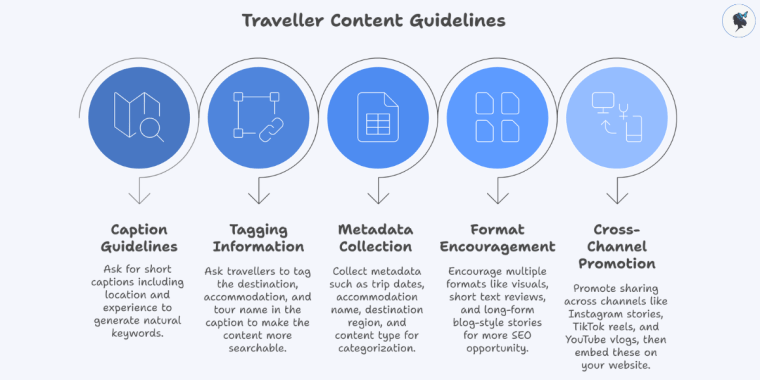
infograph: Traveller content guidelines
Traveller content guidelines
  • Provide guidelines to travellers: ask for short captions including location + experience (e.g., “Hiking the red dunes of Wadi Rum – best trip ever”). This helps generate natural keywords.
  • Ask travellers to tag the destination, accommodation, tour name in the caption (makes the content more searchable, helps link building).
  • Collect metadata: ask for trip dates, accommodation name, destination region, content type (photo, video, review) so you can later categorise and use effectively.
  • Encourage multiple formats: visuals (photos/videos), short text reviews, long‑form blog‑style stories (if willing) — more formats mean more SEO opportunity.
  • Promote sharing across channels: Instagram stories, TikTok reels, YouTube vlogs – you can then embed these on your website for richer content.

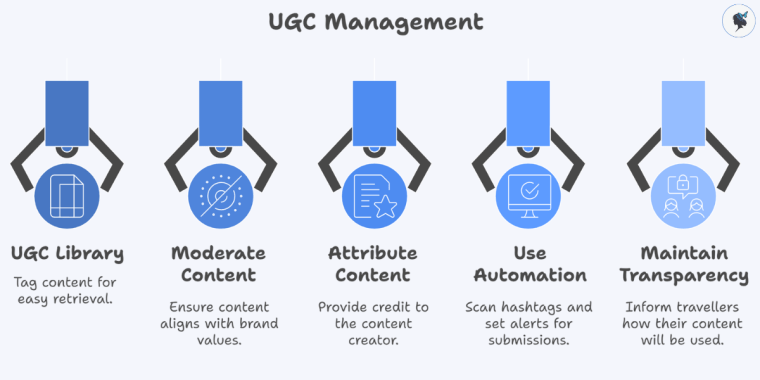
3. Manage and Moderate UGC Efficiently

infograph: UGC management
UGC management
  • Create a UGC library (digital asset management): tag content by destination, trip type, season, traveller persona. Makes retrieval for content creation easier.
  • Moderate for quality & relevance: ensure the content aligns with your brand values, destination, and avoids irrelevant/spam posts. Lack of authenticity may undermine trust.
  • Attribute properly: always provide photo/author credit, link to the user where possible (improves authenticity and community feeling).
  • Use automation where possible: scanning hashtags, setting alerts for submissions, using workflow tools for approval and tagging.
  • Maintain transparency: let travellers know how their content will be used; this builds willingness to participate and ensures compliance.

Wander Women Hot Tip: Create a “Traveller UGC Kit” you send to past guests: sample captions, suggested hashtags, simple steps to upload/share their content. The more friction you remove, the more UGC you will receive.


Techniques for Optimising UGC for Search Engines

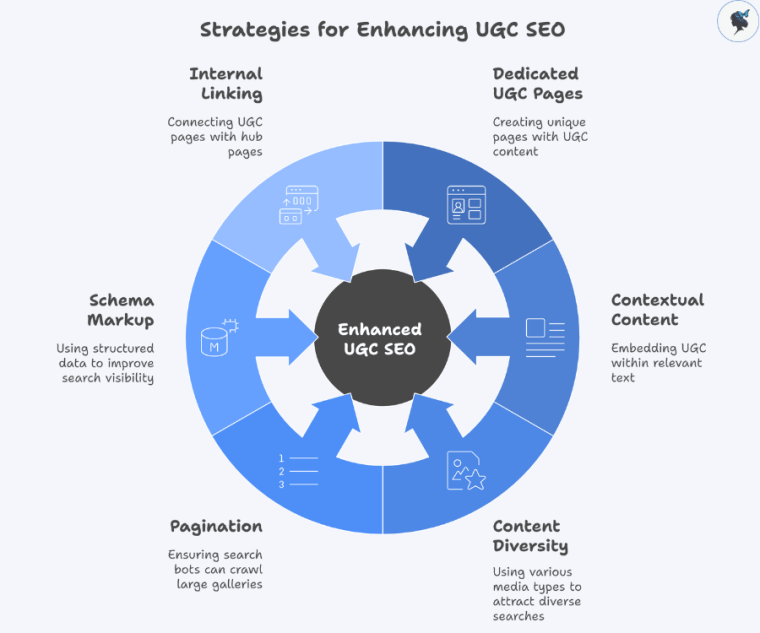
1. Structuring UGC for SEO Impact

infograph: Strategies for enhancing UGC SEO
Strategies for enhancing UGC SEO
  • Create dedicated UGC‑rich pages with unique URL, title, meta description, e.g., /traveller‑stories/destination‑x/.
  • Ensure UGC is embedded within strong contextual content: not just a gallery, but heading, intro paragraph, text around it explaining relevance (“This is what it’s like to hike the glacier…”) which improves readability, scroll depth and SEO.
  • Mix content types: use photos, videos, reviews — this diversity improves chances of appearing in various search results (image search, video search, Google Discover).
  • Consider pagination for large galleries but ensure search bots can crawl (avoid infinite scroll without fallback).
  • Use schema markup: For example, mark up an embedded traveller video with VideoObject, or a review with Review.
  • Link to it: Internal linking from destination/service hub pages to UGC page and vice versa helps distribute SEO value.

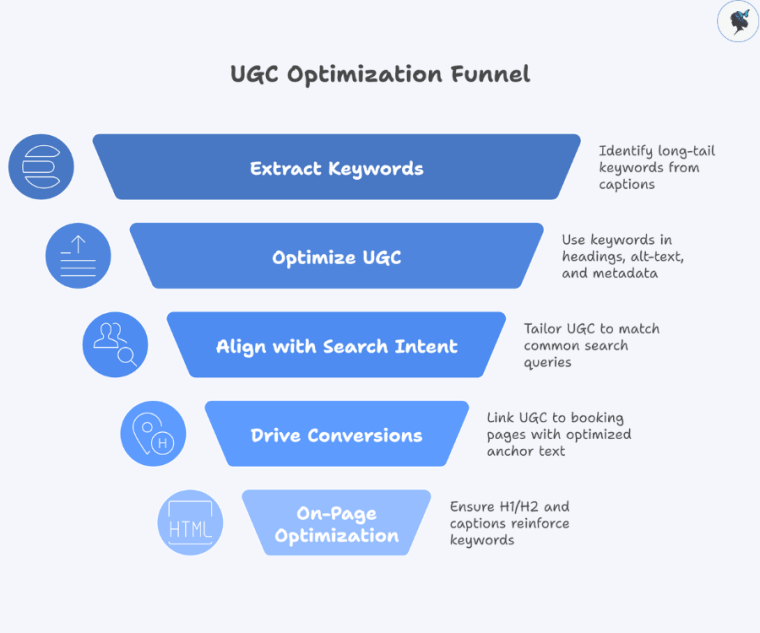
2. Keyword Strategy Within UGC

infograph: UGC optimization funnel
UGC optimization funnel
  • Extract organic language from traveller captions/comments to spot real‑world long‑tail keywords (e.g., “family friendly resort Maldivian lagoon with kids”).
  • Use those keywords in sub‑headings, alt‑text, captions, and metadata around the UGC.
  • Align UGC pages with search intent: e.g., if travellers often search “what it’s like staying in over‑water villa Maldives”, then embed relevant UGC and tailor the page accordingly.
  • Make sure the UGC helps push users down the funnel: link from the UGC story to booking/tour page with anchor text optimised for action (e.g., “Book the same villa our guest stayed in”).
  • On‑page optimisation: Ensure H1/H2 include target keywords, alt‑text for images include destination + experience, captions reinforce the topic.

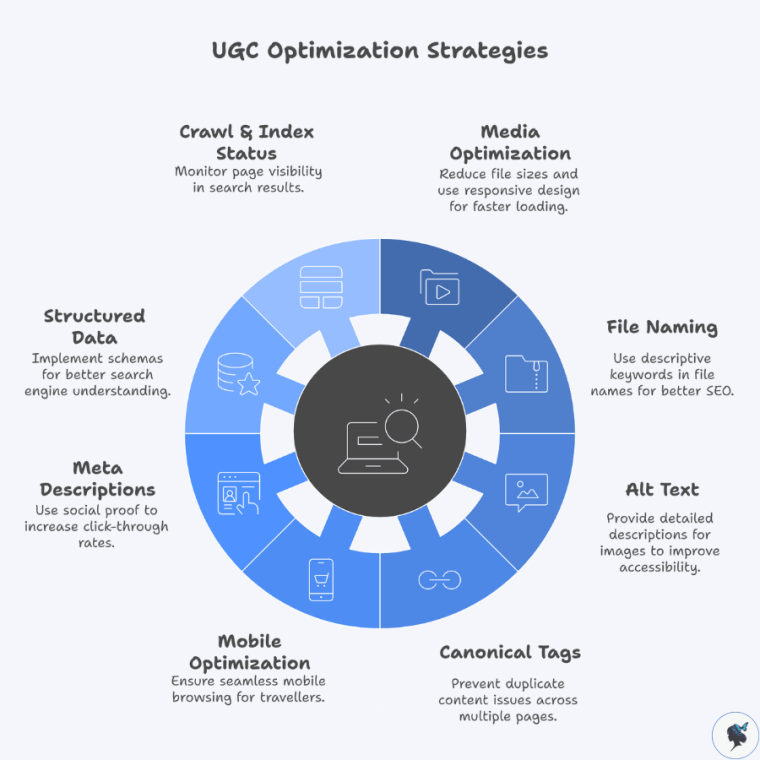
3. Technical & On‑Page Optimisation

infograph: UGC optimization strategies
UGC optimization strategies
  • Optimize media: large volumes of high‑resolution images/videos can slow page speed. Use compression, lazy loading, responsive design.
  • File naming: rename server files to include keywords (e.g., solo‑female‑traveller‑hiking‑Torres‑del‑Paine.jpg).
  • Alt text: described in natural language including destination plus experience (“Solo female traveller hiking at sunrise Torres del Paine national park”).
  • Canonical tags: If UGC appears on multiple pages, ensure canonicalization to avoid duplication.
  • Mobile‑first optimisation: Ensure UGC pages load well on mobile since many travellers browse on smartphones.
  • Meta descriptions: Use social proof (“See real traveller photos & reviews from Destination X”) to boost click‑through rate (CTR).
  • Structured data: Use Review schema for UGC testimonials, ImageObject or VideoObject schema for galleries and videos.
  • Monitor crawl & index status: Use Google Search Console to ensure UGC‑rich pages are crawled and indexed.

4. Measuring & Iterating

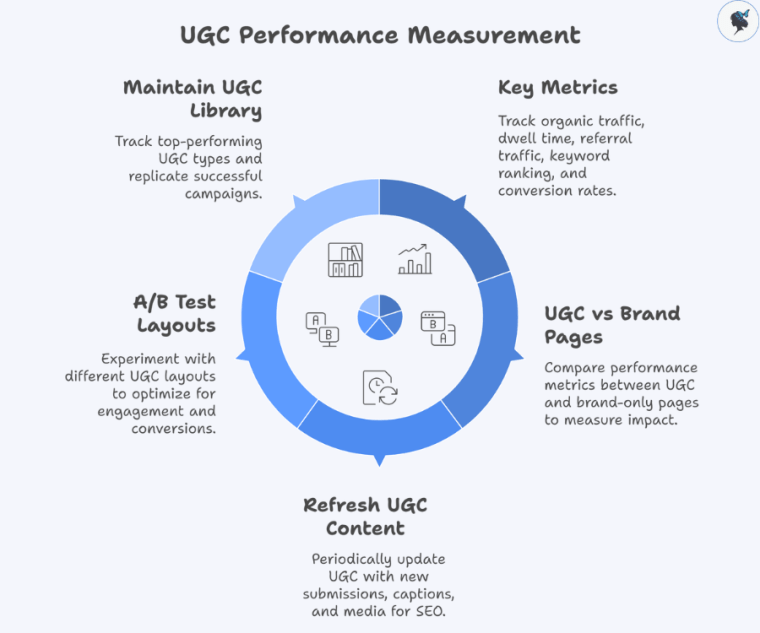
infograph: UGC performance measurement
UGC performance measurement
  • Key metrics: organic traffic to UGC pages; dwell time/scroll depth; referral traffic to booking pages; keyword ranking improvement; conversion rates (booking enquiries) originating from UGC content.
  • Compare UGC vs brand‑only pages: measure if embedding UGC leads to improved performance (e.g., lower bounce rate, higher pages per session).
  • Refresh UGC content periodically: add new traveller submissions, update captions, refresh images/videos — freshness supports SEO.
  • A/B test UGC layouts: e.g., hero image from traveller vs brand image; testimonial block vs no testimonial; call‑to‑action at bottom of UGC page vs none.
  • Maintain UGC library insights: track top performing UGC types (videos, scenic photos, cultural moments) and replicate similar campaigns.

Wander Women Hot Tip: Schedule a quarterly UGC SEO audit: list all pages with embedded traveller content, check alt‑text, meta title/desc, internal linking, page speed, mobile performance. Prioritise fixes for pages with high traffic but low conversion.


Real‑World Examples of Travel Companies Using UGC to Drive SEO & Engagement

  • Airbnb: Frequently uses guest‑shared photos and reviews in its destination pages and blog, helping travellers visualise “what it’s really like” and improving engagement.
  • Destination marketing example: A recent study found that UGC significantly improves destination image and intentions to visit, illustrating that DMO/brand‑driven UGC campaigns can shift demand materially.
  • Key takeaway for travel agencies: You may not have massive budgets, but you can embed UGC in your site, build galleries, feature “Traveller of the Month”, and link stories to service offers. Over time, this builds topical authority and trust.

Wander Women Hot Tip: Pick one UGC campaign (e.g., “Show us your stay at Resort X”), run it for 3 months, embed the resulting content in a destination hub page, and monitor traffic, engagement and conversions vs a similar page without UGC. Use the results to scale.


Conclusion

User‑generated content is not a nice‑to‑have extra in the travel industry—it’s an SEO‑strong asset, a trust builder, and a engagement amplifier. For travel agencies and brands willing to invest in soliciting, curating and optimising UGC, the benefits are clear: more organic traffic, higher engagement, better conversion potential, and authentic connection with travellers.
To recap the strategy:

  1. Solicit UGC intentionally (with prompts, incentives, seamless workflows).
  2. Curate it smartly (destination‑relevant, quality controlled, integrated into content hubs).
  3. Optimise it for web (alt text, schema, internal linking, media optimisation).
  4. Measure and iterate (audit quarterly, refresh content, replicate what works).
    Start small, pick a pilot destination or service, embed traveller content, optimise around long‑tail keywords derived from that content, and use it as a proof case internally.

Wander Women Hot Tip: Use your first 90 days to build a “UGC starter kit”: write a brief for traveller submissions, design a UGC gallery page template, map the internal linking path to your service/booking pages, and schedule the quarterly review. Once the system is set, you’ll continuously gain UGC, SEO value and conversions with decreasing incremental effort.

Need help? Contact us today to get started!

Ways AI Can Enhance Travel Content Personalization: AI-Driven Email Personalization

▶ Table of Contents
  1. Introduction
  2. Understanding AI in Travel
  3. AI-Driven Email Personalization: The Future of Targeted Travel Campaigns
  4. Case Study: BrazeAI Decisioning Studio — AI-Powered Optimization for Personalized Engagement
  5. Benefits of AI-Personalized Emails for Travel Agencies
  6. Implementation Strategies: How Travel Agencies Can Adopt AI-Driven Email Personalization
  7. Conclusion

Introduction

In today’s travel industry, personalization isn’t a “nice-to-have” — it’s an expectation. Modern travelers expect offers, content and communications that reflect their interests, previous trips, budget, and style. For travel agencies, this shift means moving beyond generic email blasts or one-size-fits-all newsletter templates.
That’s where artificial intelligence (AI) steps in. By analysing user behaviour, past bookings and contextual data, AI can transform how travel agencies craft and deliver highly personalized travel content — especially via email campaigns.
In this post, we’ll explore how AI works in the travel space, dig into how it drives email personalization, examine a leading case study, outline the clear benefits for travel agencies, and provide actionable implementation steps. If you’re aiming to boost engagement, conversion and customer loyalty through smarter email marketing — this is for you.


Understanding AI in Travel

What is AI?

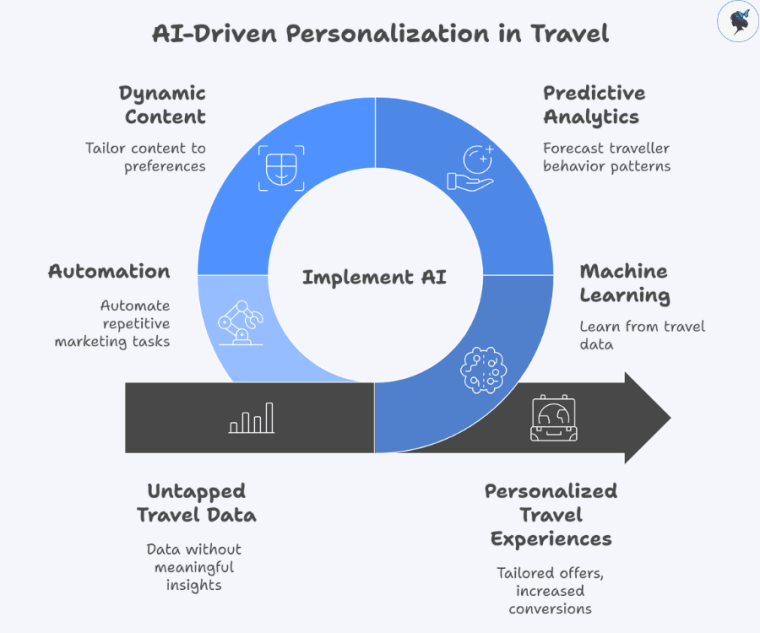
Artificial Intelligence (AI) refers broadly to computer systems that can perform tasks typically requiring human intelligence: learning from data, recognising patterns, making predictions, and sometimes generating content. Within travel marketing, AI often looks like machine-learning models, predictive analytics, dynamic content generation and automation of repetitive tasks.

Infograph: AI-driven personalization in travel
AI-driven personalization in travel

Relevance of AI in the Travel Industry

The travel industry is awash with data: traveller profiles, booking histories, preferences, search queries, seasonal trends and more. But gathering data isn’t enough — the real value comes from turning that data into meaningful insights and tailored experiences.
According to research, the market for AI-driven travel experience personalization was valued at around USD 3.61 billion in 2024, with a projected CAGR of 22.3% from 2025-2032. Furthermore, AI-driven personalisation in tourism marketing has been shown to deliver conversion increases of up to 20-25%.
This means for travel agencies: AI isn’t futuristic—it’s already reshaping how travellers engage, how offers convert, and how content must be crafted.


AI-Driven Email Personalization: The Future of Targeted Travel Campaigns

The Role of AI in Email Marketing

Email remains one of the most effective channels for travel agencies: you own the list, you control the message, you can guide travellers from email → landing page → booking. But generic blasts no longer cut it. According to a 2024 study, personalised emails delivered 6× more transactions than non-personalised ones.
Here’s how AI upgrades email marketing for travel agencies:

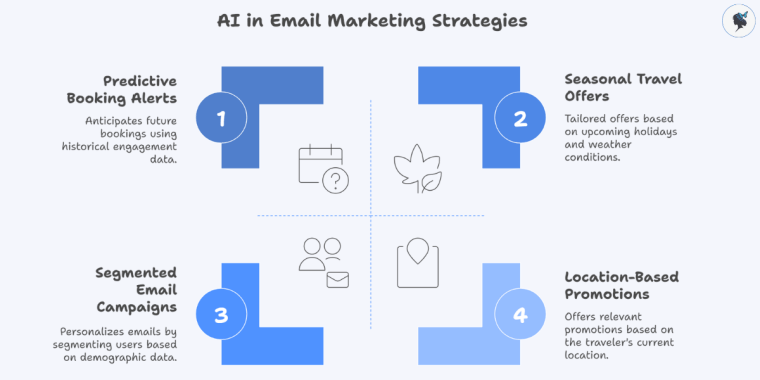
Infograph: Ai in email marketing strategies
Ai in email marketing strategies
  • Behavioural analysis: AI examines how travellers have previously engaged — which destinations they viewed, which trip types they booked, what emails they clicked, what content they ignored.
  • Demographic & profile data: Age, travel frequency, solo vs family, preferred style (luxury, budget, adventure) feed into segmenting and personalising offers.
  • Contextual data: Seasonality, upcoming holidays, weather, location, time of day — AI uses this to send more timely and relevant messages (for example: “City break escapes for early Autumn” rather than generic “Summer deals”).
  • Predictive modelling: AI anticipates when a traveller is poised to book again — and sends the right message at the right time.
  • Dynamic content generation: Email subject lines, body copy, images and CTA buttons can all be tailored per recipient, improving relevance and engagement.

More about managing seasonal content here.

Key AI Techniques Used in Email Personalization

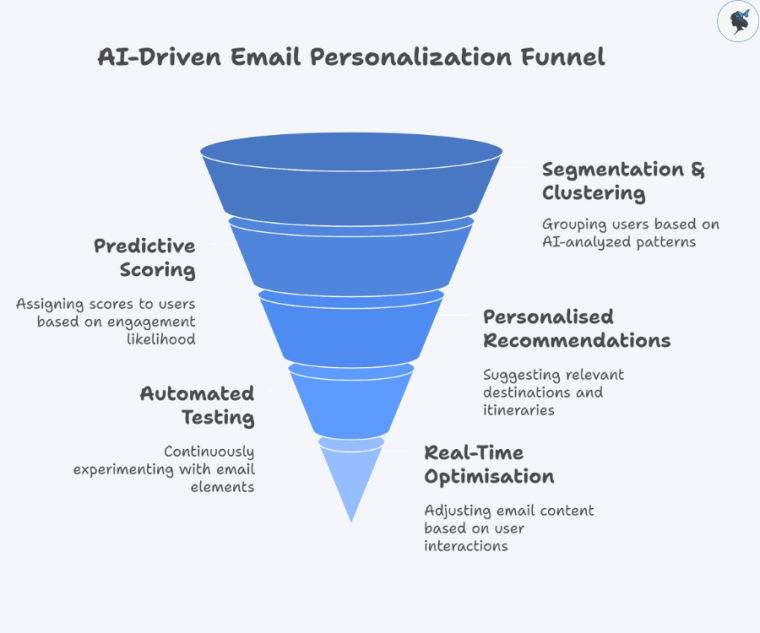
Infograph: Ai-driven email personalization funnel
Ai-driven email personalization funnel
  • Segmentation & clustering: Rather than manual segments (“families”, “solo travellers”), AI creates ever-changing clusters based on behaviour, intent and patterns.
  • Predictive scoring: Assigns scores to each user (likelihood to engage, likelihood to book), enabling prioritised targeting.
  • Personalised recommendations: Based on past behaviour and preferences, the AI suggests destinations or itineraries the traveller is most likely to respond to.
  • Automated A/B and multivariate testing: AI continuously experiments with subject lines, send times, visuals, copy, and learns which variant performs best — automatically.
  • Real-time optimisation: If a traveller clicks on a city-break email and visits your site, the next email can adjust its content accordingly (e.g., offering hotel options in that city).

More about A/B testing here.

Why It Matters for Travel Content

For travel agencies, lever­aging AI in email campaigns means the difference between “Here are 100 generic trip deals” and “Here’s a hand-picked 5-day itinerary in Lisbon that matches your food-lover profile, budget and family size”. The latter builds trust, improves conversion, and drives up lifetime value.


Case Study: BrazeAI Decisioning Studio — AI-Powered Optimization for Personalized Engagement

Overview of BrazeAI Decisioning Studio

BrazeAI Decisioning Studio is an AI marketing automation platform that specialises in self-learning personalization for email and other channels. They replace traditional A/B testing with machine-learning models that continuously optimise each offer. Their clients span hospitality, travel, retail and other industries.

How it Works

  • The AI analyses individual-level data: past transactions, engagement metrics, preference data.
  • It identifies which offer type (discount vs upgraded package vs loyalty reward) appeals to which user.
  • It picks the best send time, channel (email, push, SMS) and subject line for each user.
  • It adapts over time — learning what works for each segment and improving campaign performance.

Application in the Travel Industry

Imagine a travel agency uses BrazeAI Decisioning Studio:

  • They pull data on who has booked adventure trips versus beach holidays versus city breaks.
  • The AI segments newsletter recipients by these profiles.
  • For the “adventure seekers” segment: an email goes out with a subject line like “Ready for your next adrenaline rush? See our Peru trekking deals”, sent on Wednesday morning when this segment historically opens most.
  • For “family beach holiday” segment: an email offers early-bird booking for summer escapes, subject line “Family summer fun: 3 nights free if you book by June!”.
  • The results: higher open rates, higher click-throughs, stronger conversions. Travel agencies report boosted engagement and improved ROI thanks to AI-personalized offers.

Why This Matters

  • Shows real use of AI in automating what was previously manual and guesswork-driven.
  • Demonstrates how email content becomes “smart” — personalised and adaptive, rather than one-size-fits-all.
  • Travel agencies gain a strategic asset: targeted messaging based on data and AI insights, not just gut feel.

Benefits of AI-Personalized Emails for Travel Agencies

Let’s break down the advantages your agency can expect when you adopt AI-driven email personalization.

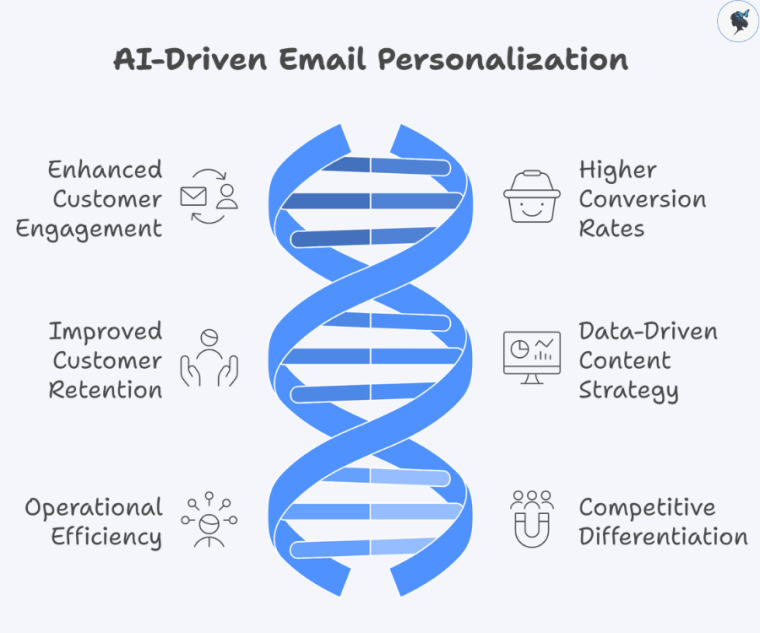
infograph: Ai-driven email personalization
Ai-driven email personalization
  • Enhanced Customer Engagement
    Personalized emails resonate more. Data shows personalised campaigns see 29% higher open rates and 42% higher conversions than generic ones.
  • Higher Conversion Rates
    By sending the right offer at the right time to the right person, you reduce friction and increase booking probability.
  • Improved Customer Retention
    Personalization fosters loyalty — travellers feel recognised and valued. Post-trip follow-ups, tailored up-sells and relevant offers drive repeat bookings.
  • Data-Driven Content Strategy
    Email AI tools generate insights about what travellers are responding to: destinations, trip types, content formats. This shapes blog topics, landing pages and future campaigns.
  • Operational Efficiency
    Automation means less manual segmentation, fewer generic blasts, and more time for creative strategy and high-value client interactions.
  • Competitive Differentiation
    Agencies embracing AI-driven personalization position themselves as tech-forward, customer-centric, and likely ahead of competitors still doing mass newsletters.

More about using AI in personalized itineraries here.


Implementation Strategies: How Travel Agencies Can Adopt AI-Driven Email Personalization

Here’s a practical step-by-step roadmap to help your travel agency get started.

infograph: AI email personalization implementation
AI email personalization implementation

Step 1: Audit and Consolidate Your Data

  • Gather data from your CRM, booking system, website analytics, email engagement history.
  • Ensure you have permissions, data hygiene and structure in place (GDPR compliance if operating in EU).
  • Identify key traveler-attributes you want to leverage: destination preferences, trip type, budget, companion type (solo, family, couple), past email engagement.

More about leveraging data here.

Step 2: Choose the Right AI Email Personalization Platform

Look for tools that integrate with your existing stack, support dynamic content, predictive modelling and automated optimisation. A few examples:

  • BrazeAI Decisioning Studio (for automated offer testing & personalization)
  • Mailchimp (offers AI features for subject lines and send time optimisation)
  • HubSpot (Marketing Hub with AI email personalization)

Wander Women Hot Tip: Ensure the tool supports your scale, data privacy needs and travel-specific requirements.

Step 3: Develop Dynamic Content Assets

  • Build a library of destination content, trip types, visuals, itineraries and offers.
  • Ensure flexible modules in your emails: dynamic placeholders for destination, budget tier, traveller segment.
  • Create copy templates tuned for traveller personas (family, solo adventure, luxury couple, etc.).
  • Use the AI platform to pull these modules and assemble tailored emails per recipient.

Step 4: Segment & Test — Start Small, Scale Fast

  • Pick one segment to start (e.g., “frequent travellers who booked city breaks last two years”).
  • Send control email (generic offer) and AI-personalised email side-by-side. Measure open, click and conversion rates.
  • Gradually expand to other segments as you learn what works.
  • Use AI’s automated testing to refine subject lines, send times and content blocks.

Step 5: Integrate with Your Broader Marketing Ecosystem

  • Synchronise email personalization with landing pages: the same traveller who clicks “family beach holiday” should land on a page with tailored content.
  • Integrate with your social media retargeting and chatbot efforts so the message is consistent across channels.
  • Use email insights to inform blog content: “Top 5 beach locations this segment clicked on” → blog post with tailored content for that audience.

Step 6: Monitor, Analyse & Optimize

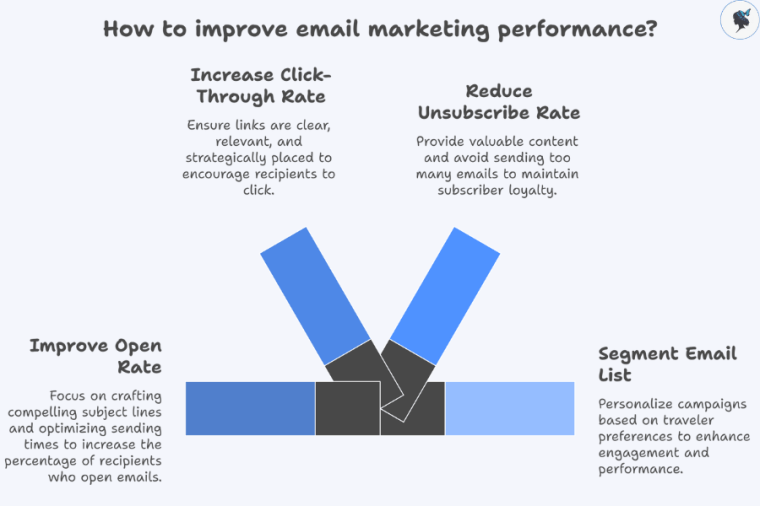
  • Track KPIs: open rate, click-through rate, conversion rate (bookings from email), engagement depth, unsubscribe rate.
  • Use AI platform reports to identify what travel segments perform best and what offers resonate.
  • Iterate content: update assets, refresh visuals, adjust segments, refine timing.
  • Ensure data privacy and compliance: travellers may be increasingly sensitive to how their data is used. Maintain transparency.

Conclusion

In a travel world where consumers expect tailored experiences and instant, relevant communications, AI-driven email personalization offers a major leap forward. By leveraging traveller behaviour, preferences and contextual data, travel agencies can transform their email campaigns from “just another deal” into meaningful, customised journeys that resonate.
Platforms like OfferFit demonstrate how AI can power smarter segmentation, offer optimisation, dynamic content and clearer ROI. The benefits are clear: higher engagement, improved conversions, stronger loyalty, deeper content insights and operational efficiency.
If you’re reading this and wondering “Where do we start?” — here’s your prompt: begin with your data, pick an AI tool, build dynamic content templates, choose one test segment and run a personalised campaign. Measure the results. Then scale.
Personalisation is no longer optional — it’s expected. And with AI, your agency can deliver it at scale. Embrace AI for your travel-email strategy and watch your content, engagement and bookings soar.

Need help with your AI email strategy? Contact us today!


Best Times to Post Travel Content on Each Platform

Introduction


▶ Table of Contents
  1. Introduction
  2. Best Times to Post on Instagram
  3. Best Times to Post on Facebook
  4. Best Times to Post on X (formerly Twitter)
  5. Best Times to Post on TikTok
  6. Best Times to Post on Pinterest
  7. Best Times to Post on LinkedIn (for Travel Industry Professionals)
  8. Best Times to Post on Bluesky
  9. Best Times to Post on Threads
  10. Best Times to Post on YouTube
  11. Best Times to Post on WhatsApp
  12. Best Times to Post on Telegram
  13. General Tips for Timing Travel Content
  14. Conclusion

Timing is a critical factor in social media marketing, especially for travel brands looking to maximize engagement and reach. Posting when your audience is most active increases the chances your content will be seen, liked, shared, and converted into bookings or inquiries. According to Sprout Social, posting at the right time can increase engagement by up to 30%. This guide covers the best times to post travel content on each major platform to help you optimize your social media strategy.


Best Times to Post on Instagram

Travel content thrives on Instagram thanks to its visual nature. Studies from Later and HubSpot suggest the best times to post are generally:

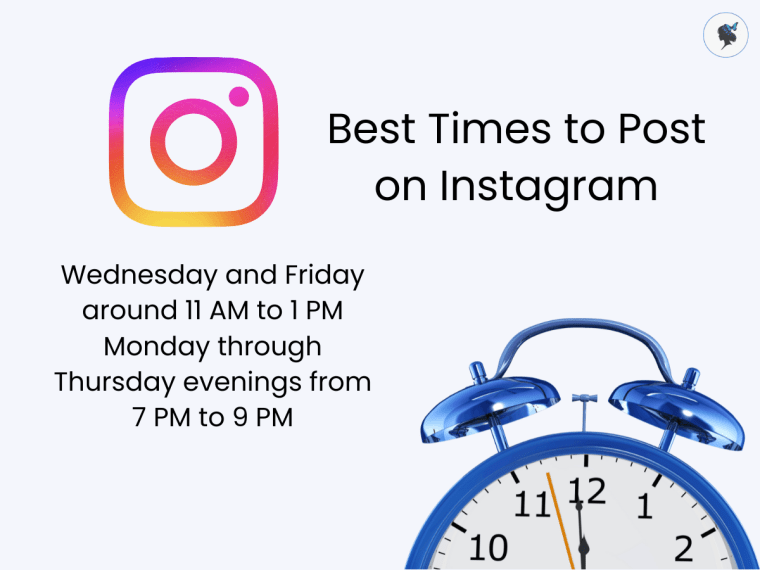
Infograph: Best Times to Post on Instagram
Best Times to Post on Instagram
  • Wednesday and Friday around 11 AM to 1 PM
  • Monday through Thursday evenings from 7 PM to 9 PM

Reels and Stories see high engagement in the evenings when users unwind. Using Instagram Insights lets you see when your specific followers are most active, helping tailor your timing. For example, a travel brand targeting young millennials might find their audience active around 8 PM on weekends.


Best Times to Post on Facebook

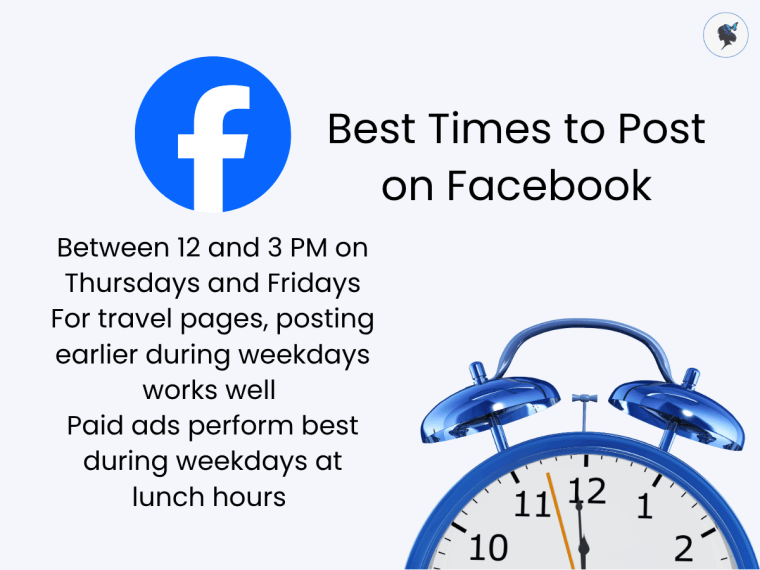
Infograph: Best Times to Post on Facebook
Best Times to Post on Facebook

Facebook engagement peaks between 12 and 3 PM on Thursdays and Fridays, with weekends seeing lower activity. For travel pages, posting slightly earlier during weekdays works well as users plan upcoming trips. Paid ads perform best during weekdays at lunch hours when users take breaks.

Facebook Insights offers detailed analytics on your page’s audience activity, so adjust timing based on your specific followers. For example, a family travel agency might find that weekend posts work better when parents have time to browse.


Best Times to Post on X (formerly Twitter)

Infograph: Best Times to Post on X (formerly Twitter)
Best Times to Post on X (formerly Twitter)

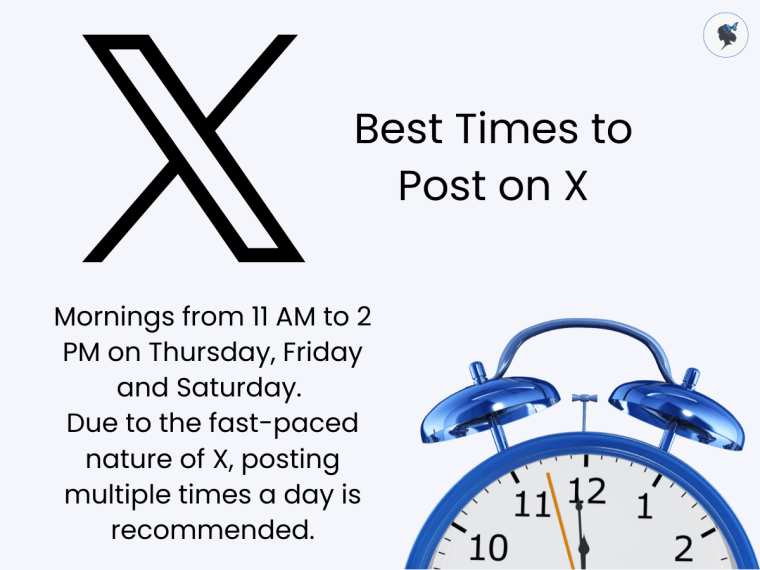
On X, the best times for travel content are typically mornings from 11 AM to 2 PM on Thursday, Friday and Saturday. Due to the fast-paced nature of X, posting multiple times a day is recommended.

Event-based posting around travel announcements or trending hashtags can also boost visibility. For instance, during major airline sales or travel expos, timing your posts to coincide with these events can amplify reach. Use X’s native analytics to track when your tweets get the most impressions.


Best Times to Post on TikTok

Infograph: Best Times to Post on TikTok
Best Times to Post on TikTok

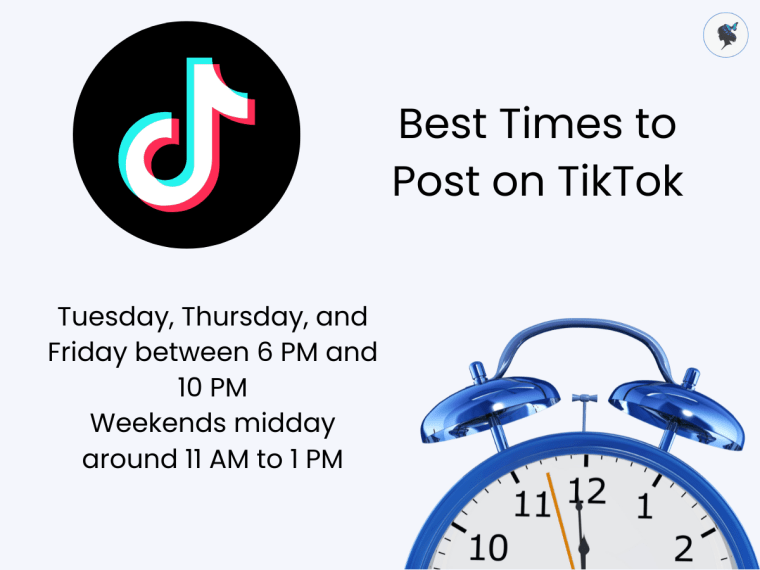
TikTok’s younger demographic means peak engagement is often after school and work hours:

  • Tuesday, Thursday, and Friday between 6 PM and 10 PM
  • Weekends midday around 11 AM to 1 PM

TikTok trends can emerge rapidly, so frequent posting and jumping on relevant challenges at the right moment is crucial. For travel brands, showcasing quick destination clips or travel hacks during peak times can increase shares and followers.


Best Times to Post on Pinterest

Infograph: Best Times to Post on Pinterest
Best Times to Post on Pinterest

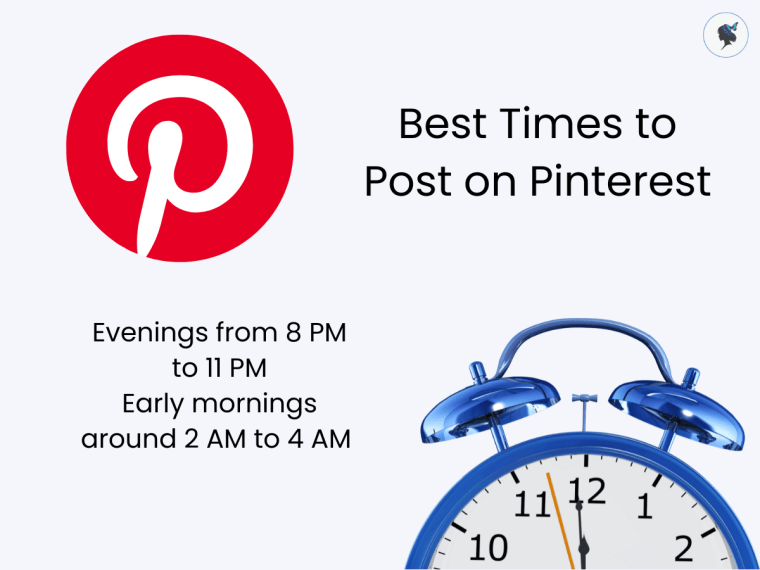
Pinterest users often plan future trips, making timing important:

  • Evenings, particularly Saturdays from 8 PM to 11 PM, are peak times.
  • Early mornings around 2 AM to 4 AM also see high activity, likely due to international users.

Pinterest’s algorithm favors fresh, relevant content during high-traffic hours, helping your pins get early saves and impressions that compound over time.


Best Times to Post on LinkedIn (for Travel Industry Professionals)

Infograph: Best Times to Post on LinkedIn
Best Times to Post on LinkedIn

LinkedIn is key for B2B travel marketing and networking. The best times are:

  • Tuesday to Thursday from 8 AM to 10 AM and 12 PM to 1 PM.
  • Posting during work breaks targets travel industry professionals, suppliers, and corporate travelers planning business trips or events.

For example, a travel company specializing in corporate travel could post case studies or industry insights during these times for maximum reach.


Best Times to Post on Bluesky

Infograph: Best Times to Post on Bluesky
Best Times to Post on Bluesky

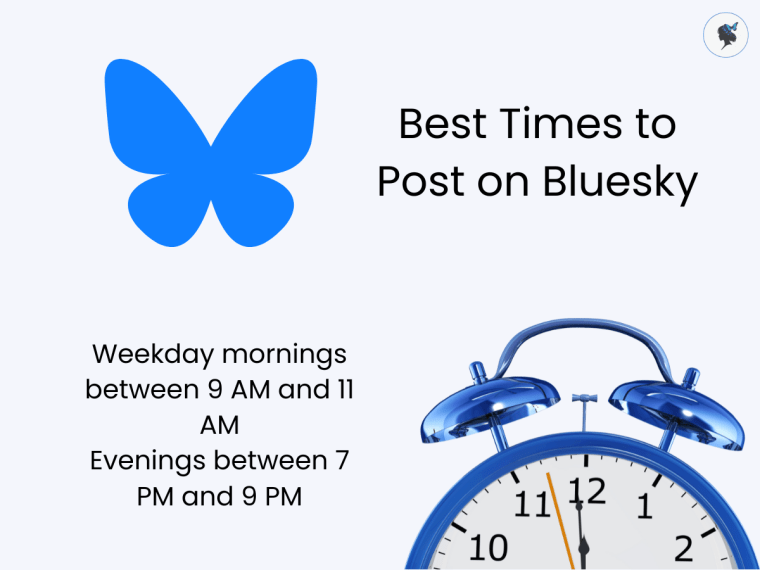
Bluesky, as an emerging decentralized social platform, currently sees its audience active mostly in US and European time zones. Early studies and user patterns indicate:

  • Weekday mornings between 9 AM and 11 AM
  • Evenings between 7 PM and 9 PM

Travel brands experimenting here should monitor engagement and adjust timing based on their specific followers, as the platform is still growing.


Best Times to Post on Threads

Infograph: Best Times to Post on Threads
Best Times to Post on Threads

Meta’s Threads is closely linked to Instagram, so its user behavior is similar:

  • Weekdays from 11 AM to 1 PM and 7 PM to 9 PM see high engagement
  • Travel brands can repurpose Instagram content for Threads and schedule posts during these windows for broader reach.

Since Threads is new, frequent testing is recommended, using Instagram’s audience data as a guide.


Best Times to Post on YouTube

Infograph: Best Times to Post on YouTube
Best Times to Post on YouTube

YouTube engagement peaks:

  • Thursday and Friday afternoons between 2 PM and 4 PM
  • Weekends from 9 AM to 11 AM

Travel brands can schedule video premieres or live Q&A sessions around these times for better viewer turnout. YouTube Analytics can help you discover when your subscribers are most active. For example, travel vloggers targeting families may find weekend mornings best for posting family-friendly travel videos.


Best Times to Post on WhatsApp

Infograph: Best Times to Post on WhatsApp
Best Times to Post on WhatsApp

WhatsApp is popular for direct communication and group promotions. The best times for travel-related messages are:

  • Evenings between 6 PM and 9 PM, when users check personal chats
  • Avoid early mornings or late nights to prevent spamming.

Using WhatsApp Status during holidays or travel seasons to share offers or travel tips can keep your audience engaged without being intrusive.


Best Times to Post on Telegram

Infograph: Best Times to Post on Telegram
Best Times to Post on Telegram

Telegram channels focused on travel tend to get the most engagement:

  • Weekdays between 10 AM and 12 PM and evenings from 7 PM to 9 PM
  • Scheduling announcements, travel deals, or tips during these times ensures your message reaches active users.

Automate posting with tools like Combot or Telemetr for consistent updates without manual effort.


General Tips for Timing Travel Content

  • Consider your audience’s location and daily routines to post when they’re most likely scrolling. For example, if your followers are mostly European travelers, adjust posting times to Central European Time (CET).
  • Test different posting times and analyze engagement metrics regularly to refine your schedule.
  • Align content timing with travel seasons and events, such as promoting ski destinations in early November or tropical escapes in late spring.

Conclusion

Knowing the best times to post travel content on each platform can significantly enhance your social media performance. Combining optimal timing with compelling content tailored to your audience’s interests maximizes engagement and conversions. Stay flexible, monitor analytics, and adapt as platforms and user behaviors evolve to keep your travel brand ahead in the social media game.

Need help with Social Media? Contact us today!


Understand Your Audience

A Guide for Travel Companies


Introduction

▶ Table of Contents

Why Knowing Your Audience Matters

In the travel industry, understanding your audience is more than just knowing who they are—it’s about understanding what drives their travel decisions. Travelers have diverse needs, preferences, and motivations, and tailoring your marketing to these factors can increase engagement, bookings, and loyalty.

Personalized marketing can boost conversion rates, making audience insights essential for any travel company looking to grow online.

What You’ll Learn in This Post

This guide will show you how to:

Infograph: Enhancing audience engagement
Enhancing audience engagement
  • Identify and analyze your audience
  • Create actionable buyer personas
  • Use analytics to uncover behavior patterns
  • Implement strategies to boost engagement through SEO, content, and social media

Understanding Your Audience

Key Demographics

Start by gathering basic information about your audience.

Infograph: Key audience demographics
Key audience demographics
  • Age: Are they Millennials, Gen Z, families, or retirees?
  • Gender: Tailor messaging if one gender predominates in your audience.
  • Location: Local, national, or international travelers?
  • Income & Travel Habits: Budget travelers, luxury seekers, or adventure enthusiasts

Example: Millennials may prioritize adventure travel, while retirees may prefer luxury cruises or cultural tours.

Read our post: marketing to Gen Z travelers.

Psychographics and Travel Motivations

Demographics alone aren’t enough. Psychographics reveal why your audience travels.

Infograph: The heart of modern travel motivations
The heart of modern travel motivations
  • Interests & Values: Sustainability, wellness, food culture, or adventure
  • Lifestyle: Solo travelers, families, remote workers, or digital nomads
  • Motivations: Bucket-list experiences, social media-worthy moments, relaxation

Behavior Patterns

Understanding behavior patterns is essential for travel brands because it informs marketing, sales, service, and product decisions across all channels, not just social media.

infograph: Factors shaping travel booking choices
Factors shaping travel booking choices
  • Booking Channels: Online vs. travel agencies
  • Content Preferences: Blogs, videos, social media, newsletters
  • Seasonal Trends: Peak travel times and holidays

Wander Women Hot Tip: Use social media polls or surveys to quickly gather demographic and psychographic insights.


Creating Buyer Personas

What Are Buyer Personas?

Buyer personas are semi-fictional profiles representing your ideal customers based on data and research.

They help travel marketers:

  • Tailor content and messaging
  • Personalize campaigns for higher engagement
  • Optimize ad targeting

Step-by-Step Guide to Creating Buyer Personas

Infograph: How to develop buyer personas?
How to develop buyer personas?
  • Collect Data: Gather insights from analytics, surveys, customer feedback, and social media.
  • Identify Patterns: Look for shared traits and behaviors.
  • Develop Persona Profiles: Include demographics, motivations, pain points, and content preferences.
  • Add Names & Stories: Make personas relatable for your marketing team.

    Example Persona: Adventure Alex

    • Age: 28, single, NYC
    • Motivations: Thrill-seeking, Instagram-worthy experiences
    • Preferred Content: Short travel videos, interactive itineraries
    • Booking Behavior: Books online, prefers mobile-friendly platforms

    Free Tool: HubSpot has a great tool: Make my Persona.


    Utilizing Analytics for Insights

    Google Analytics for Travel Companies

    Infograph: Google analytics for travel companies
    Google analytics for travel companies
    • Track key metrics: pageviews, session duration, top-performing content, and booking behavior
    • Use Audience Reports to understand age, gender, location, device, and interests

    Social Media Analytics

    Infograph: Which social media platform should be prioritized for content strategy?
    Which social media platform should be prioritized for content strategy?
    • Facebook Insights, Instagram Analytics, TikTok Analytics: Measure engagement, reach, and top-performing posts
    • Identify content formats that resonate with different audience segments

    Leveraging Feedback and Reviews

    Infograph: How to leverage feedback and reviews to improve customer satisfaction?
    How to leverage feedback and reviews to improve customer satisfaction?
    • Monitor TripAdvisor, Google Reviews, and social media comments
    • Extract insights on traveler expectations, pain points, and preferred experiences

    Wander Women Hot Tip: Set up custom dashboards in Google Analytics to track behavior on specific landing pages, blog posts, or itineraries.


    Actionable Tips for Engagement

    infograph: Enhancing user engagement in travel
    Enhancing user engagement in travel

    Personalization

    • Tailor email campaigns, blog posts, and social media content to specific personas
    • Address audience pain points and motivations in messaging

    Align Content Strategy with Travel Stages

    • Inspiration Stage: Blog posts, Instagram reels, destination guides
    • Planning Stage: Interactive itineraries, packing tips, videos
    • Booking Stage: Clear CTAs, comparison guides, booking widgets
    • Post-Trip Stage: Testimonials, UGC campaigns, email follow-ups

    Social Media Tactics

    • Run polls, Q&As, and live sessions to gather insights
    • Partner with niche influencers to enhance reach and credibility
    • Encourage user-generated content to foster community and trust

    SEO Applications

    • Use persona-driven keywords in blog posts and landing pages
    • Create location-specific content to attract local audiences

    Free Tools: Google Trends, AnswerThePublic.


    Conclusion

    Key Takeaways

    • Understanding your audience—through demographics, psychographics, and behavior—is essential for effective travel marketing
    • Buyer personas help personalize campaigns and guide content creation
    • Analytics provide actionable insights to improve SEO, content, and social media strategies

    Start taking action today

    1. Conduct a survey or poll to collect audience insights
    2. Build at least one buyer persona
    3. Audit your analytics to identify your top-performing content

    Define your audience today and watch your engagement, bookings, and online visibility grow! Need help? Contact us today!

    Why Your Travel Brand Needs a CRM

    ▶ Table of Contents
    1. Introduction
    2. Centralized Customer Data Management
    3. Enhanced Customer Segmentation and Targeting
    4. Improved Communication and Customer Service
    5. Streamlined Sales and Booking Processes
    6. Data-Driven Decision Making
    7. Building Customer Loyalty and Retention
    8. Scalability and Growth Support
    9. Conclusion

    Introduction

    In today’s competitive travel industry, building and maintaining strong customer relationships is essential. Customer Relationship Management (CRM) systems have become invaluable tools for travel brands aiming to provide personalized experiences, streamline operations, and drive growth. A CRM helps travel companies organize and leverage customer data to enhance service quality and boost sales. According to Salesforce, 79% of consumers say it’s important for brands to understand their needs, making CRM adoption crucial for success.


    Centralized Customer Data Management

    A CRM consolidates customer information from various touchpoints such as website inquiries, social media interactions, and booking platforms into one unified database. This centralized data enables travel brands to gain a complete, 360-degree view of each traveler’s preferences, past trips, and communication history.

    Infograph: CRM benefits for travel agencies.
    CRM benefits for travel agencies.

    For example, a travel agency can track that a customer prefers beach vacations and has booked trips to the Caribbean before. With this insight, the agency can tailor future recommendations and marketing messages, improving the customer experience and increasing the likelihood of repeat bookings.


    Enhanced Customer Segmentation and Targeting

    CRMs empower travel brands to segment customers based on demographics, booking behavior, travel interests, and more. This segmentation allows marketers to create highly targeted campaigns that resonate with specific traveler groups.

    Infograph: CRM-driven marketing success.
    CRM-driven marketing success.

    Imagine a campaign promoting luxury safari tours to affluent adventure travelers, while simultaneously sending family vacation package offers to customers with children. Segmenting your audience leads to more relevant messaging, which can increase open rates and conversions by over 50%.


    Improved Communication and Customer Service

    Effective communication is key to traveler satisfaction. CRMs enable automated yet personalized messages such as booking confirmations, reminders, travel tips, and post-trip surveys. Automated workflows ensure timely follow-ups without manual effort.

    Infograph: Enhancing travel satisfaction with CRMs
    Enhancing travel satisfaction with CRMs

    For instance, a CRM can send a friendly reminder about travel documents a week before departure or offer a special discount for a customer’s next trip based on their booking history. This proactive communication fosters trust and loyalty, which can boost customer retention rates by 20%.


    Streamlined Sales and Booking Processes

    CRMs help travel companies efficiently manage leads, track bookings, and monitor sales pipelines. Integrations with booking engines and payment gateways enable a seamless workflow from inquiry to final purchase.

    Infograph: CRM-driven sales cycle
    CRM-driven sales cycle

    For example, a corporate travel service can use its CRM to track group bookings, assign sales reps, and ensure timely follow-up for contract renewals. This organized process reduces booking errors and shortens sales cycles, increasing revenue and customer satisfaction.


    Data-Driven Decision Making

    The analytics capabilities within CRMs provide valuable insights into customer behavior and market trends. Travel brands can analyze which destinations are trending, identify peak booking times, and understand customer lifetime value.

    Infograph: CRM analytics cycle for travel brands
    CRM analytics cycle for travel brands

    By leveraging these insights, companies can optimize marketing budgets, tailor offers, and predict demand more accurately. For instance, spotting a surge in interest for eco-tourism trips could prompt a travel brand to develop new packages to meet customer demand, gaining a competitive edge.


    Building Customer Loyalty and Retention

    Repeat customers are the backbone of sustainable travel businesses. CRMs help brands implement loyalty programs, track rewards, and send personalized offers to encourage repeat bookings.

    Infograph: CRM-driven customer loyalty cycle
    CRM-driven customer loyalty cycle

    For example, a travel company might use CRM data to send a special discount on a client’s travel anniversary or early access to new tour packages. According to Invesp, increasing customer retention rates by just 5% can increase profits by 25-95%.


    Scalability and Growth Support

    As your travel brand grows, managing an expanding customer base across multiple channels becomes complex. CRMs scale with your business, handling larger data volumes and supporting omnichannel marketing strategies.

    Infograph: CRM scalability cycle
    CRM scalability cycle

    For example, an international travel agency can use a CRM to segment customers by region, send localized content, and manage communication in different languages. This scalability ensures consistent, personalized experiences for customers worldwide.


    Conclusion

    A CRM is not just a software tool but a strategic asset for any travel brand aiming to enhance customer relationships, improve operational efficiency, and drive revenue growth. By centralizing customer data, enabling targeted marketing, automating communication, and providing actionable insights, CRMs empower travel companies to deliver memorable experiences that keep travelers coming back.

    If your travel brand hasn’t adopted a CRM yet, now is the time to start. The investment in technology and process can pay off through increased customer satisfaction, loyalty, and profitability.

    Need help to choose the right CRM? Contact us today!

    The Complete Digital Marketing Funnel for Travel


    The Complete Digital Marketing Funnel for Travel

    ▶ Table of Contents

    Introduction

    In today’s highly competitive travel industry, simply having a website or social media presence isn’t enough. Travel brands need a structured, strategic approach to guide potential travelers from discovering your offerings to becoming loyal customers. This is where a digital marketing funnel becomes essential. It helps you attract, engage, convert, and retain customers by delivering the right message at the right time.

    infograph: Journey to traveler loyalty.
    Journey to traveler loyalty.

    According to HubSpot, companies that adopt a structured inbound funnel see a 55% increase in leads and higher conversion rates. For travel businesses, where purchase decisions can be complex and expensive, funnel marketing ensures no prospect gets left behind.


    1. Awareness Stage: Attracting Potential Travelers

    The first stage is all about visibility—making sure your travel brand is discovered by people dreaming about their next getaway. Key channels include SEO, social media ads, content marketing, and influencer partnerships.

    Infograph: Travel brand visibility stategies
    Travel brand visibility stategies
    • SEO: Travel-related search volume continues to grow; Google Trends shows that keywords like “best beach vacations” and “affordable trips 2025” spike seasonally, offering great opportunities.
    • Social Media: Platforms like Instagram and TikTok are where 80-90% of Gen Z and Millennials discover travel inspiration.
    • Influencers: Partnering with travel influencers can increase brand reach.

    Metrics to track: reach, impressions, and website visits.

    Read our post: Marketing to Gen Z travelers.


    2. Interest Stage: Engaging & Educating Prospects

    Once you have their attention, it’s important to deepen interest by providing valuable, informative content that helps prospects envision their trip and builds trust.

    infograph: Engaging and educating prospects
    Engaging and educating prospects
    • Use engaging blog posts on destinations, travel tips, and insider guides. 60% of travelers read blogs before booking trips.
    • Email newsletters with personalized tips see an average open rate of 25-30% in the travel industry.
    • Interactive content like quizzes (“What’s your travel style?”) increases engagement by over 40%.

    Metrics to track: time on site, bounce rate, email open and click-through rates.


    3. Consideration Stage: Nurturing Leads with Personalized Offers

    At this point, your prospects are weighing options. Personalized nurturing is key to tipping the scale in your favor.

    infograph: Converting travel prospects
    Converting travel prospects

    Metrics: click-through rates (CTR), engagement with personalized offers, webinar attendance.

    Read our post: the importance of personalization.


    4. Conversion Stage: Turning Prospects into Bookings

    This is the critical phase where interest turns into action—your prospect becomes a customer.

    infograph: Converting prospects to customers
    Converting prospects to customers

    Metrics: booking conversion rate, cart abandonment rate, average booking value.

    More about trust signals here.


    5. Loyalty & Advocacy Stage: Creating Repeat Travelers & Brand Ambassadors

    Repeat customers are the backbone of sustainable travel businesses. Turning travelers into loyal advocates drives ongoing revenue and new customer referrals.

    infograph: Cycle of customer loyalty in travel
    Cycle of customer loyalty in travel
    • Sending post-trip follow-ups with thank-you notes and surveys increases repeat bookings by 20-25%.
    • Implementing loyalty programs with points, discounts, and perks leads to 30% higher customer retention.
    • Encouraging user-generated content and reviews boosts brand credibility; UGC campaigns see 4x higher engagement on social media.
    • Personalized offers based on travel history increase upsell success by 10%.

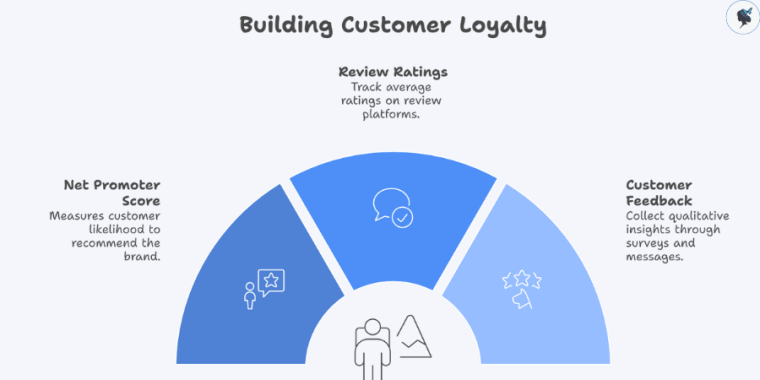
    Metrics: repeat booking rate, referral rates, Net Promoter Score (NPS).


    6. Tools & Technology to Support the Funnel

    • CRM software (e.g., Salesforce, HubSpot) for managing leads and customer data.
    • Marketing automation platforms for email and retargeting campaigns.
    • Analytics tools (Google Analytics, Facebook Insights) to measure funnel performance.
    • AI chatbots to provide 24/7 customer support and personalized recommendations.

    Investing in the right tools can improve efficiency and ROI by up to 30%.


    7. Case Studies / Examples


    Conclusion

    A well-structured digital marketing funnel is critical for travel brands aiming to grow in a competitive market. From awareness through loyalty, each stage requires tailored strategies, relevant content, and smart technology. By measuring key metrics and optimizing at every step, you can turn casual browsers into passionate travelers who come back year after year.

    Ready to implement a winning digital marketing funnel? Contact us for a tailored audit, strategy plan, or content calendar designed specifically for your travel brand.

    Marketing to Gen Z Travelers: What You Need to Know

    ▶ Table of Contents

    Introduction

    Gen Z (born 1997–2012) is reshaping global tourism. Unlike previous generations, they prioritize immersive experiences, digital discovery, and purpose-driven travel. McKinsey finds that 52% of Gen Zers are willing to spend more on experiential travel vs. just 29% of Boomers. Travel today is less about bucket lists and more about emotional connection, cultural authenticity, and digital sharing.


    1. Prioritize Authentic, Immersive Experiences

    Gen Z travelers favor experiences over luxury: 73% say they prefer experiences to material goods. They embrace offbeat adventures—from immersive festivals to community-based stays in small towns (a trend dubbed “townsizing,” with 67% expressing interest).

    Infograph: Gen Z travel preferences
    Gen Z travel preferences

    Wander Women Strategy: Develop itineraries around local traditions, boutique stays, wellness experiences, and niche festivals that create lasting memories—not just photo ops.


    2. Sustainability Is a Brand Imperative

    Gen Z is deeply eco-conscious: up to 70% prefer sustainable travel options, and nearly half worry about environmental impact when they travel. YouGov reports that many are even opting for no-fly itineraries or paying extra for carbon offsets.

    Infograph: Gen Z's eco-friendly travel choices
    Gen Z’s eco-friendly travel choices

    Wander Women Strategy: Emphasize eco-friendly lodging, responsible sourcing, local-business partnerships, and sustainability accreditation. Communicate it transparently on websites and socials.


    3. Meet Them Where They Are: Social-First Travel Discovery

    Gen Z uses TikTok, Instagram, and YouTube as their primary travel search engines: 80–90% use social media for inspiration, with ~40% preferring TikTok over Google for travel research. TikTok is especially powerful: 77% of European users were motivated to visit destinations after seeing them there.

    Infograph: Gen Z travel inspiration: from passive to active engagement
    Gen Z travel inspiration: from passive to active engagement

    Wander Women Strategy: Build short-form video content featuring raw, unfiltered travel moments—Reels, TikToks, UGC reels—and partner with micro/nano creators who mirror Gen Z values.


    4. Mobile-First Is Non-Negotiable

    Gen Z expects seamless, on-the-go experiences: 65–80% book via mobile apps, and many rely on apps for planning and last-minute deals. Around 40% use AR/VR tools to preview destinations beforehand.

    Infograph: Mobile-first is non-negotiable for Gen Z
    Mobile-first is non-negotiable for Gen Z

    Wander Women Strategy: Ensure responsive booking workflows, app-based itineraries, contactless tools, and digital concierge services. Explore VR previews or immersive experiences for high-engagement travel products.


    5. Affordable, Value-Driven, and Emotionally Intelligent

    Gen Z travels frequently (often 2–3 trips/year), despite modest incomes (60% earn under $50K). They use “soft-saving” tactics—strategic budgeting, loyalty points, and flexible trip formats—to make it possible.

    Infograph: Balancing Gen Z habits with strategic travel solutions
    Balancing Gen Z habits with strategic travel solutions

    Wander Women Strategy: Design travel budgets and modular packages with transparent pricing. Promote deals, indie or hostel stays, domestic adventures, and multi-faceted itineraries that offer high emotional ROI.


    6. Trust Peer Reviews & User-Generated Content

    Reviews and UGC are gold for Gen Z—49% depend on peer reviews, and ~30–50% book based on influencer or user content. 84% follow influencer-travel content regularly.

    Infograph: Gen Z Trust Peer Reviews & User-Generated Content
    Gen Z Trust Peer Reviews & User-Generated Content

    Wander Women Strategy: Amplify guest content: Instagram takeovers, Reels from travelers, review spotlights. Offer branded templates or hashtags for client-generated content, reposting highlights that feel authentic and fun.


    7. Gen Z Is Influencing Group & Family Travel

    While Gen Z often travels solo or with friends, they heavily influence family trip choices—80% of the time, they shape group itineraries. They want flexibility, modular activities, and multi-generational inclusivity.

    Infograph: Balancing generational needs in travel packages
    Balancing generational needs in travel packages

    Wander Women Strategy: Build hybrid packages that balance generational needs—adventure segments, relaxed cultural exploration, photo-worthy stops, wellness breaks, and optional adrenaline activities.


    8. Wellness, Self-Growth & Digital Detox Trips Appeal Strongly

    Wellness travel is trending: studies show high percentages (50-70%) of Gen Z saying travel helps their mental health, or that they seek wellness/relaxation in travel. Many prefer low-alcohol or sobriety-focused experiences and nature-rich lodging.

    Infograph: Wellness retreats overview
    Wellness retreats overview

    Wander Women Strategy: Offer curated wellness escapes—mindfulness retreats, yoga by the sea, nature hikes, or silent digital detox days. Emphasize mental clarity, purpose, and restorative experiences.


    Final Overview & Strategic Snapshot

    Gen Z TraitMarketing Insight
    Prefers experience over luxuryOffer immersive, culturally rich, and adventurous packages
    Concerned about sustainabilityFeature green credentials, carbon offsets, ethical lodging
    Discovers via social mediaInvest in TikTok, Instagram Reels, UGC and influencer collaborations
    Mobile-first behaviorOptimize app-based booking, AR/VR previews, contactless systems
    Budget-savvy yet experientialProvide flexible budgets, domestic options, modular itineraries
    Trusts peers and UGCShowcase real traveler stories and content for credibility
    Drives family travel choicesDesign multi-gen and flexible packages with varied experience layers
    Wants wellness & growth tripsOffer digital detox, wellness retreats, sober, nature-focused, and retreat tours

    Conclusion

    Marketing to Gen Z travelers in 2025 means blending digital dynamism, values-based storytelling, and affordable adventure. They seek autonomy, authenticity, and deeper meaning in how they travel—and they expect brands to share those values.

    Want to create content and campaigns that resonate with Gen Z? Contact us today!

    Instagram Growth Tips for Travel Brands

    ▶ Table of Contents
    1. Introduction
    2. Optimize Your Profile
    3. Post High-Quality, Engaging Visuals
    4. Leverage Instagram Reels and Stories
    5. Use Hashtags Strategically
    6. Engage Actively with Your Audience
    7. Collaborate with Travel Influencers
    8. Run Targeted Instagram Ads
    9. Analyze Your Metrics and Adapt
    10. Conclusion & Next Steps

    Introduction

    Instagram is a powerful platform for travel brands aiming to inspire and connect with wanderlust-driven audiences. With over 2 billion monthly active users, Instagram offers unparalleled opportunities to showcase stunning destinations, share authentic experiences, and build a loyal community. Whether you’re a boutique tour operator or a global travel agency, leveraging Instagram effectively can drive brand awareness, engagement, and bookings.


    Optimize Your Profile

    Your Instagram profile is your brand’s first impression. Use a clear, travel-related profile photo such as your logo or a signature destination image. Craft a bio that highlights your unique value and includes keywords travelers might search for, such as “adventure tours” or “family vacations.” Don’t forget to add a clickable link to your website, booking page, or a link-in-bio tool like Linktree to direct traffic effectively. According to Instagram, profiles with complete information get 30% more profile visits.

    Infograph: Instagram profile optimization pyramid
    Instagram profile optimization pyramid

    Wander Women Hot Tips:

    • Choose a clean, recognizable profile image.
    • Write a concise bio with keywords and a call to action.
    • Add a link that drives traffic to your highest priority page.

    Post High-Quality, Engaging Visuals

    Instagram is a visual-first platform, so the quality of your photos and videos is critical. Share breathtaking travel photos, immersive videos, and engaging carousel posts to tell a story. Maintain a consistent editing style and color palette to create a cohesive brand aesthetic. Brands that use consistent visuals see a 23% higher engagement rate. Don’t hesitate to mix formats—carousel posts, Reels, and Stories all serve different purposes and reach audiences in varied ways.

    Infograph: How to enhance instagram engagement through visual content?
    How to enhance Instagram engagement through visual content?

    Wander Women Hot Tips:

    • Invest in professional or well-edited travel photos.
    • Maintain visual consistency for brand recognition.
    • Experiment with content formats to maximize reach.

    Read our guide: the power of visual content.


    Leverage Instagram Reels and Stories

    Instagram Reels and Stories have become vital tools for travel brands to increase visibility and engagement. Reels, with their short, engaging videos, can go viral and reach audiences beyond your followers. Stories offer a more casual, authentic glimpse behind the scenes and allow you to use interactive features like polls, quizzes, and question stickers. Data shows that Reels receive 22% more engagement than regular video posts. Posting Stories daily keeps your brand top of mind and encourages audience interaction.

    Infograph: Which instagram feature should be prioritized for marketing?
    Which Instagram feature should be prioritized for marketing?

    Wander Women Hot Tips:

    • Create fun, inspiring Reels showcasing destinations or travel tips.
    • Use Stories to share daily updates and interactive content.
    • Incorporate stickers to boost viewer engagement.

    Use Hashtags Strategically

    Hashtags help categorize your content and extend its reach. Use a mix of popular, niche, and branded hashtags to target the right audience. For example, combine #TravelTuesday (popular) with #EcoTravelTips (niche) and your branded hashtag like #YourBrandTravels. Avoid banned or overly saturated hashtags, which can reduce your post visibility.

    Infograph: How to strategically use hashtags?
    How to strategically use hashtags?

    Wander Women Hot Tips:

    • Research and compile a hashtag set that fits your brand and audience.
    • Create and promote a unique branded hashtag.
    • Rotate hashtags to avoid spam signals from Instagram.

    Engage Actively with Your Audience

    Engagement is a two-way street. Respond to comments and DMs quickly to build trust and loyalty. Like and comment on your followers’ posts to foster community. Hosting giveaways or contests encourages interaction and grows your following organically. Instagram reports that accounts with high engagement see faster follower growth and increased visibility.

    Infograph: Instagram engagement cycle
    Instagram engagement cycle

    Wander Women Hot Tips:

    • Prioritize responding to all comments and messages.
    • Actively engage with followers and similar accounts.
    • Run contests or giveaways to encourage participation.

    Collaborate with Travel Influencers

    Partnering with influencers who align with your brand can dramatically increase your reach and credibility. Micro-influencers (10k–100k followers) often have highly engaged niche audiences and can provide authentic promotion at a lower cost. Use influencer content as social proof on your channels and track ROI carefully to ensure value. Influencer marketing yields an average of $5.78 ROI for every dollar spent.

    Infograph: Maximizing influencer partnerships
    Maximizing influencer partnerships

    Wander Women Hot Tips:

    • Identify influencers relevant to your travel niche and audience.
    • Build genuine, long-term partnerships rather than one-off posts.
    • Measure campaign results to optimize future collaborations.

    Check out our post: Leveraging Influencer Marketing.


    Run Targeted Instagram Ads

    Instagram Ads allow travel brands to promote their best content to highly targeted demographics, based on interests, locations, and behaviors. Use ads to boost posts that perform well organically or to drive traffic to landing pages. Testing different creatives and copy through A/B testing helps refine ad effectiveness.

    Infograph: Enhancing travel brand presence on Instagram
    Enhancing travel brand presence on Instagram

    Wander Women Hot Tips:

    • Promote your top-performing organic content with ads.
    • Target ads by traveler interests, demographics, and locations.
    • Continuously A/B test ad creatives and messaging for improvement.

    More about A/B testing here.


    Analyze Your Metrics and Adapt

    Use Instagram Insights or third-party analytics tools to track follower growth, engagement rates, reach, and conversion metrics. Understanding which posts and tactics drive results allows you to optimize your content calendar and strategy. Data-driven marketers are 6 times more likely to report success. Regular analysis keeps your efforts aligned with your goals and audience preferences.

    Infograph: Optimizing marketing strategy through data analysis
    Optimizing marketing strategy through data analysis

    Wander Women Hot Tips:

    • Monitor key metrics like engagement rate, reach, and follower growth.
    • Identify top-performing content and replicate its success.
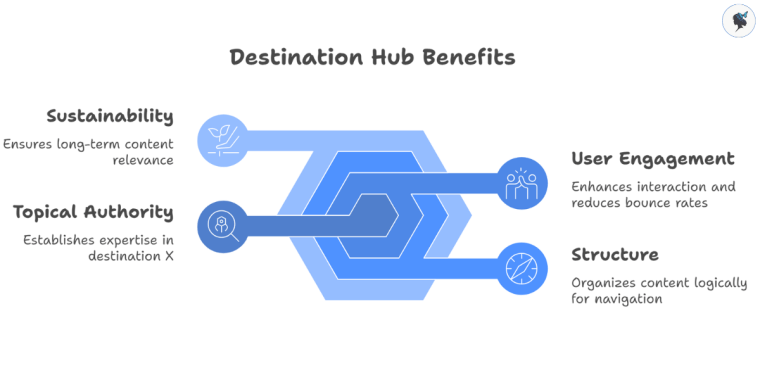
    • Adjust posting times and content types based on analytics.
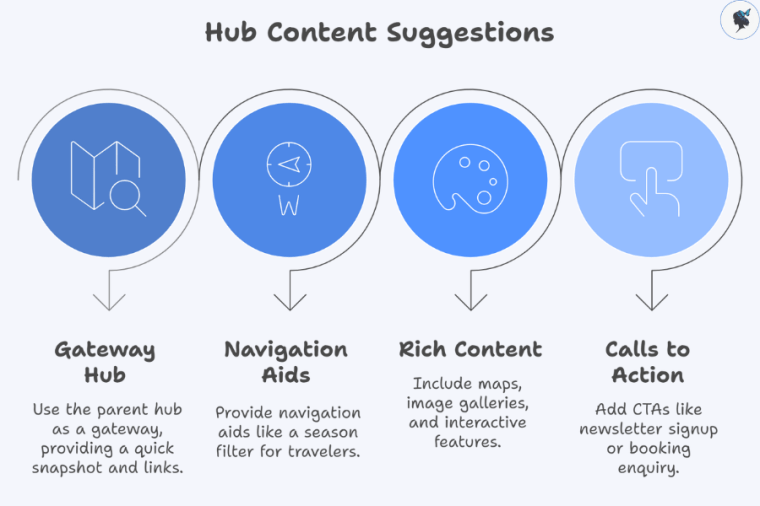
    Conclusion & Next Steps

    Growing your Instagram presence as a travel brand requires consistent effort, creativity, and strategic planning. By optimizing your profile, posting engaging visuals, leveraging Reels and Stories, using hashtags wisely, engaging your audience, collaborating with influencers, running targeted ads, and analyzing your data, you can build a vibrant community of travel enthusiasts eager to explore with you. Start by auditing your current profile and creating a content calendar to implement these tips systematically.
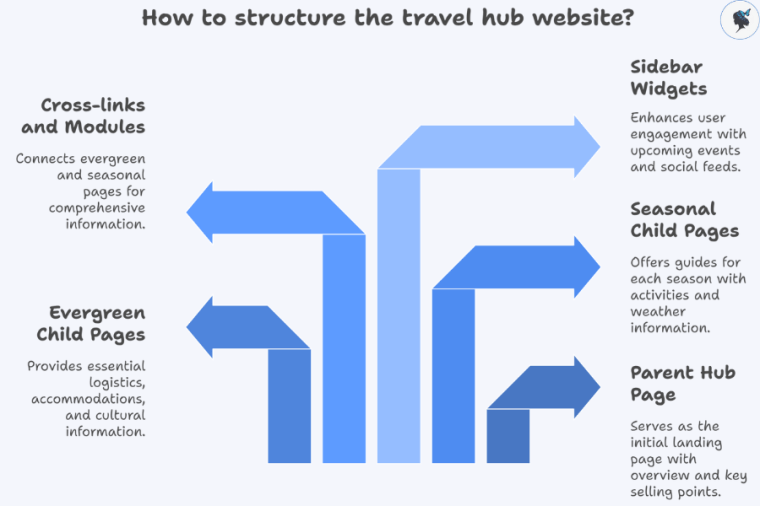
    Need help with Instagram? Contact us today!