How Travel Brands Can Use User‑Generated Content as SEO Assets

▶ Table of Contents
  1. Introduction
  2. The Strategic Significance of UGC in Travel
  3. Best Practices for Leveraging UGC as SEO Assets
  4. Effective Strategies for Soliciting UGC from Travellers
  5. Techniques for Optimising UGC for Search Engines
  6. Real‑World Examples of Travel Companies Using UGC to Drive SEO & Engagement
  7. Conclusion

Introduction

In the travel industry, we’re seeing a tectonic shift in how travellers discover, evaluate and book trips. Rather than simply absorbing branded content, today’s (and tomorrow’s) travellers rely heavily on user‑generated content (UGC)—photos, videos, reviews, social posts from real travellers—to inspire, inform and influence their decisions. According to one 2025 statistic, 86% of travellers said they were inspired to visit a location after seeing user‑generated content.
Meanwhile, the market for UGC in travel is estimated at around USD 279.8 million in 2025, with a projected growth to USD 1,132.1 million by 2035. (Future Market Insights)
For travel agencies and destination brands, this means UGC isn’t just “good to have” — it’s a high‑impact asset for content marketing, social media, and SEO. When properly solicited, curated and optimised, UGC drives engagement, improves search visibility, and builds trust with prospective travellers.

Wander Women Hot Tip: View UGC as a dual‑purpose tool: 1) social engagement and inspiration, 2) SEO asset and web content amplifier. Plan both uses whenever you request or reuse traveller content.


The Strategic Significance of UGC in Travel

1.Why UGC is a High‑Value Asset for Travel Brands
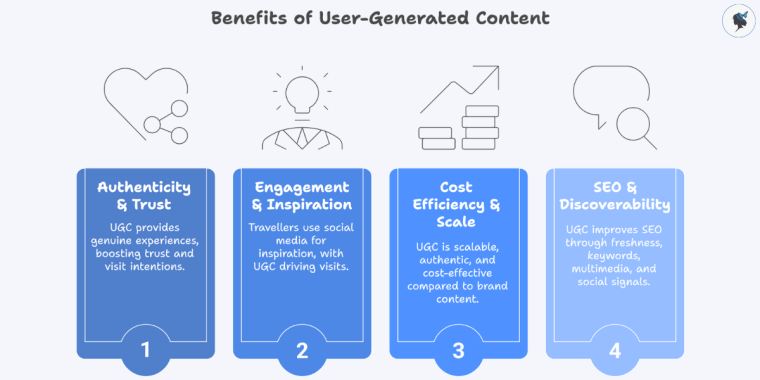
infograph: Benefits of User-Generated Content
Benefits of User-Generated Content
  • Authenticity & trust: UGC offers “real people, real experience” rather than polished brand messages. A 2025 study found UGC has a significant positive effect on destination imagery and tourist visit intentions.
  • Engagement and inspiration: In the travel sector particularly, 83% of travellers use social media for trip inspiration. Another stat: 86% of travellers were inspired to visit a location after seeing UGC.
  • Cost efficiency & scale: Compared with high‑production brand content, UGC can be more scalable, authentic and cost‑effective. For example, a marketing stat notes that visual UGC is considered more impactful by 85% of marketers compared to professional photography.
  • SEO & discoverability: UGC contributes to freshness signals, real traveller language (long‑tail keywords), multimedia content (photos/videos) and social signals that help search engines and users alike.

You might like our post: Use UGC to Enhance Your Travel Brand’s Trust

2. How UGC Impacts SEO & the Travel Funnel
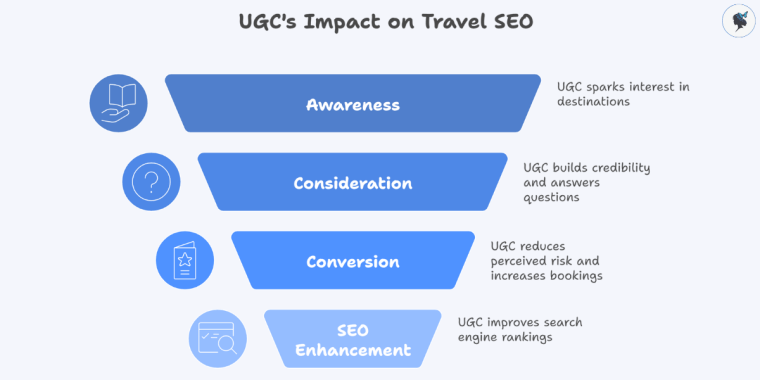
infograph: UGC's impact on travel SEO
UGC’s impact on travel SEO
  • Awareness phase: UGC helps travellers discover destinations (“I saw this Instagram reel and now want to go”).
  • Consideration phase: Reviews, photos, videos from travellers build credibility and answer questions (“What’s it really like staying at this hotel?”).
  • Conversion phase: Real‑traveller content reduces perceived risk, making bookings more likely.
  • SEO in action:
    • Fresh UGC updates signal to search engines a page is current and relevant.
    • Traveller language captures long‑tail, conversational keywords (e.g., “what it was like to stay in a tree house in Costa Rica”). More about Long-Tail Keywords here.
    • Multimedia UGC supports rich search results (image/video search, Google Discover).
    • Internal linking of UGC pages into destination/service hubs strengthens topical authority.
  • Metric improvements: UGC often leads to longer time on page, deeper scrolls (since people enjoy real‑traveller content), better engagement metrics—all of which can support rankings.

Wander Women Hot Tip: Build your content funnel around UGC touchpoints:

  • For TOFU (top‑of‑funnel) create “traveller story” pages and galleries.
  • For MOFU (middle) embed UGC into destination/service hub pages (real review + service link).
  • For BOFU (bottom) use UGC testimonials and case studies that push toward booking.
    Map your internal linking so that UGC feeds into your commercial pages.

Check out: The Complete Digital Marketing Funnel for Travel


Best Practices for Leveraging UGC as SEO Assets

1. Curate and Showcase UGC Strategically

infograph: UGC integration strategies
UGC integration strategies
  • Create dedicated sections on your site for UGC: e.g., “Traveller Gallery”, “Real Stories”, “Trip Highlights”. Use these as entry‑points and link into hub/destination/service content.
  • Use UGC in blog posts: integrate traveller quotes, photos, video snippets to humanise content and make it richer.
  • Build content clusters: For example, a destination page that includes brand content + embedded UGC streams (photos/videos) + links to sub‑pages. This boosts structure and authority.
  • Maintain quality control: Not all UGC will be suitable. Filter for relevance, authenticity, and brand fit. Research shows UGC influences tourist image and behaviour only when perceived as genuine.
  • Refresh UGC often: A destination page that embeds new traveller posts signals freshness to search engines and encourages repeat visits.
  • Align UGC showcase with user‑intent: E.g., if the page is “Adventure Travel in Iceland”, select UGC showing adventure contexts rather than leisure pool images.

2. Integrate UGC with On‑Page SEO Elements
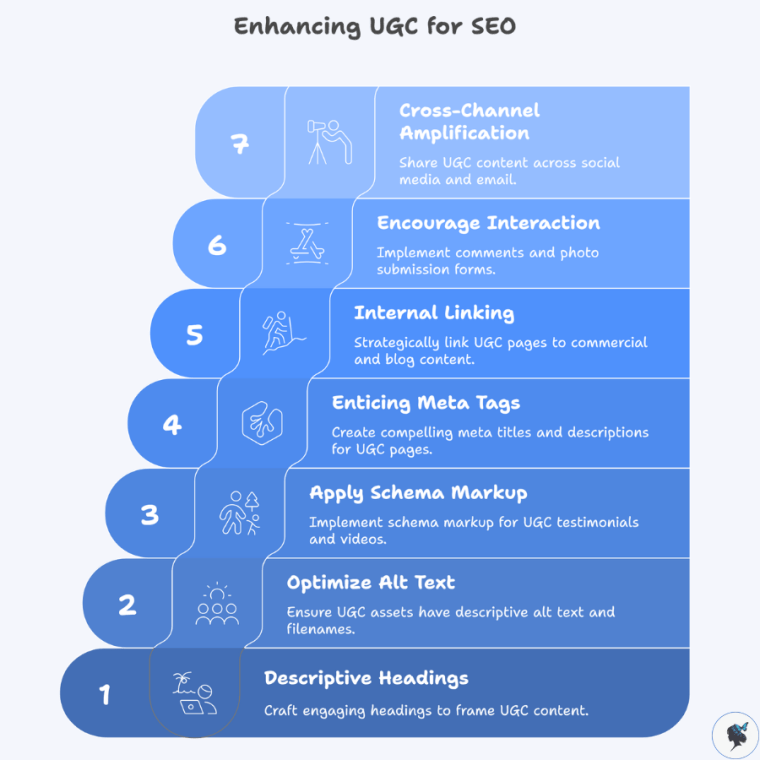
infograph: Enhancing UGC for SEO
Enhancing UGC for SEO
  • Use descriptive headings/sub‑headings that frame UGC: e.g., “See real traveller photos from our Maldives resort”, “What guests say: tree‑house experience in Belize”.
  • Optimize alt text and filenames of UGC assets: eg “solo‑female‑traveller‑hiking‑Torres‑del‑Paine.jpg” or “family‑trip‑senior‑couple‑Santorini‑sunset.png”.
  • Apply schema markup where relevant: Review schema around UGC testimonials, VideoObject schema for traveller videos.
  • Meta tags: Create enticing meta titles/descriptions for UGC‑rich pages (“Real traveller photos & reviews of XYZ resort – see what it’s really like”).
  • Internal linking strategy: Link from UGC pages to commercial/service pages (“Book the same villa our guest visited”), and from blog content into UGC pages for deeper engagement.
  • Encourage user‑interaction: Optional comments or “submit your photo” forms increase dwell time and activity on page.
  • Cross‑channel amplification: Use UGC‑led content in social media, email, newsletters to drive traffic back to on‑site pages (which improves search signals).

3. Monitor & Optimize Performance
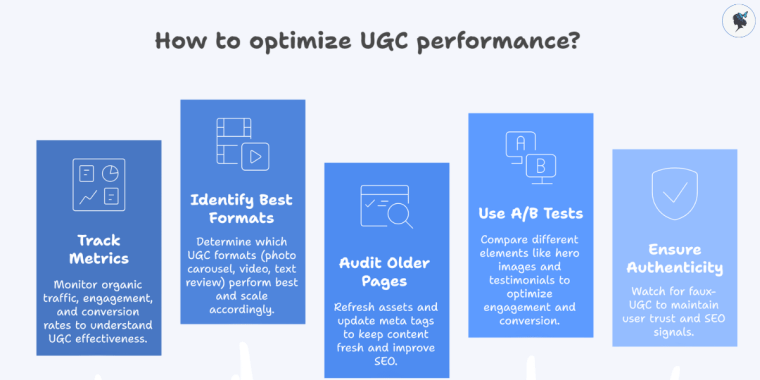
infograph: How to optimize UGC performance?
How to optimize UGC performance?
  • Track metrics: organic traffic to UGC pages, engagement (time on page, scroll depth), conversion from UGC content (clicks to booking).
  • Identify which UGC formats perform best (photo carousel vs video vs text review) and scale accordingly.
  • Audit older UGC pages: refresh assets, update meta tags, add new traveller posts to keep content fresh (search engines reward recent updates).
  • Use A/B tests: e.g., UGC gallery hero vs brand hero image, UGC testimonial vs no testimonial. Compare engagement and conversion outcomes.
  • Watch for faux‑UGC or irrelevant content—it may harm user trust and SEO signals. Authenticity matters.

Wander Women Hot Tip: Maintain a UGC content calendar: schedule quarterly refreshes of your UGC‑rich pages, track when traveller content awaits moderation, and ensure each UGC update prompts a mini‑SEO audit (alt text, schema, linking).


Effective Strategies for Soliciting UGC from Travellers

1. Build a UGC‑Friendly Ecosystem

infograph: UGC engagement cycle
UGC engagement cycle
  • Make it easy for travellers to submit their content: mobile upload forms, dedicated hashtag campaigns, photo spot prompts during or after the trip.
  • Incentivise contributions: run UGC contests (e.g., “Best sunset photo from our Bali resort”), feature winners, offer small rewards or recognition.
  • Use branded hashtags and prompts: “#OurBrandTraveller”, “#MyResortStory” – encourages sharing and helps aggregation.
  • In‑trip prompts: At check‑in, on‑tour, create signage or digital prompts encouraging travellers to tag your brand and share their moments.
  • Post‑trip follow‑up: send automated emails or SMS shortly after travel inviting submissions (“Share your favourite photo & you could be featured”).
  • Legal and rights management: ensure travellers agree to your terms for content reuse (photo rights, social media tags) at the point of submission.

2. Encourage UGC That Is SEO‑Friendly
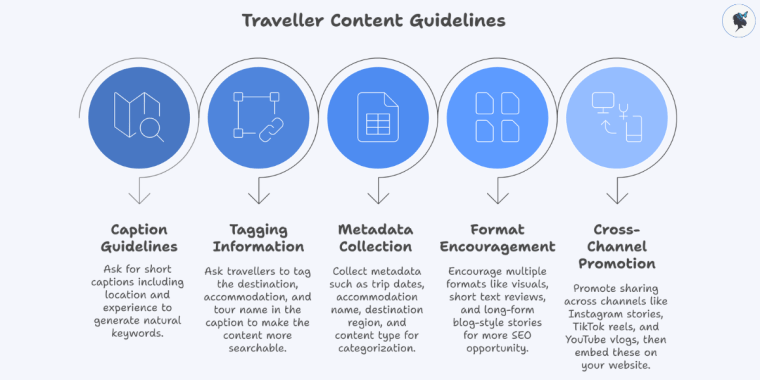
infograph: Traveller content guidelines
Traveller content guidelines
  • Provide guidelines to travellers: ask for short captions including location + experience (e.g., “Hiking the red dunes of Wadi Rum – best trip ever”). This helps generate natural keywords.
  • Ask travellers to tag the destination, accommodation, tour name in the caption (makes the content more searchable, helps link building).
  • Collect metadata: ask for trip dates, accommodation name, destination region, content type (photo, video, review) so you can later categorise and use effectively.
  • Encourage multiple formats: visuals (photos/videos), short text reviews, long‑form blog‑style stories (if willing) — more formats mean more SEO opportunity.
  • Promote sharing across channels: Instagram stories, TikTok reels, YouTube vlogs – you can then embed these on your website for richer content.

3. Manage and Moderate UGC Efficiently
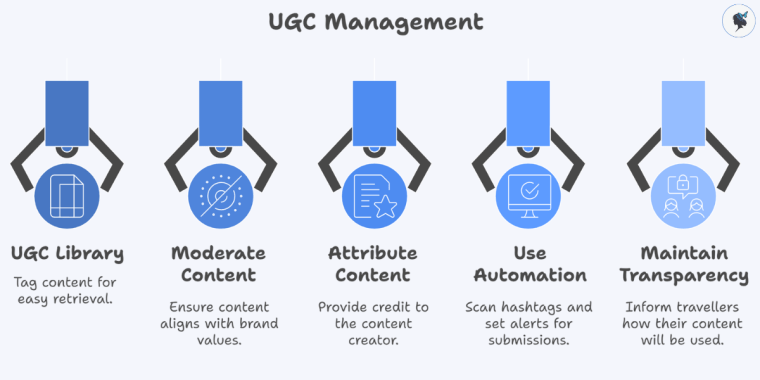
infograph: UGC management
UGC management
  • Create a UGC library (digital asset management): tag content by destination, trip type, season, traveller persona. Makes retrieval for content creation easier.
  • Moderate for quality & relevance: ensure the content aligns with your brand values, destination, and avoids irrelevant/spam posts. Lack of authenticity may undermine trust.
  • Attribute properly: always provide photo/author credit, link to the user where possible (improves authenticity and community feeling).
  • Use automation where possible: scanning hashtags, setting alerts for submissions, using workflow tools for approval and tagging.
  • Maintain transparency: let travellers know how their content will be used; this builds willingness to participate and ensures compliance.

Wander Women Hot Tip: Create a “Traveller UGC Kit” you send to past guests: sample captions, suggested hashtags, simple steps to upload/share their content. The more friction you remove, the more UGC you will receive.


Techniques for Optimising UGC for Search Engines

1. Structuring UGC for SEO Impact
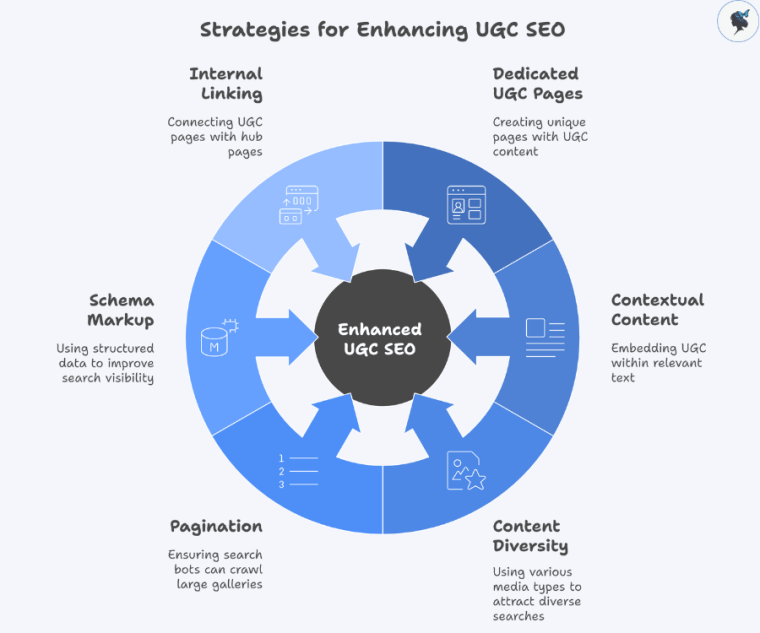
infograph: Strategies for enhancing UGC SEO
Strategies for enhancing UGC SEO
  • Create dedicated UGC‑rich pages with unique URL, title, meta description, e.g., /traveller‑stories/destination‑x/.
  • Ensure UGC is embedded within strong contextual content: not just a gallery, but heading, intro paragraph, text around it explaining relevance (“This is what it’s like to hike the glacier…”) which improves readability, scroll depth and SEO.
  • Mix content types: use photos, videos, reviews — this diversity improves chances of appearing in various search results (image search, video search, Google Discover).
  • Consider pagination for large galleries but ensure search bots can crawl (avoid infinite scroll without fallback).
  • Use schema markup: For example, mark up an embedded traveller video with VideoObject, or a review with Review.
  • Link to it: Internal linking from destination/service hub pages to UGC page and vice versa helps distribute SEO value.

2. Keyword Strategy Within UGC
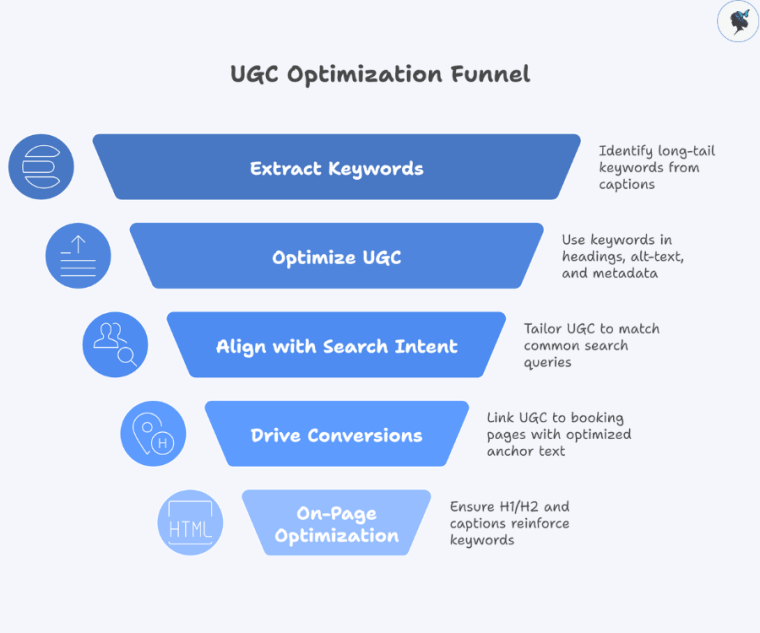
infograph: UGC optimization funnel
UGC optimization funnel
  • Extract organic language from traveller captions/comments to spot real‑world long‑tail keywords (e.g., “family friendly resort Maldivian lagoon with kids”).
  • Use those keywords in sub‑headings, alt‑text, captions, and metadata around the UGC.
  • Align UGC pages with search intent: e.g., if travellers often search “what it’s like staying in over‑water villa Maldives”, then embed relevant UGC and tailor the page accordingly.
  • Make sure the UGC helps push users down the funnel: link from the UGC story to booking/tour page with anchor text optimised for action (e.g., “Book the same villa our guest stayed in”).
  • On‑page optimisation: Ensure H1/H2 include target keywords, alt‑text for images include destination + experience, captions reinforce the topic.

3. Technical & On‑Page Optimisation
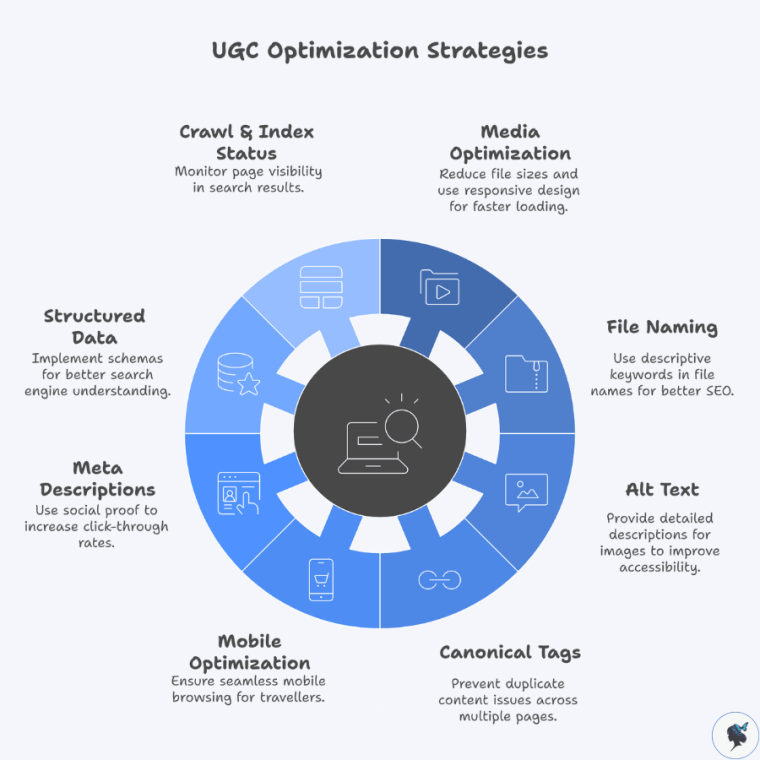
infograph: UGC optimization strategies
UGC optimization strategies
  • Optimize media: large volumes of high‑resolution images/videos can slow page speed. Use compression, lazy loading, responsive design.
  • File naming: rename server files to include keywords (e.g., solo‑female‑traveller‑hiking‑Torres‑del‑Paine.jpg).
  • Alt text: described in natural language including destination plus experience (“Solo female traveller hiking at sunrise Torres del Paine national park”).
  • Canonical tags: If UGC appears on multiple pages, ensure canonicalization to avoid duplication.
  • Mobile‑first optimisation: Ensure UGC pages load well on mobile since many travellers browse on smartphones.
  • Meta descriptions: Use social proof (“See real traveller photos & reviews from Destination X”) to boost click‑through rate (CTR).
  • Structured data: Use Review schema for UGC testimonials, ImageObject or VideoObject schema for galleries and videos.
  • Monitor crawl & index status: Use Google Search Console to ensure UGC‑rich pages are crawled and indexed.

4. Measuring & Iterating
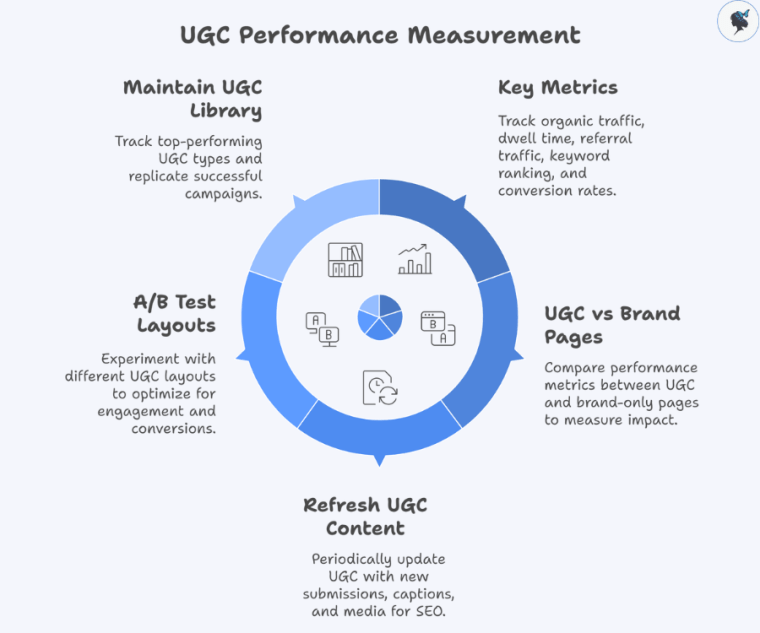
infograph: UGC performance measurement
UGC performance measurement
  • Key metrics: organic traffic to UGC pages; dwell time/scroll depth; referral traffic to booking pages; keyword ranking improvement; conversion rates (booking enquiries) originating from UGC content.
  • Compare UGC vs brand‑only pages: measure if embedding UGC leads to improved performance (e.g., lower bounce rate, higher pages per session).
  • Refresh UGC content periodically: add new traveller submissions, update captions, refresh images/videos — freshness supports SEO.
  • A/B test UGC layouts: e.g., hero image from traveller vs brand image; testimonial block vs no testimonial; call‑to‑action at bottom of UGC page vs none.
  • Maintain UGC library insights: track top performing UGC types (videos, scenic photos, cultural moments) and replicate similar campaigns.

Wander Women Hot Tip: Schedule a quarterly UGC SEO audit: list all pages with embedded traveller content, check alt‑text, meta title/desc, internal linking, page speed, mobile performance. Prioritise fixes for pages with high traffic but low conversion.


Real‑World Examples of Travel Companies Using UGC to Drive SEO & Engagement

  • Airbnb: Frequently uses guest‑shared photos and reviews in its destination pages and blog, helping travellers visualise “what it’s really like” and improving engagement.
  • Destination marketing example: A recent study found that UGC significantly improves destination image and intentions to visit, illustrating that DMO/brand‑driven UGC campaigns can shift demand materially.
  • Key takeaway for travel agencies: You may not have massive budgets, but you can embed UGC in your site, build galleries, feature “Traveller of the Month”, and link stories to service offers. Over time, this builds topical authority and trust.

Wander Women Hot Tip: Pick one UGC campaign (e.g., “Show us your stay at Resort X”), run it for 3 months, embed the resulting content in a destination hub page, and monitor traffic, engagement and conversions vs a similar page without UGC. Use the results to scale.


Conclusion

User‑generated content is not a nice‑to‑have extra in the travel industry—it’s an SEO‑strong asset, a trust builder, and a engagement amplifier. For travel agencies and brands willing to invest in soliciting, curating and optimising UGC, the benefits are clear: more organic traffic, higher engagement, better conversion potential, and authentic connection with travellers.
To recap the strategy:

  1. Solicit UGC intentionally (with prompts, incentives, seamless workflows).
  2. Curate it smartly (destination‑relevant, quality controlled, integrated into content hubs).
  3. Optimise it for web (alt text, schema, internal linking, media optimisation).
  4. Measure and iterate (audit quarterly, refresh content, replicate what works).
    Start small, pick a pilot destination or service, embed traveller content, optimise around long‑tail keywords derived from that content, and use it as a proof case internally.

Wander Women Hot Tip: Use your first 90 days to build a “UGC starter kit”: write a brief for traveller submissions, design a UGC gallery page template, map the internal linking path to your service/booking pages, and schedule the quarterly review. Once the system is set, you’ll continuously gain UGC, SEO value and conversions with decreasing incremental effort.

Need help? Contact us today to get started!
Managing Seasonal Offers and Dynamic Inventory: SEO Best Practices for Travel Agencies


▶ Table of Contents
  1. Introduction
  2. Understanding Dynamic Inventory
  3. SEO Implications of Dynamic Pages
  4. Best Practices for Managing Dynamic Offers
  5. Enhancing User Experience
  6. Case Study
  7. Conclusion

Introduction

For travel agencies, dynamic inventory pages—featuring seasonal offers, limited-time packages, or fluctuating availability—are essential for converting travelers. However, frequent changes pose SEO challenges. Pages may appear and disappear each season, risking lost rankings, duplicate content, or broken links.

Properly handling these pages requires a combination of technical SEO strategies and content planning to preserve search visibility while delivering a seamless user experience.

Wander Women Hot Tip: Start by auditing your existing offers pages. Identify which seasonal or expiring content has caused 404 errors or ranking drops in the past.


Understanding Dynamic Inventory

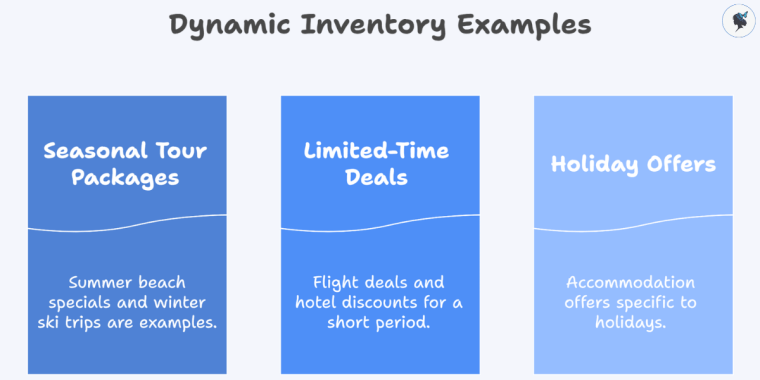
infograph: Dynamic inventory examples
Dynamic inventory examples

1. Definition and Examples

Dynamic inventory pages are those updated frequently based on availability, promotions, or seasonality. Common examples include:

  • Seasonal tour packages (e.g., summer beach specials, winter ski trips)
  • Limited-time flight deals or hotel discounts
  • Holiday-specific accommodation offers
  • Travel demand varies by season; peak periods often bring high search interest for specific destinations.
  • Search behavior changes accordingly—for instance, “best ski resorts” spikes in winter.
  • Agencies must update content timely to match traveler intent.

Wander Women Hot Tip: Track seasonal search trends per destination to plan offers content ahead of peak interest, ensuring your pages are indexed and visible when travelers search.

You might be interested in our post: Strategies for Managing Seasonal Content.


SEO Implications of Dynamic Pages

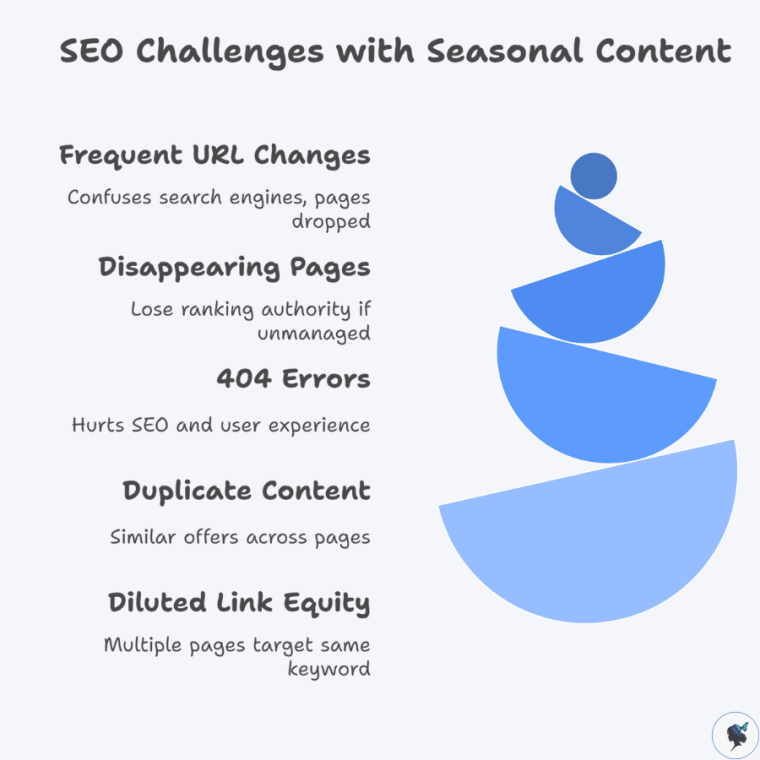
infograph: SEO challenges with seasonal content
SEO challenges with seasonal content

1. Crawling and Indexing Challenges

  • Frequent URL changes can confuse search engines, leading to pages being dropped from the index.
  • Disappearing pages may lose ranking authority if not managed correctly.

More about crawlability and indexability here.

2. Risks of 404 Errors and Duplicate Content

  • Expired offers returning 404s hurt both SEO and user experience.
  • Similar offers across multiple pages can create duplicate content issues.
  • Link equity may be diluted if multiple seasonal pages target the same destination or keyword.
  • Without proper canonicalization or redirects, valuable SEO signals can be lost.

Wander Women Hot Tip: Develop a consistent URL strategy for seasonal offers, keeping base URLs evergreen while updating the content dynamically.


Best Practices for Managing Dynamic Offers

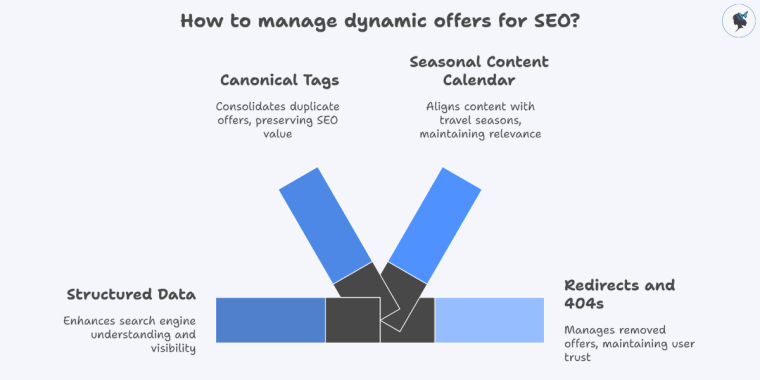
infograph: How to manage dynamic offers for SEO?
How to manage dynamic offers for SEO?

1. Structured Data Implementation

  • Use Offer, Product, and Event schema to help search engines understand seasonal packages.
  • Structured data can enable rich snippets in search results, increasing CTR and visibility.

2. Canonical Tags

  • Use canonical tags to consolidate duplicate or similar offers, preserving SEO value.
  • Example: /summer-beach-special canonicalized to /beach-offers ensures all authority points to the main destination page.

3. Seasonal Content Calendar

  • Plan content updates aligned with travel seasons.
  • Schedule posts for new packages before peak search periods to maintain relevance and indexing.

4. Redirects and 404 Handling

  • Use 301 redirects for removed offers to relevant alternatives.
  • Soft 404s for expired offers can maintain user trust without harming SEO.

Wander Women Hot Tip: Maintain a master offers index page that links to all seasonal pages. This acts as a central hub for both users and search engines.


Enhancing User Experience

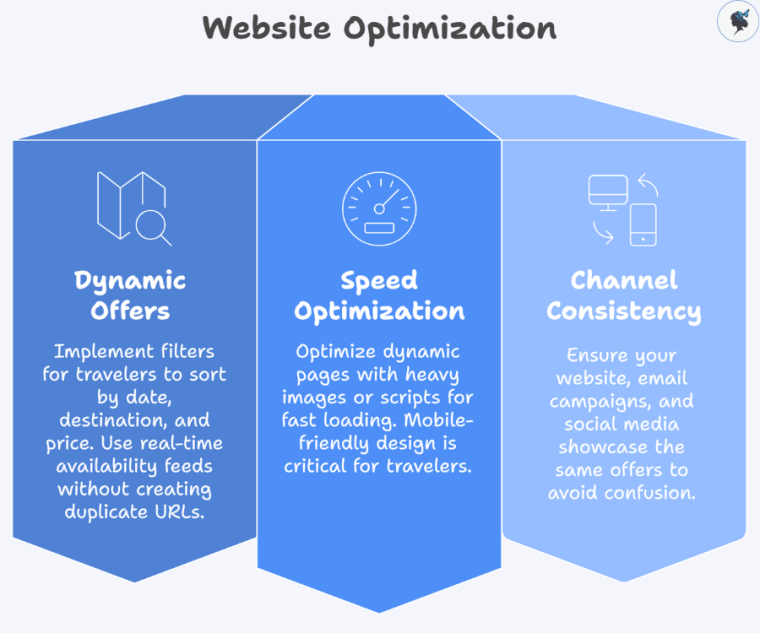
infograph: Website optimization
Website optimization

1. Displaying Offers Dynamically

  • Implement filters for travelers to sort by date, destination, and price.
  • Use real-time availability feeds without creating duplicate URLs for each variant.

2. Page Speed and Mobile Optimization

  • Dynamic pages often include heavy images or scripts—optimize for fast loading.
  • Mobile-friendly design is critical, as most travelers search and book on mobile devices.

More about mobile optimization here.

3. Consistency Across Channels

  • Ensure your website, email campaigns, and social media showcase the same offers to avoid confusion.

Wander Women Hot Tip: Use lazy loading for images and caching for frequently updated content to balance dynamic functionality with page speed.


Case Study

Ingenia Holiday Parks — Migration & SEO protection

  • Client: Ingenia Holiday Parks (part of Ingenia Communities).
  • Project: Large-scale platform migration from WordPress to headless CMS (Sanity) with a dev partner (Inlight) and SEO partner Optimising.
  • Goal: Migrate a high-traffic site without losing organic rankings or bookings.
  • Outcome: traffic levels sustained through cutover (200k+ monthly organic visits), impressions doubled year-on-year, key park pages showing significant click gains, and bookings remained consistent. Optimising reports rankings/impressions stabilised within two weeks and continued to improve thereafter.

Wander Women Hot Tip: Analyze which seasonal pages consistently generate traffic and bookings to prioritize future updates.


Conclusion

Managing dynamic inventory pages effectively requires a balance of SEO, content planning, and user experience:

  • Use structured data to highlight seasonal offers in search results.
  • Apply canonical tags and 301 redirects to preserve SEO value.
  • Maintain a content calendar to plan updates and ensure pages remain relevant.
  • Optimize page speed and mobile experience to enhance usability.

By implementing these strategies, travel agencies can maintain rankings, improve conversions, and maximize visibility for seasonal offers without compromising SEO.

Wander Women Hot Tip: Treat your dynamic offers pages as a living asset. Update, optimize, and monitor them regularly to ensure both travelers and search engines continue to find your best seasonal content.

Need help with your dynamic content? Contact us today!

Strategies for Managing Seasonal Content: Winter

▶ Table of Contents
  1. Introduction: Why Winter Content Needs a Strategy
  2. Winter Issues Travel Agencies Face
  3. Short-Term Fixes for Winter Content
  4. Long-Term Strategies for Winter Content
  5. Unique Winter Content Ideas
  6. Sample Winter Content Calendar
  7. Actionable Tips for Travel Agencies
  8. Conclusion

Introduction: Why Winter Content Needs a Strategy

Winter is a unique season for travel agencies. While many associate it with skiing, holiday markets, and cozy escapes, it also comes with significant challenges. Websites often see slower traffic, and content created for previous years can quickly become outdated.

Effective winter content management is critical for travel agencies to maintain SEO performance, attract travelers, and convert seasonal interest into bookings. This guide covers both short-term fixes and long-term strategies to help agencies maximize the impact of winter content.

You might like: Managing Seasonal Content: Fall.

Winter Issues Travel Agencies Face

Understanding the challenges specific to winter content is key to developing effective strategies.

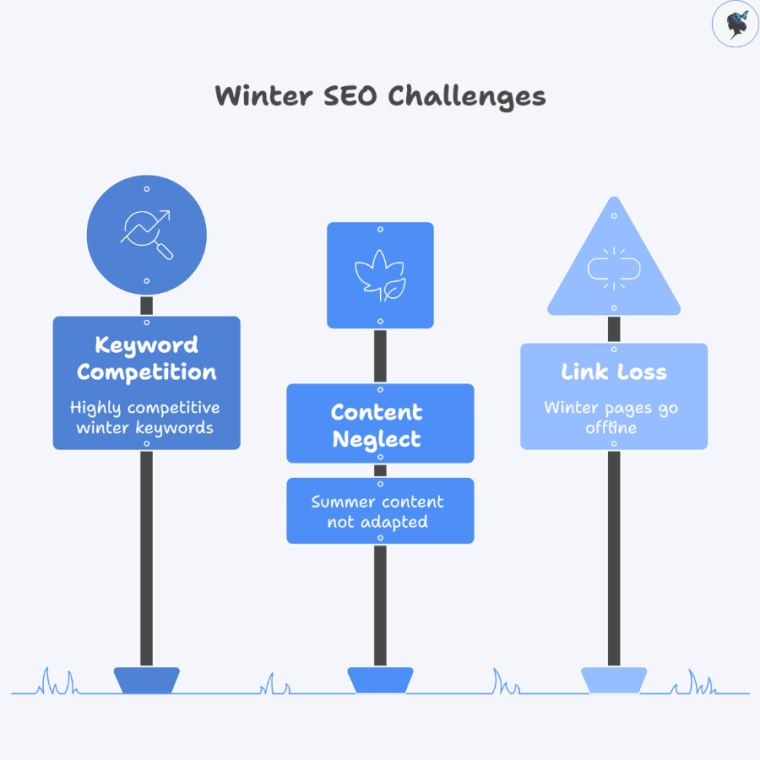
Infograph: Winter SEO challenges
Winter SEO challenges

1. Low Organic Visibility

  • Popular keywords like “winter escapes,” “ski holidays,” or “winter getaways” are highly competitive.
  • Search interest is heavily seasonal, often peaking in early winter and dropping quickly afterward, leaving many pages underutilized.

2. Lack of Content Repurposing

  • Many agencies focus on summer or autumn content, but fail to adapt it for winter themes.
  • Opportunities to repurpose content across seasons — for example, turning a summer mountain guide into a winter skiing guide — are often missed.

More about repurposing content here.

  • Older winter pages often go offline post-season, resulting in loss of backlinks and authority.
  • This reduces organic visibility for new content and diminishes the site’s overall SEO performance.

Short-Term Fixes for Winter Content

To achieve quick wins and keep winter content relevant, travel agencies can implement several short-term strategies.

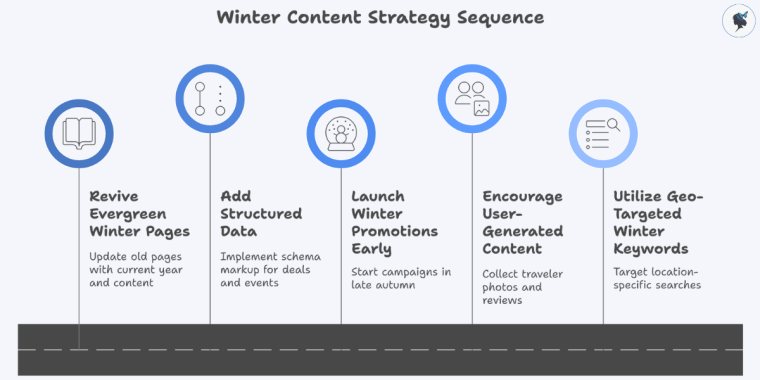
Infograph: Winter content strategy sequence
Winter content strategy sequence

1. Revive Evergreen Winter Pages

  • Update pages from previous years with the current year and refreshed content.
  • Example: “Top Ski Resorts – Updated Winter Guide 2026.”
  • Benefits: preserves search rankings and maintains relevance for returning visitors.

More about evergreen content here.

2. Add Structured Data

  • Implement schema markup for winter deals, events, and holiday packages.
  • Recommended types:
    • Event schema (for winter festivals or activities)
    • Offer schema (for promotions and package deals)
    • FAQ schema (for common traveler questions)
  • Structured data enhances rich results in Google, improving click-through rates.

3. Launch Winter Promotions Early

  • Start campaigns in late autumn to capture early planners.
  • Channels: email newsletters, social media teasers, and blog posts.
  • Early promotion increases the likelihood of pre-bookings and reduces competition during peak winter searches.

4. Encourage User-Generated Content

  • Collect traveler photos, stories, and reviews to enhance engagement.
  • Campaign idea: “Share Your Favorite Winter Trip Memories.”
  • Benefits: fresh content, social proof, and improved SEO through new text and image content.

More about User-Generated Content here.

5. Utilize Geo-Targeted Winter Keywords

  • Target location-specific searches to reduce competition and attract travelers seeking specific destinations.
  • Examples:
    • “Best winter escapes in Switzerland”
    • “Family-friendly ski resorts in Colorado”
  • Geo-targeting helps attract high-intent visitors likely to book.

Long-Term Strategies for Winter Content

Short-term fixes are important, but long-term planning ensures sustained value from your winter content.

Infograph: Enhancing winter content strategy
Enhancing winter content strategy

1. Keep Winter Landing Pages Live Year-Round

  • Avoid taking seasonal pages offline; instead, update them annually.
  • Benefits: retains SEO value, maintains backlinks, and improves site authority.
  • Link winter content to related off-season guides, holiday promotions, or early booking offers.
  • Example: linking a winter ski guide to a “Best Summer Mountain Hikes” post to encourage year-round engagement.

3. Create Evergreen Winter Guides

  • Develop content that remains relevant across multiple years. Examples:
    • “Best Time to Visit Alpine Ski Resorts”
    • “Winter Festivals Around the World”
  • Evergreen content minimizes the need for yearly rewrites while continuing to attract traffic.

4. Track Performance Using SEO Tools

  • Monitor winter content using Google Search Console, Ahrefs, or Semrush.
  • Track key metrics: organic traffic, keyword rankings, click-through rates, and conversions.
  • Insights inform both updates to current content and planning for next year.

5. Align Content With User Intent

  • Differentiate content for informational queries (e.g., packing guides, travel tips) and transactional queries (e.g., booking ski trips).
  • Ensure each page addresses the intent effectively:
    • Informational content educates and inspires.
    • Transactional content drives bookings and conversions.

More about user intent here.


Unique Winter Content Ideas

Innovative content can attract and engage audiences while differentiating your agency from competitors.

  1. Winter Escape Checklist – Practical tips for preparing for winter trips, from packing to safety.
  2. How to Pack for Alpine Winter Trips – Guides tailored to families, solo travelers, and adventure seekers.
  3. Virtual Snow-Sports Previews – Interactive videos or VR experiences of ski slopes, snowboarding runs, and winter trails.
  4. Feature Local Winter-Only Events or Traditions – Highlight festivals, Christmas markets, or seasonal cultural activities.
  5. Interviews With Local Guides – Insider tips on winter highlights, hidden gems, and adventure activities.

Sample Winter Content Calendar

A well-structured content calendar ensures timely content creation, promotion, and evaluation.

MonthActions
September–OctoberPrepare and publish winter content; refresh evergreen guides; gather user-generated content
November–JanuaryRun winter-themed campaigns (New Year’s deals, ski trips, holiday escapes); promote content via social media and newsletters
February–MarchAnalyze performance; gather insights for next season; begin preparing spring content

Wander Women Hot Tip: Integrate SEO audits, structured data checks, and promotional campaigns into the calendar to maximize winter content effectiveness.


Actionable Tips for Travel Agencies

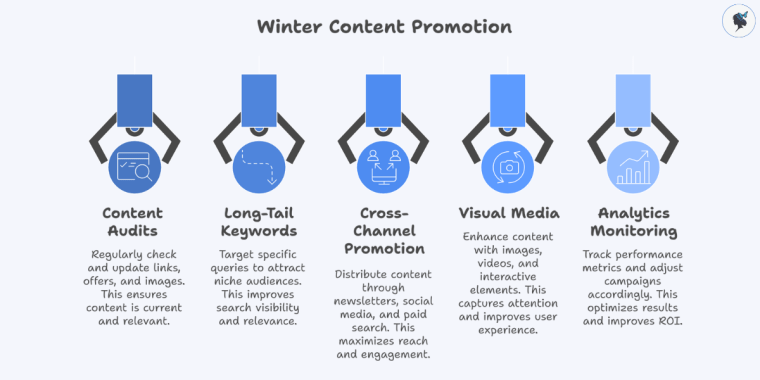
Infograph: Winter content promotion
Winter content promotion
  • Audit Content Regularly: Schedule seasonal audits to update outdated links, offers, and images.
  • Focus on Long-Tail Keywords: Use queries like “family-friendly winter trips in Switzerland” instead of generic terms.
  • Promote Across Channels: Leverage newsletters, social media, and paid search to drive traffic to winter content.
  • Incorporate Visual Media: Use high-quality images, videos, and interactive elements like maps or quizzes.
  • Monitor Analytics: Track performance and adjust campaigns based on engagement, conversion rates, and search trends.

More about long-tail keyword identification here.


Conclusion

Winter content presents unique challenges for travel agencies — from slow traffic and outdated pages to competitive keywords and seasonal interest. By implementing short-term fixes, such as refreshing evergreen pages, launching early promotions, and leveraging user-generated content, agencies can quickly improve visibility and engagement.

Long-term strategies like maintaining evergreen landing pages, building backlinks, creating evergreen guides, and aligning content with user intent ensure sustained SEO performance and year-round relevance.

With innovative content ideas like winter escape checklists, virtual snow-sports previews, and local festival features, travel agencies can stand out in the crowded winter travel market. By following a structured content calendar and combining short- and long-term strategies, agencies can maximize bookings, maintain authority, and engage travelers throughout the winter season.

Begin auditing your winter content today. Refresh high-performing guides, implement structured data, and plan early promotions to ensure your winter travel content drives maximum engagement and conversions.

Need help with your winter content? Contact us today!


Strategies for Managing Seasonal Content: Summer

▶ Table of Contents
  1. Introduction: Why Summer Content Needs a Strategy
  2. Summer Issues Travel Agencies Face
  3. Short-Term Fixes for Summer Content
  4. Long-Term Strategies for Sustainable Seasonal Content
  5. Unique Summer Content Ideas
  6. Sample Summer Content Calendar
  7. Actionable Tips for Travel Agencies
  8. Conclusion

Introduction: Why Summer Content Needs a Strategy

For travel agencies, summer is the season everyone talks about — long vacations, beach getaways, family trips, and international travel spikes. Yet, paradoxically, many agencies struggle to maximize traffic and bookings outside peak months, leaving summer content underperforming.

Travel agencies need a proactive content strategy for summer — one that addresses immediate traffic dips, strengthens SEO, and ensures long-term relevance year after year.

Summer Issues Travel Agencies Face

Understanding the common pitfalls of summer content is crucial before implementing solutions.

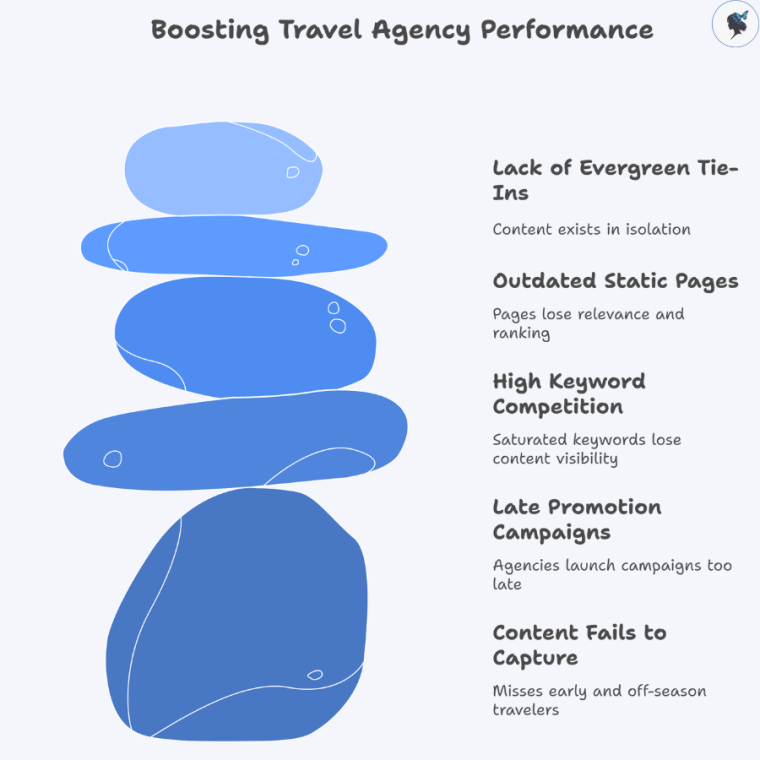
infograph: Boosting travel agency performance
Boosting travel agency performance

1. Traffic and Booking Dips Outside Peak Months

  • Many agencies see a spike in website visits in June–August but a significant drop in May or September.
  • Content often fails to capture early planners or off-season travelers.

2. Content Lacks Early Promotion

  • Agencies tend to launch summer guides or promotional campaigns too late.
  • Early promotion (spring or even late winter) can capture travelers planning 3–6 months ahead, giving agencies a competitive advantage.
  • Keywords like “summer holidays,” “beach vacations,” and “summer travel deals” are saturated.
  • Without creative, long-tail targeting, your content risks being lost amid global competition.

4. Pages Get Outdated Year to Year

  • Static pages lose relevance and fail to rank in search engines.
  • Content with outdated information (prices, regulations, events) decreases credibility and discourages repeat visits.

5. Lack of Evergreen Tie-Ins

  • Summer content often exists in isolation without connections to off-peak or shoulder-season content.
  • Agencies miss opportunities to guide users year-round, such as linking summer destinations to winter or fall experiences.

More about evergreen content here.


Short-Term Fixes for Summer Content

For immediate improvements to summer content, travel agencies can implement several quick-win strategies.

Infograph: Enhancing summer content strategy
Enhancing summer content strategy

1. Refresh Last Year’s Successful Content

  • Update itineraries, imagery, and statistics from the previous year.
  • Example: “Top 10 Mediterranean Beaches – Updated 2026”.
  • Refreshing existing content is faster than creating new posts while improving SEO relevance.

2. Launch Promotions Early

  • Start campaigns in spring to capture travelers planning ahead.
  • Channels: newsletters, social media teasers, blog posts, and paid search campaigns.
  • Early promotion increases the likelihood of bookings before competitors saturate the market.

3. Add User-Generated Content

  • Incorporate traveler photos, reviews, and testimonials.
  • Campaign idea: “Share Your Best Summer Memories”.
  • Benefits: boosts engagement, adds fresh content, and enhances SEO through social signals.

More about user-generated content here.

4. Update Titles and Metadata

  • Include the current year in page titles and meta descriptions to signal freshness.
  • Example: “Summer in Bali 2026: Insider Tips & Deals”.
  • Fresh metadata helps improve CTRs and search rankings.

More about meta titles and descriptions here.

5. Leverage Local Summer Keywords

  • Target geographic or niche-specific terms to reduce competition.
  • Examples: “Best summer festivals in Provence”, “Family-friendly beaches in Florida”.
  • Localized keywords attract travelers looking for specific experiences rather than generic searches.

Long-Term Strategies for Sustainable Seasonal Content

Beyond short-term fixes, agencies should implement strategies that maintain relevance year after year.

infograph: Achieving sustainable seasonal content
Achieving sustainable seasonal content

1. Maintain Evergreen Landing Pages

  • Avoid year-specific URLs like /summer-2025-guide.
  • Keep evergreen URLs such as /summer-travel-guide and update content annually.
  • Benefits: retains backlinks, improves search rankings, and reduces maintenance.
  • Promote summer content during off-season via email, blog posts, or social media.
  • Link to evergreen content from other pages to increase domain authority.

More about internal linking here.

3. Repurpose Content Across Seasons

  • Turn summer guides into shoulder-season planning resources:
    • Example: “Plan Your Winter Trip Now: Lessons From Summer Destinations”.
  • Repurposing extends the lifespan of content and maintains relevance year-round.

More about repurposing content here.

  • Use Google Trends, Semrush, or Ahrefs to track interest shifts and seasonal keywords.
  • Adjust content focus based on search volume, emerging destinations, or traveler queries.

5. Segment Audiences for Tailored Updates

  • Personalize content for families, solo travelers, luxury travelers, or adventure seekers.
  • Example: send family-focused summer guides to parents while highlighting adventure activities to solo travelers.

More about the importance of personalization here.


Unique Summer Content Ideas

Creating engaging and shareable summer content can differentiate your agency.

  1. Top Hidden Beach Spots for 2026 – Lesser-known destinations that appeal to adventurous travelers.
  2. Interactive “Plan Your Summer Getaway” Quiz – Captures emails and engages users while recommending trips.
  3. User-Submitted Summer Photo Gallery – Encourages community participation and adds dynamic content to your site.
  4. Off-Season vs. Peak-Season Cost Comparison – Helps travelers plan budget-friendly trips and cross-promotes off-peak content.
  5. Local Summer Festival Guides with Sustainable Travel Tips – Combines experiential travel with responsible tourism, appealing to eco-conscious travelers.

Sample Summer Content Calendar

A structured timeline ensures timely content creation, promotion, and updates.

MonthActions
January–FebruaryConduct keyword research, analyze last year’s traffic, segment audiences
MarchRefresh previous content, plan new blog posts, gather user-generated content
AprilLaunch early spring promotions, post teaser content on social media
MayPublish summer guides, interactive content, quizzes, and photo galleries
June–AugustRun summer-themed campaigns, promote content via email/social media, monitor engagement
SeptemberAnalyze metrics, start repurposing content for shoulder season
October–DecemberUpdate evergreen content for next year, build backlinks, optimize landing pages

Wander Women Hot Tip: Always integrate content review checkpoints into your calendar to ensure pages are accurate, up-to-date, and SEO-friendly.


Actionable Tips for Travel Agencies

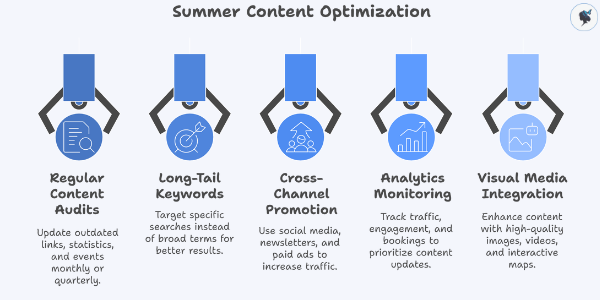
infograph: Summer content optimization
Summer content optimization
  • Audit Content Regularly: Schedule monthly or quarterly audits to update outdated links, statistics, and events.
  • Focus on Long-Tail Keywords: Target specific searches like “family-friendly summer trips in Greece” instead of just “summer vacations.”
  • Promote Across Channels: Leverage social media, newsletters, and paid ads to drive traffic to summer content.
  • Use Analytics: Monitor which pages drive traffic, engagement, and bookings to prioritize updates.
  • Incorporate Visual Media: Summer travel content benefits from high-quality images, videos, and interactive maps.

Conclusion

Summer content is more than a seasonal necessity; it’s a strategic asset for travel agencies. By addressing traffic dips, optimizing for SEO, leveraging user-generated content, and linking to evergreen and off-season pages, agencies can maximize engagement and bookings throughout the year.

Short-term fixes like updating old content, launching early promotions, and targeting local keywords provide immediate results, while long-term strategies such as maintaining evergreen pages, monitoring trends, and segmenting audiences ensure sustainable performance.

With unique content ideas like interactive quizzes, hidden beach guides, and sustainable festival tips, travel agencies can stand out in a crowded summer travel market. By following a structured content calendar and committing to both short- and long-term strategies, agencies can maintain relevance, authority, and engagement from early spring planning through post-summer wrap-ups.

Start by auditing your summer content today. Refresh high-performing posts, plan next year’s guides early, and experiment with interactive content to keep travelers engaged year-round.

Need help with your summer content strategy? Contact us today!


Strategies for Managing Seasonal Content: Fall

▶ Table of Contents
  1. Introduction: Why Fall Content Needs a Strategy
  2. Common Fall Content Issues
  3. Short-Term Fixes for Fall Content
  4. Long-Term Strategies for Fall Content
  5. Unique Fall Content Ideas
  6. Sample Fall Content Calendar
  7. Actionable Tips for Travel Agencies
  8. Conclusion

Introduction: Why Fall Content Needs a Strategy

Fall is a season that many travel agencies overlook, yet it offers unique opportunities for engagement and bookings. From autumn foliage and harvest festivals to cozy weekend getaways, the months of September through November see an influx of travelers seeking memorable experiences.

However, travel agencies often face challenges with fall content: traffic dips after summer, outdated blog posts, and limited SEO strategies targeting autumn-specific searches. According to Google Trends, searches for terms like “fall getaways” or “autumn road trips” spike in early September but taper off quickly, emphasizing the need for timely, optimized content.

This guide provides actionable strategies for managing fall content, covering common challenges, short-term fixes, long-term strategies, unique content ideas, and a seasonal calendar to maximize engagement and SEO performance.


Common Fall Content Issues

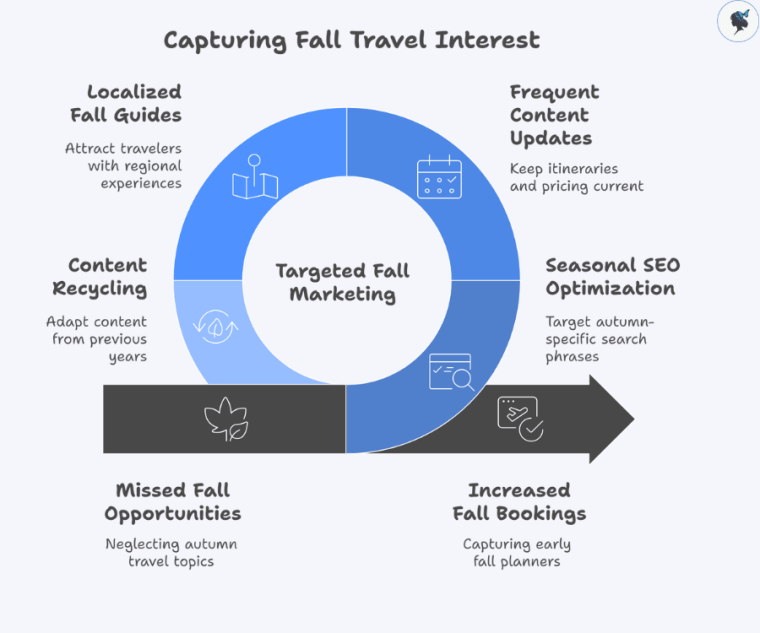
infograph: Capturing fall travel interest
Capturing fall travel interest

Fall content often underperforms due to several common pitfalls:

1. Missed Mid-Season Interest

  • Travel agencies frequently focus on summer vacations or winter holidays, neglecting fall-specific topics such as foliage tours, harvest festivals, and cozy autumn retreats.
  • This oversight results in missed opportunities to capture early fall planners or travelers seeking weekend getaways.

2. Pitfalls of Seasonal SEO

  • Overemphasis on summer or winter keywords can leave fall content with low organic visibility.
  • Autumn searches are highly seasonal and often competitive, requiring targeted optimization for phrases like “best fall foliage drives” or “autumn wine tours.”

3. Infrequent Updates

  • Many fall posts are not revisited annually, leading to:
    • Outdated itineraries and pricing
    • Broken links or expired events
    • Reduced search engine rankings

4. Lack of Localized Fall Guides

  • Generic content fails to attract travelers looking for specific regional experiences, such as New England foliage, Midwest harvest festivals, or Pacific Northwest wine tours.

5. Failure to Recycle or Repurpose Content

  • Agencies rarely adapt content from previous years or cross-seasonally, missing the chance to maintain relevance and build SEO authority year after year.

Read our post about repurposing content here.


Short-Term Fixes for Fall Content

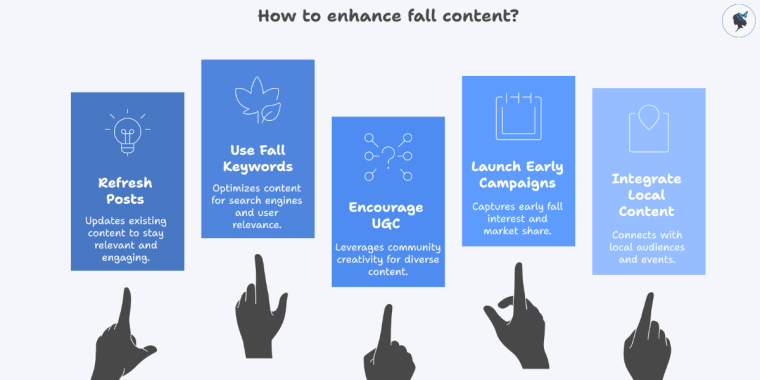
infograph: Short-Term Fixes for Fall Content
Short-Term Fixes for Fall Content

Implementing short-term strategies can quickly improve visibility and engagement for autumn content.

1. Refresh Existing Fall Posts

  • Update previous autumn guides with the current year, fresh statistics, and new images.
  • Example: “Top 10 Fall Foliage Drives – Updated 2026.”
  • Update meta descriptions to reflect current events and offers for improved click-through rates.

More about meta descriptions here.

2. Use Fall-Specific Keywords

  • Incorporate high-intent keywords like:
    • “fall festivals near me”
    • “autumn weekend getaways”
    • “best cider tours in fall”
  • Target long-tail keywords to reduce competition and attract travelers ready to book.

Learn more about long-tail keywords here.

3. Encourage User-Generated Content (UGC)

  • Collect traveler photos, stories, and reviews to enhance engagement and social proof.
  • Campaign idea: “Share Your Favorite Fall Adventure”.
  • UGC helps with fresh content generation, SEO, and social media promotion.

More about user-generated content here.

4. Launch Early Fall Campaigns

  • Promote autumn escapes in late summer to capture early planners.
  • Include themed blog posts, local event roundups, and promotional packages.

5. Integrate Localized Content

  • Highlight regional experiences:
    • Foliage tours
    • Harvest festivals
    • Local food and wine trails
  • Localized content attracts high-intent travelers and improves SEO for geo-targeted searches.

More about attracting high-intent travelers here.


Long-Term Strategies for Fall Content

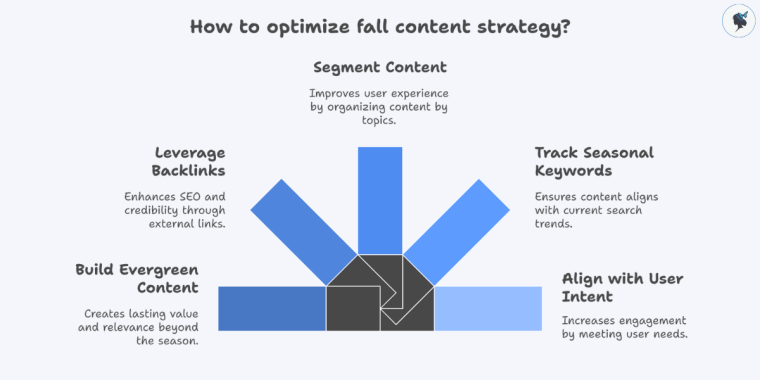
Infograph: Long-Term Strategies for Fall Content
Long-Term Strategies for Fall Content

For sustainable success, travel agencies should implement long-term strategies that maintain relevance and maximize SEO performance.

1. Build Evergreen Fall Content

  • Create guides that remain valuable each year, such as:
    • “Best Autumn Road Trips in the U.S.”
    • “Top Cozy Fall Stays for Couples”
  • Evergreen content minimizes the need for new posts while retaining search engine authority.

More about evergreen content here.

  • Collaborate with local DMOs, tourism boards, and event organizers to generate inbound links.
  • Linking fall content to off-season guides or holiday promotions strengthens SEO and increases site authority.

3. Segment Content by Topics

  • Organize fall content into themes for better user navigation and SEO:
    • Foliage drives and scenic locations
    • Food and harvest festivals
    • Cozy stays and cabin getaways

More about content clusters here.

4. Track and Optimize Seasonal Keywords

  • Use tools like Sitebulb, Semrush, or Ahrefs to monitor autumn keyword trends.
  • Re-optimize content annually based on search volume, competition, and engagement metrics.

5. Align Content With User Intent

  • Differentiate between informational content (tips, itineraries, packing guides) and transactional content (booking guides, promotional packages).
  • Ensure each piece of content addresses the traveler’s needs effectively, improving engagement and conversions.

Learn more about search intent here.


Unique Fall Content Ideas

Creating engaging, distinctive content can attract and retain readers while boosting SEO.

  1. “Cider-Tasting Road Trip in Fall” – Combine food, drink, and travel for experiential content.
  2. “Autumn Photography Tour Spots” – Guide for photographers seeking perfect foliage shots.
  3. “Fall Packing Tips for Chill Evenings” – Practical advice for travelers in cooler climates.
  4. “Local Harvest Festival Calendar” – Curated by region, featuring dates and activities.
  5. “Top 5 Fall Foliage Hikes” – Highlight scenic trails with peak autumn colors.

Wander Women Hot Tip: Use multimedia like interactive maps, Instagram photo galleries, or short videos to increase engagement and time-on-page.


Sample Fall Content Calendar

A structured timeline ensures that content is timely, optimized, and promoted effectively.

MonthActivities
JuneConduct keyword research; review prior year’s fall content; plan campaigns
JulyUpdate existing fall guides; incorporate local event calendars; prepare visuals
AugustLaunch early promotions; tease fall content on social media; collect UGC
SeptemberPublish main fall content; optimize for seasonal SEO; share interactive content
OctoberPromote via newsletters, social posts, and blogs; highlight local events and festivals
NovemberAnalyze engagement, traffic, and conversions; gather insights for next year

Wander Women Hot Tip: Align content production, SEO audits, and promotional campaigns to capture early planners and maintain visibility throughout the season.


Actionable Tips for Travel Agencies

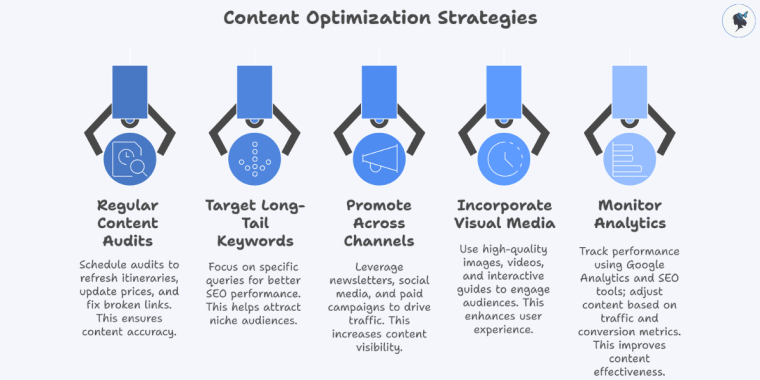
Infograph: Actionable Tips for Travel Agencies
Actionable Tips for Travel Agencies
  • Audit Content Regularly: Schedule seasonal audits to refresh itineraries, update prices, and fix broken links.
  • Target Long-Tail Keywords: Focus on queries like “best fall foliage drives in Vermont” for better SEO performance.
  • Promote Across Channels: Leverage newsletters, social media, and paid campaigns to drive traffic.
  • Incorporate Visual Media: Use high-quality images, videos, and interactive guides to engage audiences.
  • Monitor Analytics: Track performance using Google Analytics and SEO tools; adjust content based on traffic and conversion metrics.

Conclusion

Fall content presents a unique opportunity for travel agencies to capture travelers seeking seasonal experiences, from foliage tours to harvest festivals. While challenges like low mid-season interest and outdated content exist, implementing short-term fixes (refreshing posts, launching early campaigns, and promoting UGC) can quickly improve engagement and visibility.

Long-term strategies, including evergreen guides, backlink building, content segmentation, and ongoing keyword optimization, ensure that fall content remains relevant year after year.

By leveraging unique content ideas such as fall foliage hikes, cider-tasting road trips, and local festival calendars, agencies can differentiate themselves in a competitive market. Following a structured content calendar maximizes reach, improves SEO, and drives bookings throughout the autumn season.

Begin auditing your fall content today. Refresh guides, implement SEO best practices, and create engaging seasonal experiences to attract travelers and maintain authority in your market.

Need help with your fall content? Contact us today!


Strategies for Managing Seasonal Content

Why Seasonal Content Management Matters for Travel Agencies

▶ Table of Contents
  1. Why Seasonal Content Management Matters for Travel Agencies
  2. Understanding Seasonal Trends in the Travel Industry
  3. Strategies for Managing Seasonal Content Effectively
  4. Case Studies: Seasonal Content Success Stories
  5. Building a Sustainable Seasonal Content Strategy

In the travel industry, seasonal peaks and troughs are baked into everything you do: summer beach holidays, winter ski trips, shoulder-season city breaks. But for a travel agency, that creates a content and SEO challenge: if you only publish content when demand spikes, you risk letting your online visibility fall off in the off-season, losing organic traffic, bookings and authority.

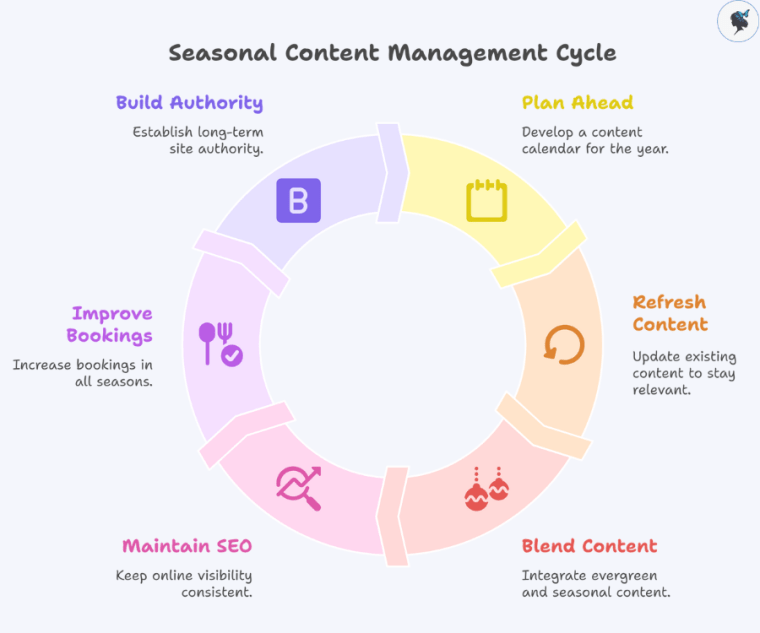
infograph: Seasonal content management cycle
Seasonal content management cycle

A recent article from Bulldog Digital Media points out that “travel behaviour is cyclical … if you miss key seasonal moments, you miss out on significant revenue opportunities.” Meanwhile, a specialist SEO article for travel agencies emphasises seasonality as one of the key SEO-challenges in the travel market.

By managing your seasonal content thoughtfully — planning ahead, refreshing it strategically, and blending in evergreen support content — you can maintain your SEO momentum year-round, improve bookings in both high and low periods, and build long-term site authority. This post will show travel-agency-specific strategies for doing exactly that.


Identifying Seasonal Patterns

To manage seasonal content effectively, you must first understand when and how your demand rises and falls.

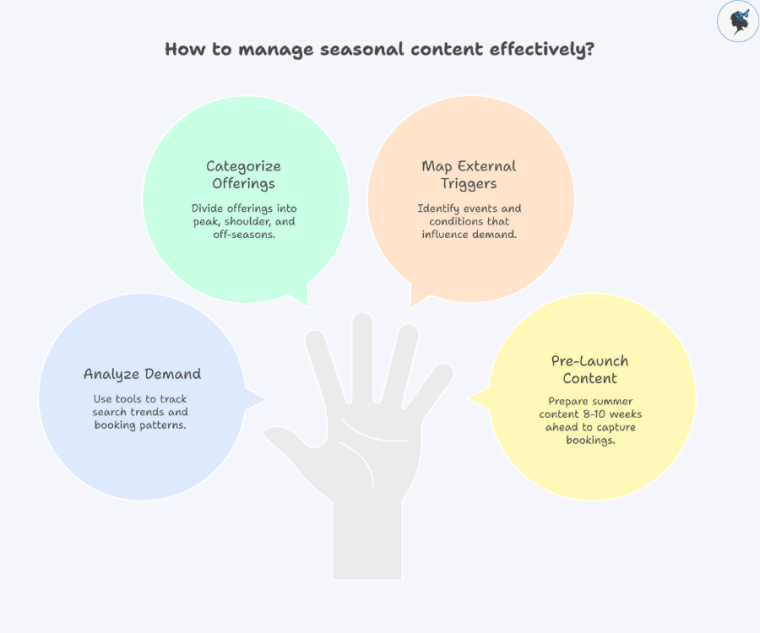
infograph: How to manage seasonal content effectively?
How to manage seasonal content effectively?
  • Use tools like Google Trends, your internal booking/website analytics, and even Google Search Console to track when people search for your destinations (e.g., “summer beach holidays Spain”, “ski resorts Austria December”).
  • Categorise your offerings into clear seasons:
    • peak (high demand),
    • shoulder (transitional),
    • and off-season.
  • Tourism marketing often divides travel demand into these three categories.
  • Map external triggers: school holidays, public holidays, events (festivals, cruises, etc.), weather patterns, and also travel restrictions/shifts (e.g., recent pandemic-related changes).

Wander Women Hot Tip: have your summer-holiday content live 8-10 weeks ahead of launch so you catch booking momentum.

Analysing Content Performance by Season

Once you have awareness of your seasonal windows, look at how your existing content performs:

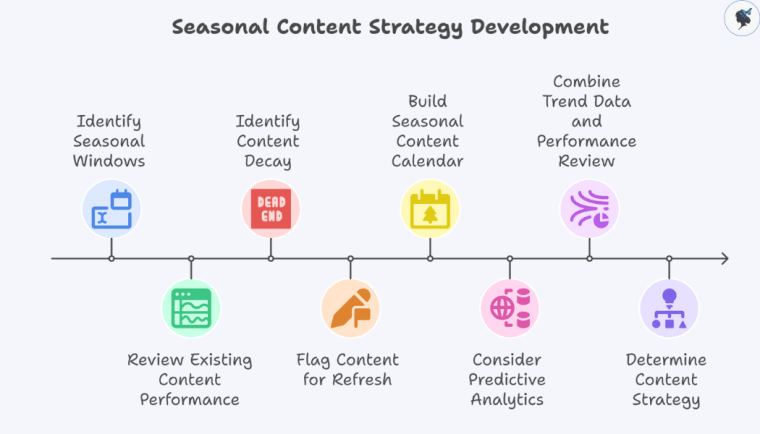
Infograph: Seasonal content strategy development
Seasonal content strategy development
  • Review your analytics to see which pages/posts drop off in the off-season or which ones still hold steady.
  • Identify content decay — e.g., a blog post published for “summer 2024 beach deals” might see traffic crash in November. Flag those posts for refresh or repurposing.
  • Build a seasonal content calendar tied to these peaks/shoulders/off-season periods, so you’re not scrambling when seasonality changes.
  • Consider using predictive analytics.

By combining trend-data plus internal performance review, you can see when content matters most and which content needs a year-round strategy rather than “launch-and-forget”.

More about data analytics here.


Strategies for Managing Seasonal Content Effectively

Here are five actionable strategies travel agencies can implement to keep seasonal content working for them all year round.

Plan Seasonal Content Well in Advance

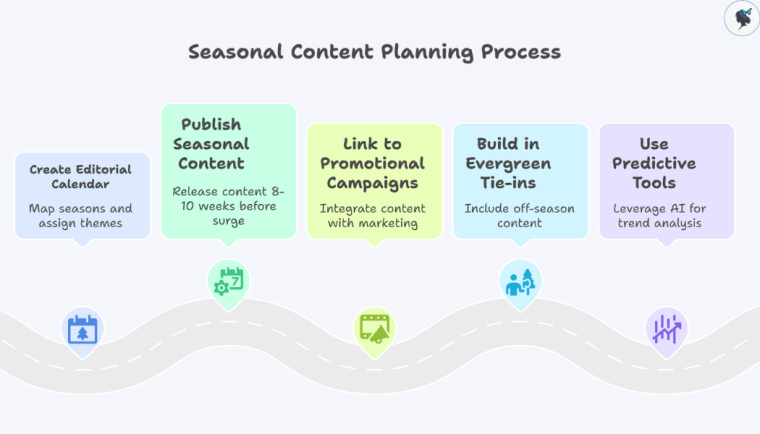
Infograph: Seasonal content planning process
Seasonal content planning process
  • Create a 12-month editorial calendar: map each major season (winter holidays, summer travel, shoulder periods) and assign content themes and publication dates.
  • Publish your key seasonal content 8–10 weeks before the booking surge begins. For example, if summer bookings pick up in April, your “Top 2026 Summer Beach Packages” post should go live in February or March.
  • Link content to promotional campaigns: have blog posts, landing pages and social media tie into your email campaigns, early-bird offers, and remarketing efforts.
  • Build in evergreen tie-ins within seasonal content. For example: “Best Beaches in Spain for Summer 2026 – And How to Visit Off-Season Too.” This allows you to update rather than re-create each year.
  • Use predictive tools: the Smartvel article outlines how agencies can use AI and trends data to get ahead of upcoming travel interest surges.

More about using AI in travel here.

Repurpose and Refresh Existing Content

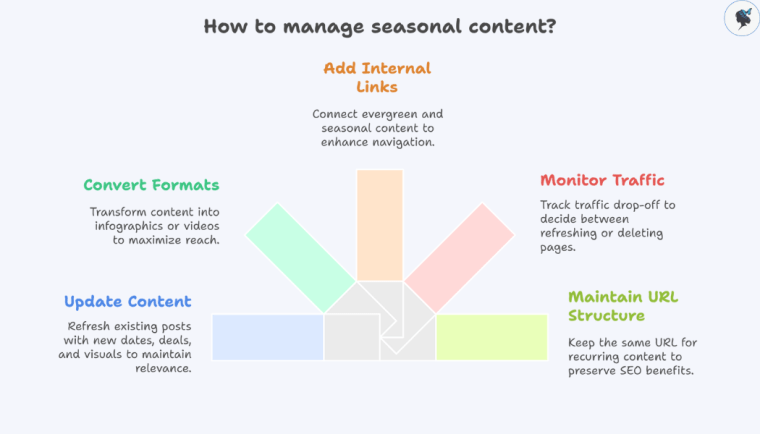
Infograph: How to manage seasonal content?
How to manage seasonal content?
  • Rather than deleting or archiving last year’s seasonal posts, update them: change dates, insert new deals, refresh visuals, update SEO-metadata.
  • Convert content formats: blog posts – infographics – short videos or Instagram Reels. This helps maximize reach from one core idea.
  • Add internal links between your evergreen and seasonal content: e.g., a “Year-Round Spain Travel Guide” (evergreen) linking to “Summer 2026 Ibiza Beach Packages” (seasonal).
  • Monitor traffic drop-off on seasonal pages; when it falls below a threshold, mark the page for refresh rather than deletion, so you preserve domain authority and link equity.
  • Maintain the URL structure for recurring content (e.g., /christmas-markets-europe/) and update the content rather than creating a new page each year — this gives you the benefit of existing backlinks, internal links and domain trust.

Read more about internal linking here.

Utilize Social Media & Promotion to Extend Seasonal Reach

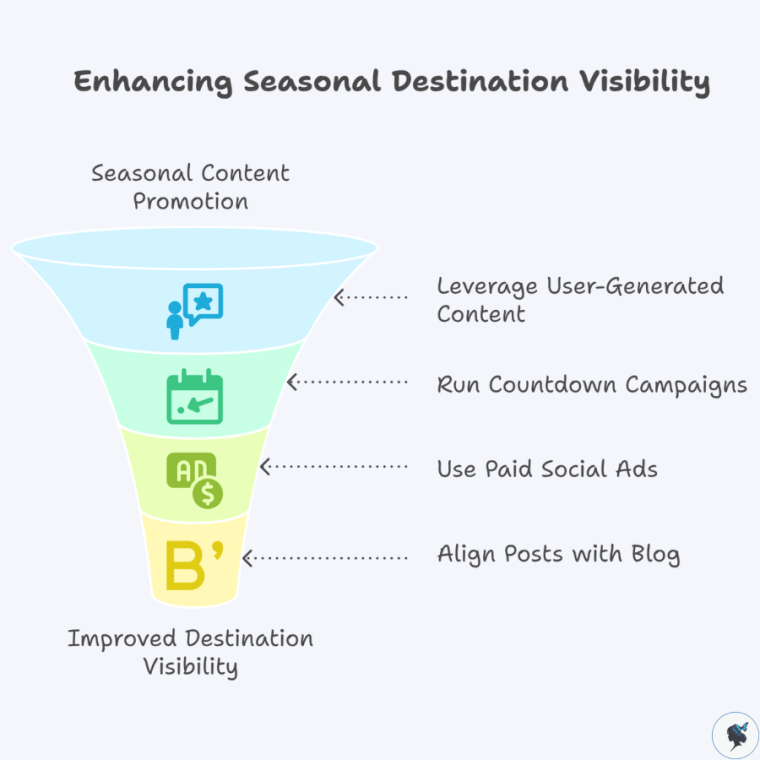
infograph: Enhancing seasonal destination visibility
Enhancing seasonal destination visibility
  • Use social media not only at peak season, but during shoulder and off-seasons: promote older seasonal content with “Throwback” or “Plan Ahead” messaging.
  • Leverage user-generated content (UGC): encourage travellers who visited in past seasons to share photos or stories, re-promote them to maintain destination visibility even when it’s off-season.
  • Run countdown or teaser campaigns ahead of high-booking seasons: e.g., “12 Weeks to Summer: Why You Should Book Now.”
  • Use paid social ads timed before the booking surge, supporting organic content.
  • Align posts with your blog/landing page strategy so social and content marketing reinforce each other — improving dwell
  • time, share metrics and signals to search engines.

Read our post: User-Generated Content.

Implement SEO Best Practices for Seasonal Keywords

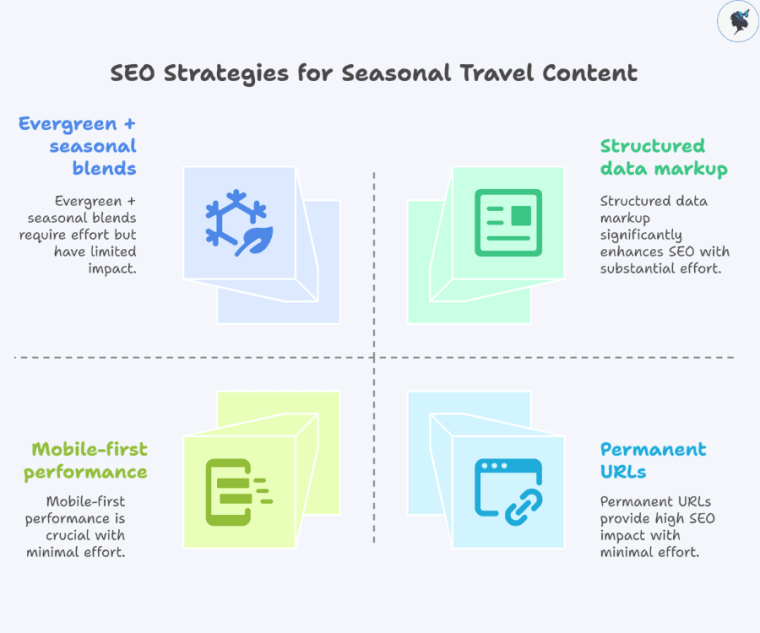
infograph: SEO strategies for seasonal content
SEO strategies for seasonal content
  • Do keyword research not just for current season terms (e.g., “summer beach holidays 2026 Spain”) but also evergreen + seasonal blends (e.g., “best beaches Spain” + “summer 2026 deals”).
  • Maintain permanent URLs for recurring content; update metadata (title tag/description) each year rather than creating a new URL to preserve ranking and link history.
  • Use structured data/schema markup where appropriate — for example event schema if you are covering a festival or seasonal attraction.
  • Internal linking: create a hub-and-spoke architecture — a pillar evergreen page (‘Country travel guide’) linking to seasonal subpages (‘Winter in …’, ‘Summer in …’).
  • Monitor ranking fluctuations: the travel-industry SEO guide emphasises that seasonality is a major cause of ranking and traffic swings in this niche.
  • Ensure mobile-first and fast page-speed performance — especially as many travellers research and book on mobile devices.

More about mobile optimization here.

Create Evergreen Supporting Content

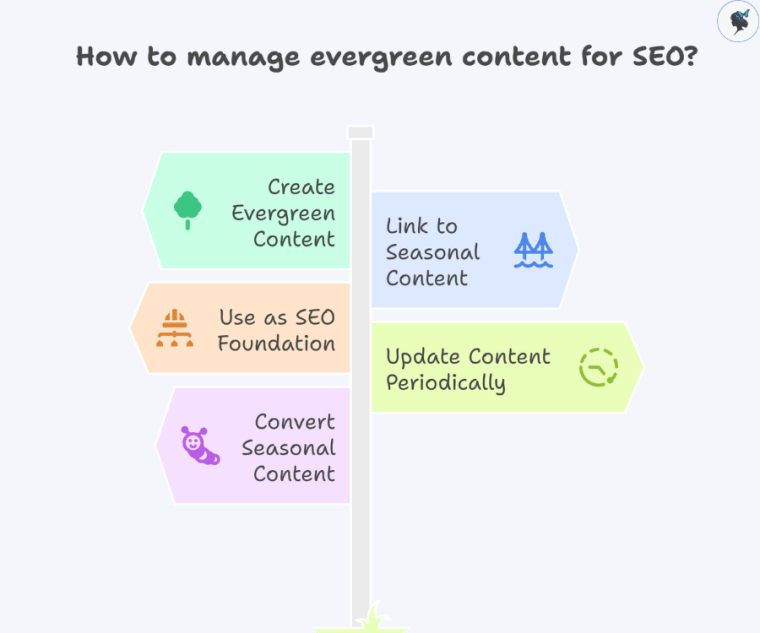
infograph: How to manage evergreen content for SEO?
How to manage evergreen content for SEO?
  • Build content that is not tied to a season, such as:
    • “How to pack for a multi-destination Europe trip”,
    • “Travel insurance: what you need to know”, or
    • “How to choose a family-friendly tour operator”. These posts hold value year-round and help maintain site authority.
  • Link evergreen content to your seasonal posts: this strengthens overall site structure and keeps traffic flowing between pages even when seasonal interest is low.
  • Use evergreen content as your “foundation” for your site’s SEO health — so that even when the seasonal pages dip, you still have reliable traffic and domain authority.
  • Update evergreen content periodically (e.g., once per quarter) to keep it fresh and relevant to search engines — don’t leave it static.
  • Review old seasonal content and convert some into evergreen format where practical — e.g., “Why Visit Iceland in Any Season” instead of just “Summer in Iceland”.

Read: how to create evergreen content.


Case Studies: Seasonal Content Success Stories

Here are some hypothetical (but grounded) examples of how travel agencies can use these strategies. While proprietary data may not be publicly available, these reflect sector best practices.

Ski Travel Agency Turning Off-Season into Shoulder-Season Growth
A ski-focused agency publishes a “Top Ski Resorts for Season 2025/26” blog in September and also adds a section on “Summer Hiking & Mountain Biking at the Same Resorts.” The refreshed article gets updated each March and gets internal links from their evergreen “Outdoor Adventures Europe” pillar page. As a result, instead of traffic dropping 70% in summer, they see only a 30% drop and maintain a good volume of bookings for summer and early autumn.

Beach Destination Tour Operator Maintaining Visibility Year-Round
A beach tour operator creates a pillar page for “Best Beach Destinations in Spain” (evergreen) and has subpages for “Summer 2026 Beach Packages”, “Late-Season Autumn Breaks”, “Winter Sun Getaways”. They update the seasonal subpages each year, preserving URLs and backlinks. During off-peak months they run UGC and social posts (“Remember your summer holiday in 2025? Book early for 2026”). This helps retain about 60-70% of their usual organic traffic even in the low season.

City-Break Specialist Leveraging Annual Events
A travel agency focuses on city-breaks and has a page for “Christmas Markets in Europe” — the page URL remains the same year-to-year, but they update content every October with new dates, deals and local events. They build an internal link from their evergreen city-travel guide. Because they preserve the URL and link equity, their page ranks consistently each year and traffic grows through backlinks from travel-bloggers linking to the same page annually.

Read: managing seasonal content: fall.


Building a Sustainable Seasonal Content Strategy

Seasonal content is not something to publish once, then archive and forget. For travel agencies, it’s a dynamic asset that — if managed correctly — can support bookings and SEO year-round.

  • Plan ahead with a 12-month editorial calendar that anticipates peaks, shoulders and troughs.
  • Refresh and repurpose existing content instead of deleting or re-creating each year.
  • Use social promotion and UGC to keep destinations alive in off-season months.
  • Apply sound SEO practices to seasonal content: maintain URLs, update metadata, use internal linking, and monitor ranking shifts.
  • Build evergreen supporting content to stabilise your domain’s authority and traffic across seasons.
infograph: Achieving year-round content success
Achieving year-round content success

If you’re responsible for content in your travel agency, now is the time to audit your seasonal content:

  • Which pages are still live from last year?
  • Which ones have decayed in traffic?
  • What evergreen “foundation” content do you have?
  • Are you linking evergreen – seasonal – evergreen?
  • Can you publish next season’s content earlier so you establish search visibility ahead of the rush?

By treating seasonal content as a cyclical, renewable asset rather than a one-off campaign, you’ll position your agency for stronger organic visibility, more bookings and more sustainable performance in both high and low travel periods.

Need help with your seasonal content strategy? Contact us today!

Blogging vs. Video: What Travel Brands Should Prioritize

▶ Table of Contents
  1. Introduction
  2. The Power of Blogging for Travel Brands
  3. The Impact of Video Content in Travel Marketing
  4. Comparing Reach and Engagement
  5. Target Audience Considerations
  6. When to Prioritize Blogging
  7. When to Prioritize Video
  8. Combining Blogging and Video for Maximum Impact
  9. Conclusion

Introduction

Content marketing is essential for travel brands aiming to connect with potential travelers, build trust, and ultimately drive bookings. In today’s digital landscape, blogging and video content have emerged as two of the most powerful tools to achieve these goals. However, deciding whether to prioritize blogging or video can be challenging, especially when resources are limited. Understanding the strengths and nuances of each format can help travel brands make informed decisions that align with their marketing objectives.


The Power of Blogging for Travel Brands

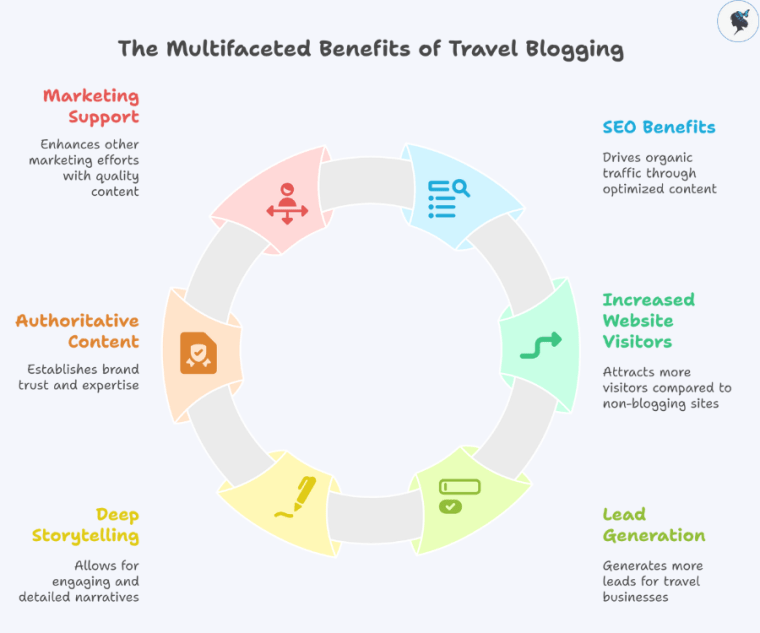
Blogging remains a cornerstone of digital marketing, primarily because of its significant SEO benefits. Well-optimized blog posts can drive consistent, long-term organic traffic by targeting search queries related to destinations, travel tips, and experiences. According to HubSpot, companies that blog receive 55% more website visitors and 67% more leads than those that don’t.

Infograph: The multifaceted benefits of travel blogging
The multifaceted benefits of travel blogging

Blogs allow for deep storytelling and detailed travel guides, providing rich information that travelers rely on during their planning phases. Writing authoritative content helps establish your brand as a trusted expert, which is crucial in the highly competitive travel market. Moreover, blogs support other marketing efforts by feeding email campaigns and social media posts with quality content.

Read our post: How storytelling can transform your blog.


The Impact of Video Content in Travel Marketing

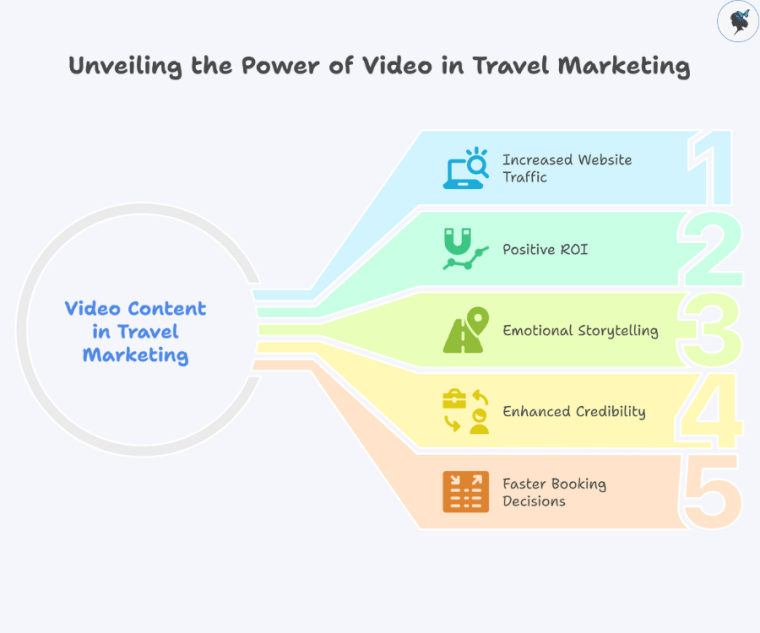
Video consumption is skyrocketing, especially on social media platforms where visual content captures attention rapidly. Platforms like YouTube, Instagram Reels, and TikTok have transformed how travelers discover and engage with travel brands. According to Wyzowl, 87% of marketers report that video has increased traffic to their websites, and 88% say video gives them a positive ROI.

Infograph: Unveiling the power of video in travel marketing
Unveiling the power of video in travel marketing

Videos enable emotional storytelling by showcasing immersive experiences, beautiful landscapes, and real-time adventures. This format appeals to travelers’ senses, creating a stronger connection than text alone. Video testimonials from past customers and live updates can also boost credibility and urgency, driving faster booking decisions.

More about storytelling here.


Comparing Reach and Engagement

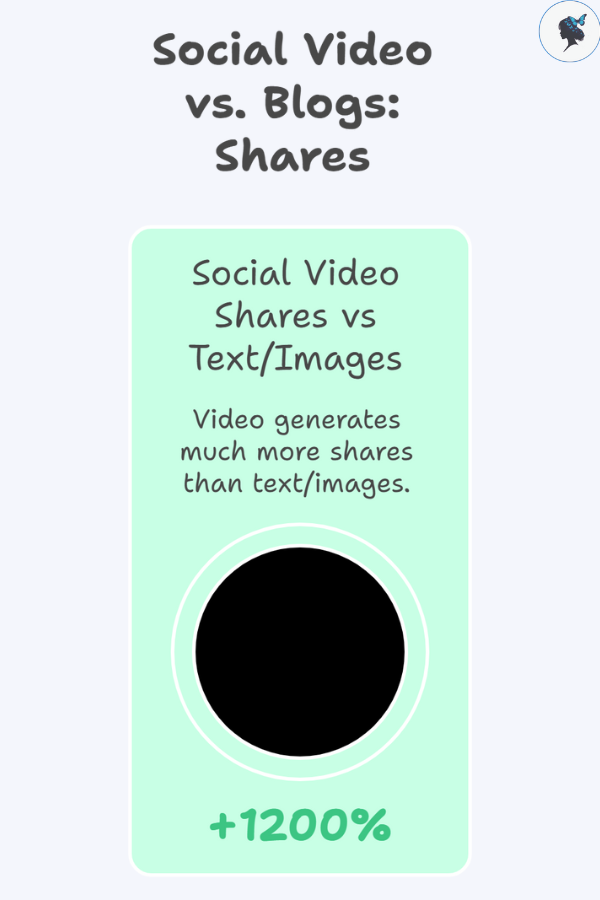
When comparing blogs and videos, metrics such as average time spent, shares, and conversion rates offer valuable insights. Research from Medium shows that social video generates 1200% more shares than text and images combined, which indicates higher engagement potential.

Infograph: Social video vs blogs: shares
Social video vs blogs: shares

However, blogs typically generate higher SEO value and better performance in search engines, sustaining traffic over time. Video production tends to require higher costs and resources, including equipment, editing, and scripting, whereas blogging can be more cost-effective and faster to produce. Choosing the right balance depends on your budget, team skills, and marketing goals.


Target Audience Considerations

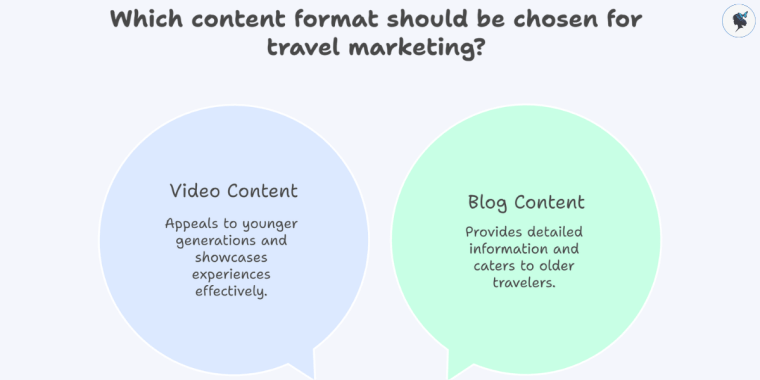
Understanding your target audience is critical when choosing between blogging and video. Younger generations like Gen Z and Millennials favor video content, especially on mobile devices, with 90% of Gen Z consumers preferring to see videos from brands.

Infograph: Which content format should be chosen for travel marketing?
Which content format should be chosen for travel marketing?

Meanwhile, older travelers may prefer blogs that allow for detailed research at their own pace. Additionally, travel stages influence content preference: travelers in the inspiration phase might engage more with videos showcasing experiences, whereas those in the decision-making phase often seek detailed blog posts to finalize plans. Accessibility issues such as slow internet or device constraints can also affect content consumption.

Read our post: marketing to Gen Z travelers.


When to Prioritize Blogging

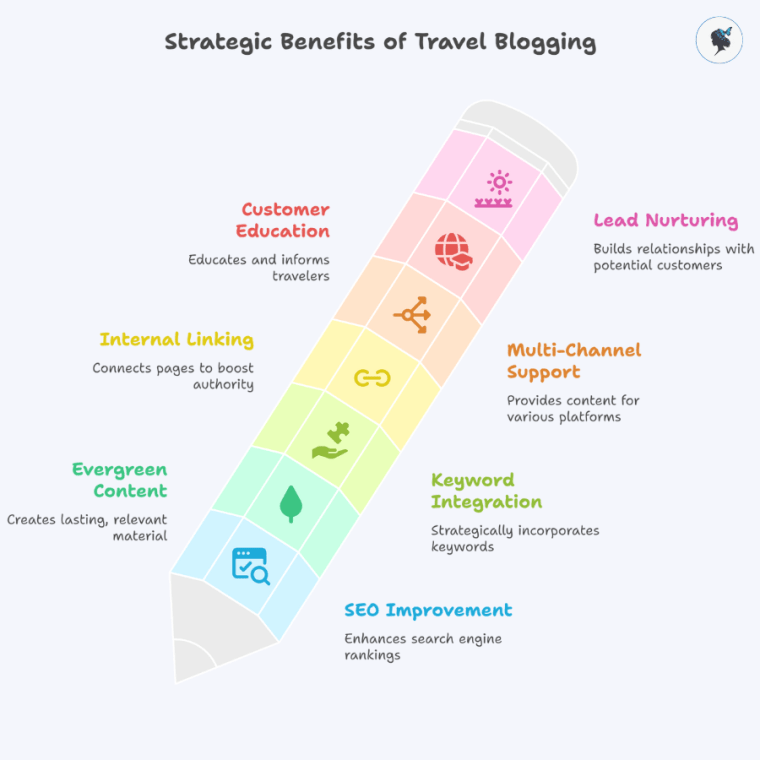
Blogging should be a priority if your goal is to improve SEO rankings and build a repository of evergreen content. Detailed guides, how-tos, and FAQs help travelers find your brand through organic search and provide comprehensive trip planning support. Blogging also offers flexibility for integrating keywords and internal links, boosting your site’s authority.

Infograph: Strategic benefits of travel blogging
Strategic benefits of travel blogging

Furthermore, blogs complement multi-channel strategies by providing content that can be repurposed for newsletters, social media captions, and downloadable resources. If your travel brand focuses on educating customers and nurturing leads over time, investing in blogging is essential.

Read our post: How to repurpose travel blog content.


When to Prioritize Video

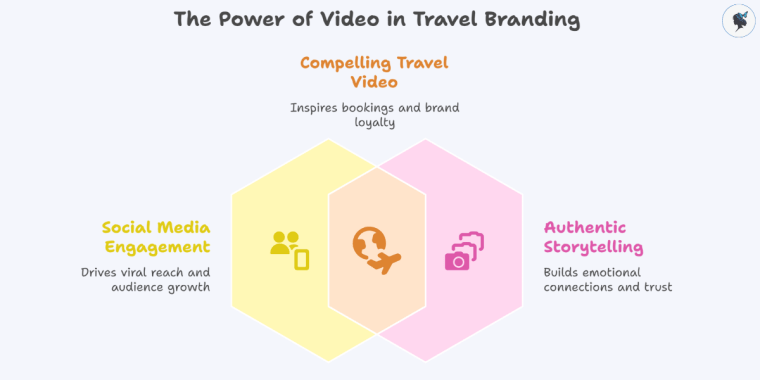
Video content is ideal when your objective is to maximize social media engagement and tell compelling brand stories. Travel experiences are highly visual, and videos can capture excitement, culture, and scenery in ways text cannot. Short-form videos perform well on platforms like Instagram and TikTok, perfect for reaching younger audiences and generating viral interest.

Infograph: The power of video in travel branding
The power of video in travel branding

Videos also work well for showcasing customer testimonials and live updates from destinations, which add authenticity and urgency. If your travel brand aims to build emotional connections and prompt immediate bookings or inquiries, prioritizing video content can be highly effective.

Read our post: how to use stunning travel photography and videos.


Combining Blogging and Video for Maximum Impact

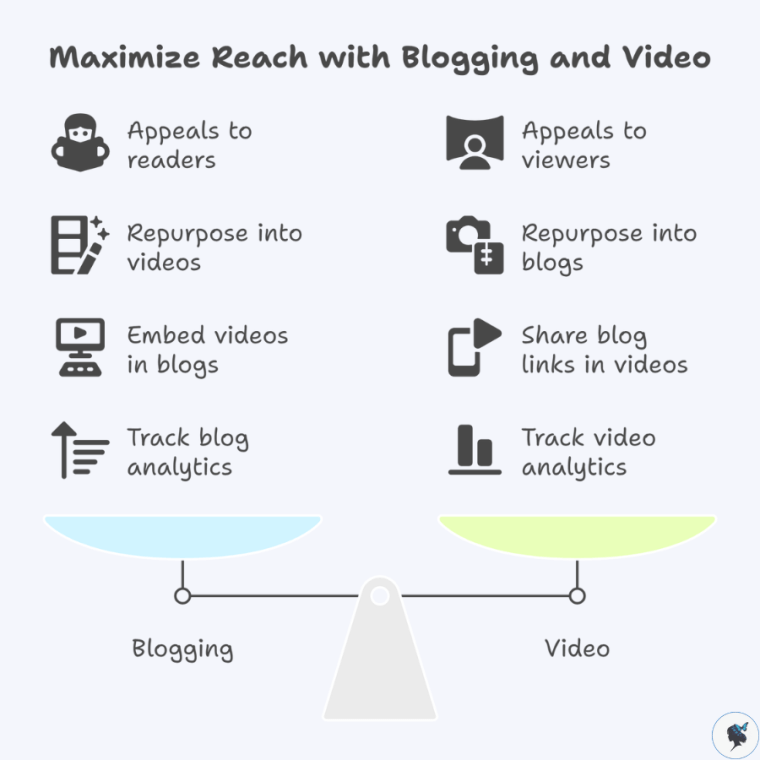
The most successful travel brands leverage both blogging and video to maximize their reach and engagement. Repurposing blog content into videos (e.g., travel tips, destination highlights) and vice versa allows you to appeal to different audience preferences without doubling workload.

Infograph: Maximize reach with blogging and video
Maximize reach with blogging and video

Cross-promotion—embedding videos in blog posts or sharing blog links in video descriptions—can improve SEO and enhance user experience. Tracking performance analytics from both formats enables data-driven decisions, helping you fine-tune your content strategy to what resonates most with your audience.


Conclusion

There is no one-size-fits-all answer when deciding between blogging and video for travel brands. The best approach depends on your brand’s goals, target audience, budget, and resources. Starting with clear objectives and testing both formats helps identify what drives the most engagement and conversions.

Continuously monitoring trends and adapting your strategy ensures your travel brand remains competitive in the evolving digital landscape. Whether you lean towards detailed blogs, captivating videos, or a combination of both, delivering valuable and inspiring content will always be key to winning traveler loyalty and business growth.

Need help? Contact us today!


The Role of SEO in Attracting High-Intent Travelers


The Role of SEO in Attracting High-Intent Travelers

▶ Table of Contents
  1. The Role of SEO in Attracting High-Intent Travelers
    1. Introduction
    2. Understanding High-Intent Travelers
    3. Keyword Research for High-Intent Travel Searches
    4. On-Page SEO Strategies to Capture High-Intent Traffic
    5. Content Creation to Nurture and Convert High-Intent Leads
    6. Technical SEO and User Experience
    7. Local SEO for Geo-Targeted High-Intent Travelers
    8. Measuring SEO Success in Attracting High-Intent Travelers
    9. Conclusion & Next Steps

Introduction

In the highly competitive travel industry, attracting high-intent travelers—those ready to book or make purchasing decisions—is crucial for business success. SEO (Search Engine Optimization) plays a pivotal role in reaching this audience by positioning your travel brand at the top of search results when potential customers are actively looking to book trips. According to a study by BrightEdge, 53% of all website traffic comes from organic search, emphasizing SEO’s importance in customer acquisition.


Understanding High-Intent Travelers

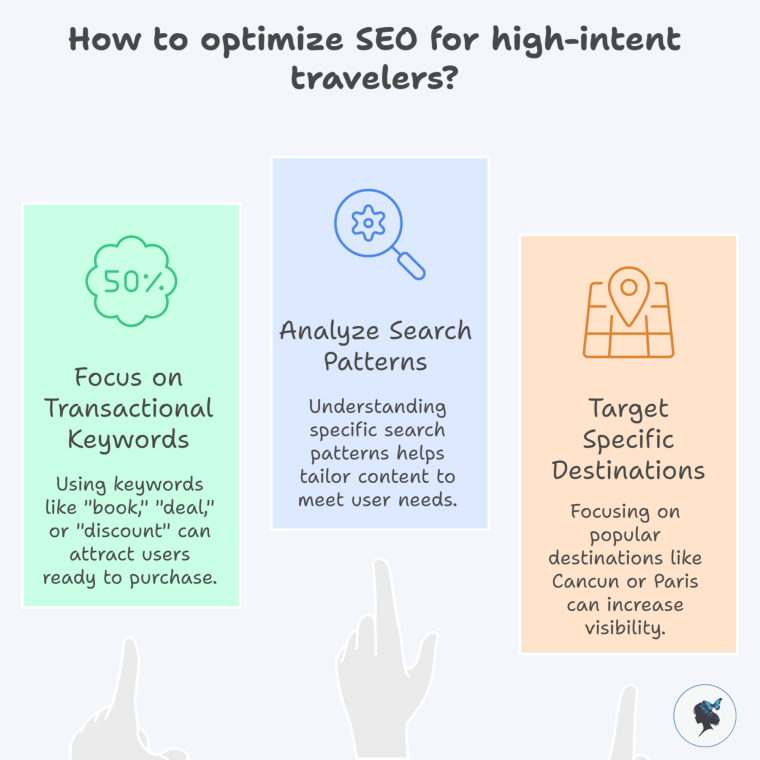
High-intent travelers exhibit specific behaviors and search patterns that indicate readiness to purchase, such as searching for “best family resorts in Cancun” or “last-minute flight deals to Paris.” Unlike informational searches like “how to travel on a budget,” high-intent queries often include transactional keywords like “book,” “deal,” or “discount.” Recognizing this intent helps tailor SEO strategies to capture these valuable visitors. Research shows that approximately 70% of consumers perform online searches before making travel decisions.

Infograph: How to optimize SEO for high-intent travelers.
How to optimize SEO for high-intent travelers.

More about search intent here.


Keyword Research for High-Intent Travel Searches

Effective keyword research identifies terms travelers use when ready to book. Tools like Google Keyword Planner, Ahrefs, and Semrush help uncover keywords with high search volume and buying intent. Long-tail keywords, though less searched, often signal strong purchase intent and lower competition—like “luxury honeymoon resorts in Bali with ocean view.” Targeting these can attract niche audiences and improve conversion rates. According to Ahrefs, long-tail keywords account for over 70% of all web searches.

Infograph: Keyword strategy for travel bookings.
Keyword strategy for travel bookings.

More about mastering long-tail keywords here.


On-Page SEO Strategies to Capture High-Intent Traffic

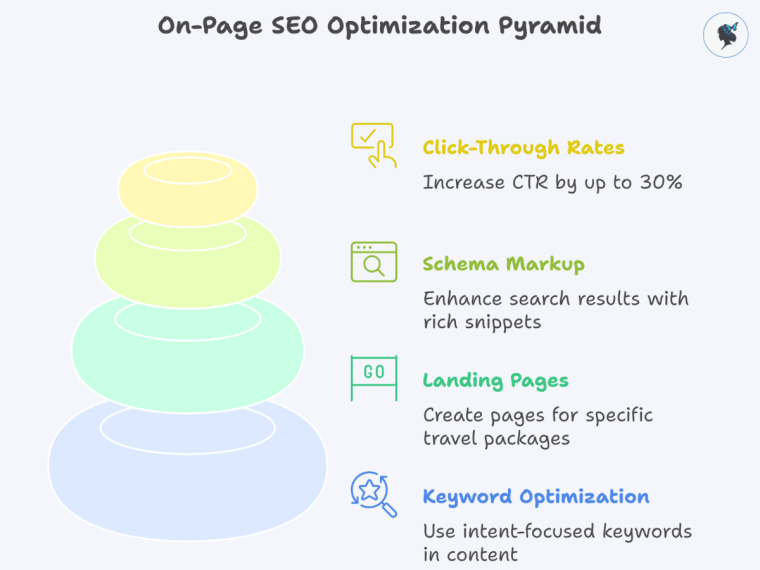
Optimizing on-page elements ensures search engines and travelers understand your offerings. Use intent-focused keywords in meta titles, descriptions, headers, and URLs. Create dedicated landing pages for specific destinations or travel packages to match searcher intent directly. Implementing schema markup enhances search result appearance with rich snippets, increasing click-through rates by up to 30%.

Infograph: On-Page SEO optimization pyramid.
On-Page SEO optimization pyramid.

More about on-page SEO here.


Content Creation to Nurture and Convert High-Intent Leads

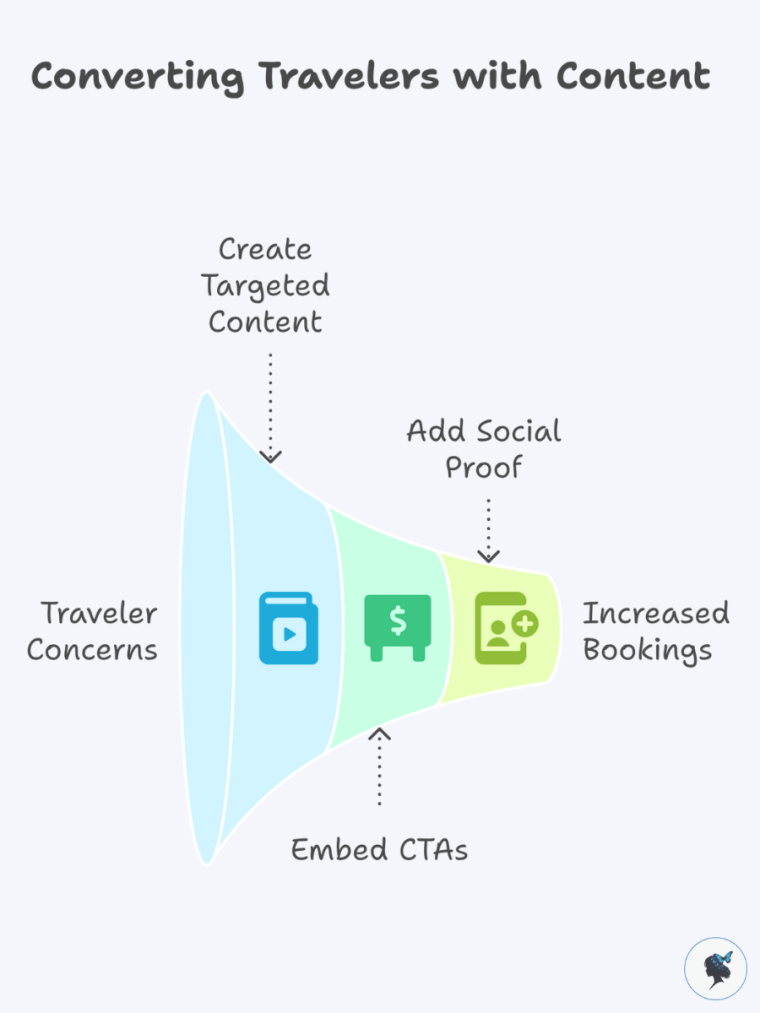
High-quality, targeted content addresses traveler concerns and drives conversions. Write blog posts, guides, and FAQs that solve problems—like “What to pack for a Caribbean cruise” or “Cancellation policies for last-minute bookings.” Embed clear calls to action (CTAs) such as “Book now” or “Request a free quote.” Including testimonials and user reviews adds social proof, building trust and encouraging bookings. Studies reveal that 92% of travelers read reviews before making a booking.

Infograph: Converting travelers with content.
Converting travelers with content.

More about trust signals here.


Technical SEO and User Experience

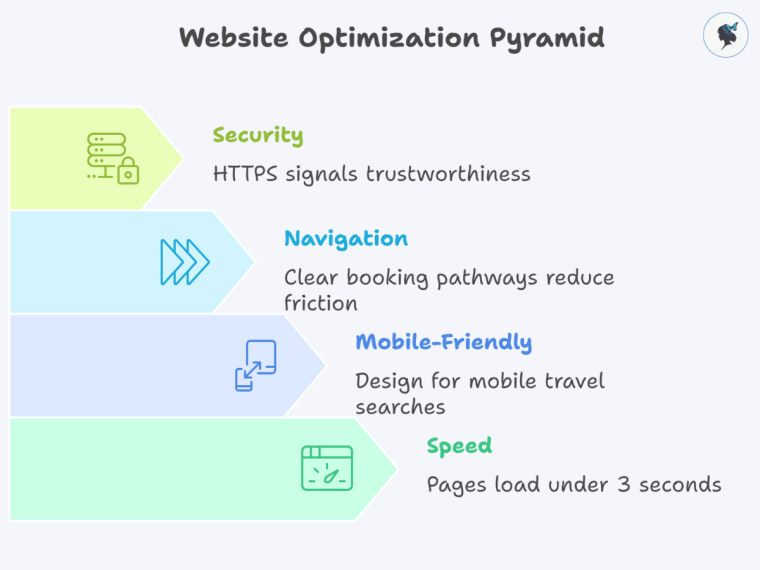
A smooth, fast, and secure website enhances user experience and supports SEO rankings. Ensure your pages load quickly—Google recommends under 3 seconds—as slow sites increase bounce rates. Mobile-friendly design is essential, with over 60% of travel searches occurring on mobile devices. Clear navigation and easy booking pathways reduce friction, while HTTPS security signals trustworthiness to both users and search engines.

Infograph: Website optimization pyramid.
Website optimization pyramid.

More about mobile optimization here.


Local SEO for Geo-Targeted High-Intent Travelers

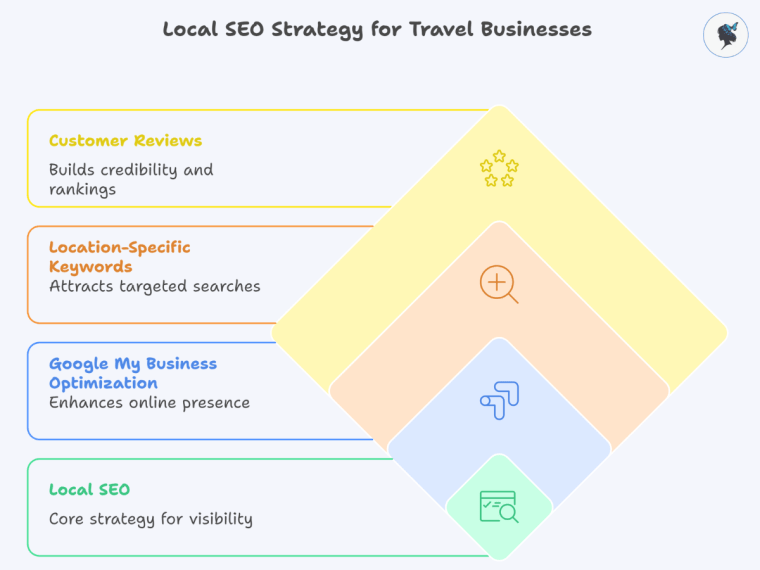
Local SEO is vital for travel businesses targeting specific destinations or nearby customers. Optimize your Google My Business profile with accurate info, photos, and up-to-date offers. Use location-specific keywords such as “best hotel in downtown Miami” to attract geo-targeted searches. Encourage happy customers to leave positive reviews, which improve local rankings and credibility. Seoprofy reports that 72% of consumers who did a local search visited a store within 5 miles.

Infograph: Local SEO strategy for travel businesses.
Local SEO strategy for travel businesses.

Read our ultimate guide to local SEO here.


Measuring SEO Success in Attracting High-Intent Travelers

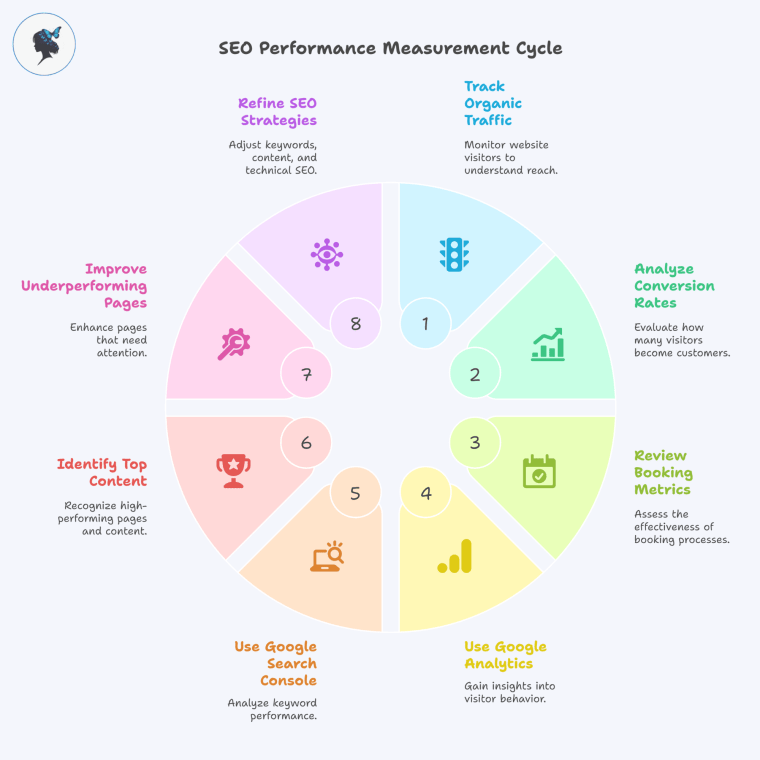
Tracking organic traffic, conversion rates, and booking metrics allows you to gauge SEO effectiveness. Use Google Analytics to monitor visitor behavior and Google Search Console for keyword performance insights. Regularly reviewing these metrics helps identify top-performing content and pages needing improvement. Data-driven marketers are 6 times more likely to be successful in digital marketing. Use these insights to refine keywords, content, and technical SEO for continuous growth.

Infograph: SEO performance measurement cycle.
SEO performance measurement cycle.

Conclusion & Next Steps

SEO is a powerful tool to attract high-intent travelers actively searching for travel options. By understanding traveler intent, conducting focused keyword research, optimizing on-page and technical SEO, creating targeted content, and leveraging local SEO, travel brands can capture ready-to-book audiences effectively. Start with a comprehensive SEO audit and keyword strategy to align your efforts. Continual measurement and adaptation ensure your SEO drives consistent bookings and long-term growth.

Contact us today for your FREE SEO audit!


How to Optimize Travel Content for Generative AI: From GEO to AEO


How to Optimize Travel Content for Generative AI: From GEO to AEO

▶ Table of Contents

Introduction

According to a Minty Digital industry analysis, 40% of travelers now say AI helps them discover new destinations — signaling that AI is already reshaping how people explore and plan trips. In today’s landscape, travel marketers and DMOs must evolve from traditional SEO to strategies that help their content be recognized, synthesized, and cited by generative AI engines like ChatGPT, Gemini, or Bing Copilot.

Infograph: How should travel content be optimized for AI recognition?
How should travel content be optimized for AI recognition?

Wander Women Hot Tip: Start by auditing your highest-traffic content — and ask: would an AI assistant “see” and trust it?


Understanding Generative AI in the Travel Ecosystem

1 What Is Generative AI — and Why It Matters for Travel?

A recent study by Booking.com reveals that 74% of travelers appreciate AI-generated recommendations that help them avoid overcrowded destinations or peak travel times. news. For travel brands, generative AI doesn’t just shift discovery — it changes how users ask questions and expect answers. An AI might generate a full itinerary, narrative, or comparative recommendation rather than deliver a list of links.

For example: A traveler might ask, “Plan me a 10-day road trip in Italy focused on food and small towns.” Instead of showing links, AI engines build a complete itinerary — citing a few trusted sources.

Infograph: How should travel brands leverage generative AI?
How should travel brands leverage generative AI?

Wander Women Hot Tip: Test your own destination or itinerary queries by asking ChatGPT — see whether your brand is surfaced or ignored.

2 What Is Generative Engine Optimization (GEO)?

In 2025, the AI-in-travel market is projected to reach USD 531.95 billion by 2029, underlining that AI-driven content will dominate travel tech investment.
GEO (Generative Engine Optimization) is the practice of optimizing your travel content so that AI systems understand, reference, or weave your content into generated travel narratives. It leans heavily on semantic clarity, topical depth, and structured context rather than just keyword density.

GEO prioritizes:

  • Semantic clarity — clear relationships between topics (e.g., destinations, activities, experiences).
  • Structured context — well-labeled schema, FAQs, and entity-based connections.
  • Credibility — first-hand expertise, author transparency, and verified data.
Infograph: How to optimize travel content for AI?
How to optimize travel content for AI?

Wander Women Hot Tip: When drafting destination content, think in “entity clusters” (attraction, region, nearby towns) rather than standalone pages.

More about content clusters here.

3 What Is Answer Engine Optimization (AEO)?

In recent Semrush research, AI Overviews now appear in over 13% of all queries, up from 6.49% earlier in 2025 — confirming that answer-style summaries are becoming more common in search. AEO (Answer Engine Optimization) is about tailoring content so that short, factual responses from your content can power featured snippets, voice answers, or AI summaries.

AEO ensures your pages can power:

  • Featured snippets
  • Voice search answers
  • AI Overviews (Google’s new generative summaries)

Example:

  • AEO query: “Best time to visit Iceland”
  • Answer: “The best time to visit Iceland is from June to August for warmer temperatures and longer daylight hours.”
  • Well-structured, schema-backed pages are what AI models prefer for these results.
infograph: Top AEO strategies for travel guides.
Top AEO strategies for travel guides.

Wander Women Hot Tip: Embed succinct, Q&A-style snippets within your longer travel guides to seed AEO-ready content.

Read out post: Optimize your blog for voice search.


Why Travel Brands Must Adapt to AI-Driven Discovery

Search Engine land reports that in March 2025, 27.2% of U.S. searches ended without a click (versus 24.4 % a year prior), highlighting how zero-click behavior is rising. Meanwhile, Bain estimates 80% of consumers rely on “zero-click” results in at least 40% of their searches, reducing organic traffic by 15–25%. For the travel industry, this means traditional SEO — chasing clicks — is no longer enough. Brands must aim to be the answer, not just occupy a top link.

infograph: Zero-click search impact on travel.
Zero-click search impact on travel.

Wander Women Hot Tip: Map your top-performing pages and see which are most at risk of being eclipsed by AI summaries — prioritize them for AI optimization.


Key Differences Between GEO and AEO

FactorAEOGEO
GoalProvide concise factual responsesBe referenced in longer AI-generated narratives
Ideal Content TypeFAQs, how-to lists, definitionsDestination guides, itineraries, deep stories
Optimization FocusSchema, brevity, clarityEntities, context linking, authority signals
Typical Use Case“When is best time to visit Iceland?”“Plan a 7-day Iceland itinerary with hidden gems”

Generative travel SEO in 2025 means integrating both — AEO for attention, GEO for context and relevance.
Wander Women Hot Tip: For each topic, include one “AEO hook” (a quick answer block) and a deeper GEO passage.


Strategies for GEO SEO in Travel

1 Focus on Entity-Based SEO

The travel content that thrives with AI frames clear semantic relationships.
To help AI understand your destination:

  • Mention key entities (cities, landmarks, attractions) using consistent naming.
  • Use schema types like:
  • TouristAttraction
  • Itinerary
  • Hotel
  • Restaurant
  • Include relevant relationships: “Palermo is part of Sicily.” “Mount Etna is a top-rated tourist attraction near Catania.”
Infograph: Structuring travel content with AI.
Structuring travel content with AI.

Wander Women Hot Tip: Always link your pages using the same canonical names (e.g. “Sicily / Sicilia”) to help AI resolve entity consistency.

2 Build AI-Comprehensible Content Structures

AI models parse headings, Q&A, and structured layout to extract meaning.
Use:

  • Clear H2/H3 headings reflecting traveler intent (e.g., “Where to Stay in Lisbon for First-Time Visitors”).
  • Natural question-and-answer formats.
  • FAQ sections covering conversational search terms.
Infograph: AI content comprehension funnel.
AI content comprehension funnel.

Wander Women Hot Tip: Before writing, map your content as an AI “outline” — will an AI be able to extract meaning easily?

3 Use Verified and Localized Data

Travel content that cites authoritative sources tends to be trusted by AI engines.
That means:

  • Include sources, statistics, and citations (e.g., from tourism boards or government data).
  • Highlight author credentials and local expertise.
  • Use fresh, updated content — outdated info may be de-prioritized by AI.
Infograph: Enhancing travel content trust.
Enhancing travel content trust.

Wander Women Hot Tip: Embed local tourism board APIs or datasets where possible to power freshness.

4 Strengthen Context with Internal Linking

Content clusters matter more than isolated pages.
Link deep — “Top 10 Things in Lisbon” → “Hidden Gardens of Alfama” → “Lisbon Day Trips by Train.”

Infograph: Strengthen context with internal linking.
Strengthen context with internal linking.

Wander Women Hot Tip: Use descriptive anchor text (not generic “click here”) to reinforce semantic relations.

More about internal linking here.

5 Optimize Multimedia for AI Recognition

AI models also interpret images and metadata.
Make it easy for them by:

  • Using descriptive alt text (e.g., “Sunrise over Santorini caldera, Greece”).
  • Embedding EXIF metadata with location and copyright info.
  • Adding captions that explain context.
Infograph: Enhancing AI image recognition.
Enhancing AI image recognition.

Wander Women Hot Tip: Always embed a “caption snippet” below images — the first sentence becomes AI fodder.


Implementing AEO for Travel Content

1 Create FAQ-Driven Segments

Insert a small FAQ block in each topic page (2–5 Qs) with natural language traveler queries.

  • “What’s the best time to visit?”
  • “How many days should I spend here?”
  • “Is it family-friendly?”

Wander Women Hot Tip: Use your search analytics to identify 2 or 3 long-tail conversational queries and answer them succinctly.

2 Use Structured Data Markup

Apply FAQPage, HowTo, Review, Organization schema where relevant.
This makes your content machine-readable for AI answer engines.

Apply schema like:

  • FAQPage
  • HowTo
  • Organization
  • Review

Wander Women Hot Tip: Validate schema in Google’s Rich Results tool — errors often prevent AI uptake.

3 Write for Conversational Queries

People talk to AI like humans. Embed subheadings that mirror phrasing: “Where to eat in Porto like a local?”

Infograph: Optimizing travel content for AI.
Optimizing travel content for AI.

Wander Women Hot Tip: Use variations (Who, What, Where, Why) in headings to cover more conversational ground.


Monitor metrics beyond clicks:

  • AI mentions / citations in tools like Perplexity, Bing Copilot
  • Branded search lift post-AI exposure
  • Referral traffic from AI “read more” links (if available)
  • Zero-click visibility (impressions in search console from summary panels)

Wander Women Hot Tip: Build a “monitoring query list” of 10–20 seed travel topics and check weekly whether AI engines surface your content.


Case Studies and Best Practices

Case Study 1: Sicily Itinerary Optimization

A boutique travel blog restructured its “7-Day Sicily Itinerary” applying entity markup, internal linking clusters, and FAQ sections — within weeks, their content began appearing in Bing Copilot and Perplexity’s reference list.

Wander Women Hot Tip: After publishing, test your content prompt “Plan a 7-day Sicily trip” to see if your article is cited.

Case Study 2: DMO Destination Hub Model

A DMO created a hub-and-spoke model:

  • Hub: “Explore Northern Portugal”
  • Spokes: “Douro Valley Wine Tours,” “Porto Neighborhood Walks,” “Eco-Stays in Minho”

They saw increased topical authority and AI mention traction.

Wander Women Hot Tip: Use a visual site map to confirm each subpage is tightly linked to the hub.


The Future: Where GEO Meets Social Discovery

In 2025, a study observed that almost 1 in 5 UK adults aged 25–34 are now using AI tools to design holiday packages. Social platforms — TikTok, Instagram, YouTube — are increasingly feeding into AI models as source data. Brands should optimize UGC and social metadata (captions, tags) to become part of those AI inputs.

Wander Women Hot Tip: When reposting social content, republish it as a structured blog snippet to feed both social and AI visibility.

More about repurposing content here.


Conclusion

In this AI-first environment, visibility is no longer about ranking — it’s about being recognized. Travel marketers must fuse GEO (depth + context) with AEO (clarity + structure) to stay relevant.

Wander Women Hot Tip: Treat your site as a knowledge graph — not a collection of pages — and feed AI the best path through it.

Need help? Contact us today.